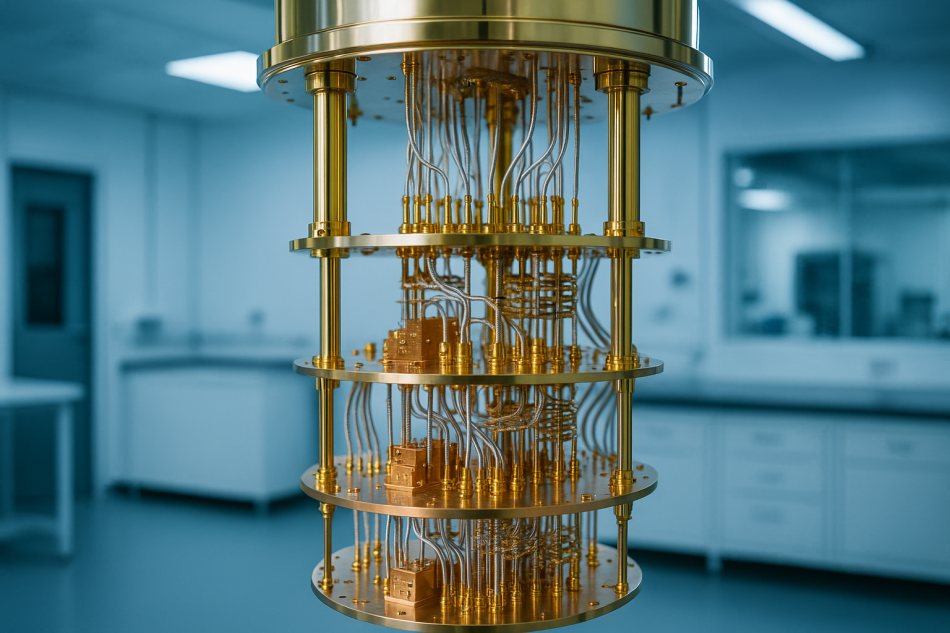

Ask most people to picture a quantum computer and they imagine gates: crisp logical operations flipping and entangling qubits one step at a time, like a quantum version of the circuits inside a laptop. That is the model IBM, Google, IonQ, and nearly everyone else is building toward. D-Wave took a different fork in the road years ago, and it is still walking it. Its machines do not run gate sequences at all. They solve problems by settling into them.
Cooling into an answer
Quantum annealing rests on a simple physical instinct: physical systems tend to slide toward their lowest energy state. Roll a marble around a lumpy bowl and it eventually comes to rest at the deepest point. D-Wave's trick is to encode a hard problem so that its best solution corresponds to that deepest point, the lowest-energy configuration of a network of qubits.
The machine starts in an easy situation. Every qubit is placed in a smooth quantum superposition, a state whose lowest-energy configuration is trivial to reach. Then the hardware slowly changes the rules, dialing up the terms that represent the actual problem while dialing down the easy starting terms. If this transformation happens gently enough, a result from quantum mechanics called the adiabatic theorem promises the system stays in its lowest-energy state the whole way through. When the process ends, you measure the qubits, and their pattern of ones and zeros is supposed to be your answer.
The problems this fits are called optimization problems. Think of scheduling delivery trucks, laying out a portfolio, routing traffic, or arranging molecules. Many of these can be rewritten in a form physicists know well, the Ising model, which describes a grid of tiny magnets that each want to point up or down and that push and pull on their neighbors. Frame your problem as those magnetic interactions and D-Wave's chip becomes a physical stand-in for the math.
A very different chip
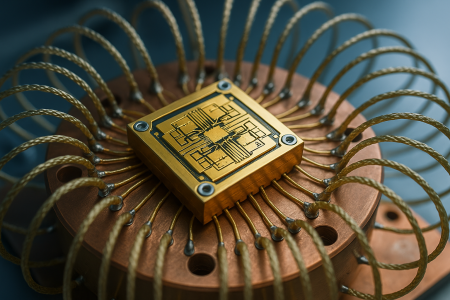
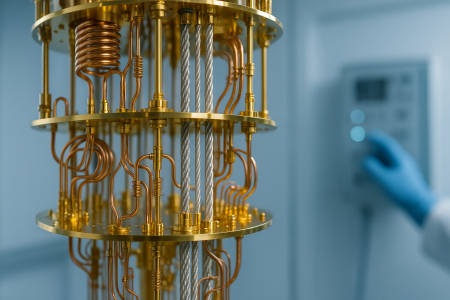
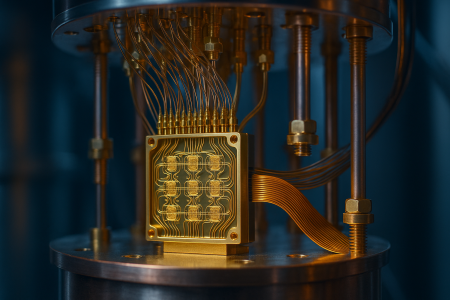
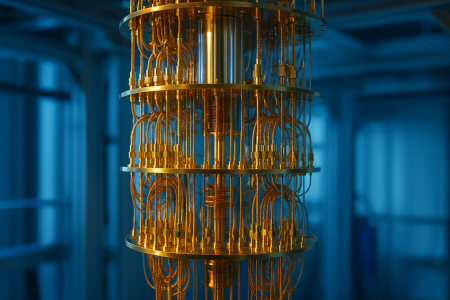
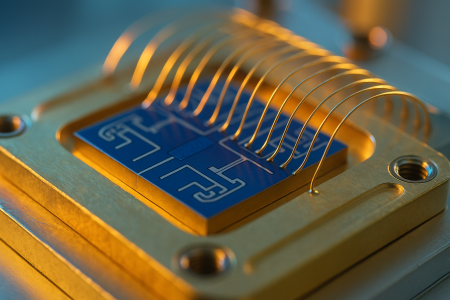
D-Wave's processors are superconducting, chilled in dilution refrigerators like the gate-based machines from IBM and Google. But the qubits and their wiring look nothing alike. The company has pushed qubit counts into the thousands, far beyond any gate-based device, because annealing qubits do not need the same exquisite individual control. You are not addressing each one with a precisely timed pulse; you are setting up an energy landscape and letting the whole system relax.
That scale comes with a catch. What matters for optimization is not just how many qubits exist but how richly they connect. Real problems demand that many variables influence each other, and physical chips can only wire each qubit to a handful of neighbors. So D-Wave chains multiple physical qubits together to act as one better-connected logical variable, a process called embedding. A problem that looks small on paper can eat a large share of the chip once embedded, which is one reason raw qubit counts do not translate directly into problem size.
Powerful, but hard to prove
The uncomfortable question hanging over annealing is whether it delivers a genuine quantum speedup. Classical computers have very good optimization tricks of their own, including simulated annealing, which mimics the same cooling idea in software. For many benchmark problems, tuned classical solvers keep pace with or beat the quantum hardware. Demonstrating a clear, unambiguous advantage on a commercially useful problem has proven stubbornly difficult, and skeptics have spent years poking at early claims.
D-Wave's counterargument is pragmatic. Its machines are real, available in the cloud, and running customer workloads today rather than in a decade. The company has also published work suggesting its hardware can outrun classical methods on certain carefully chosen simulation problems drawn from physics, where the goal is to model magnetic materials rather than optimize a schedule. That is closer to home turf for a device built from interacting quantum magnets.
Two roads, maybe converging
D-Wave has not ignored the gate-based world. The company has signaled plans to build gate-model hardware alongside its annealers, an acknowledgment that some problems, especially in chemistry and cryptography-scale factoring, need the full flexibility of programmable gates and the error correction that comes with them. Annealing offers no obvious path to the kind of fault tolerance the surface code gives circuit machines.
The lasting lesson of D-Wave is that quantum computing was never a single technology. It is a family of bets on how to coax useful behavior out of fragile quantum systems. The annealer's wager was that for a specific class of problems, you can skip the gates entirely and let physics do the search. Whether that pays off commercially is still being decided, but it kept a genuinely different idea alive while the rest of the field marched in one direction.