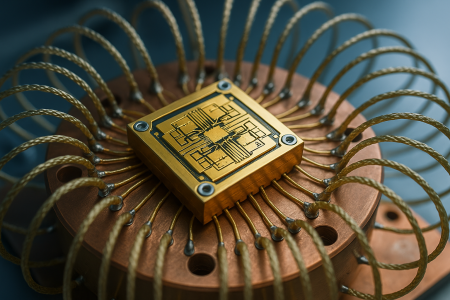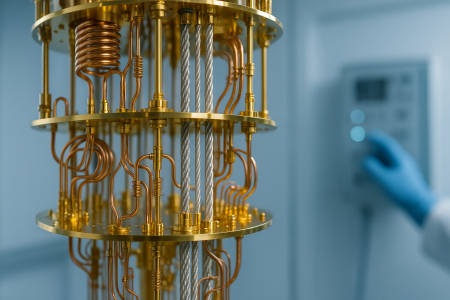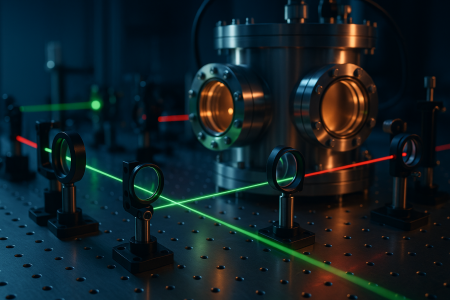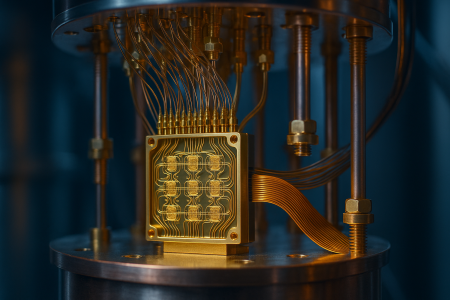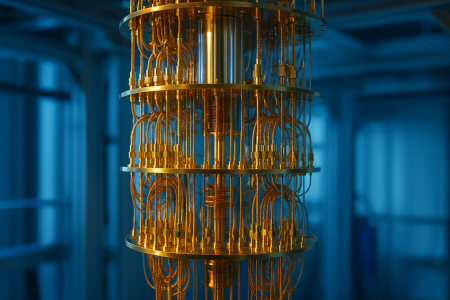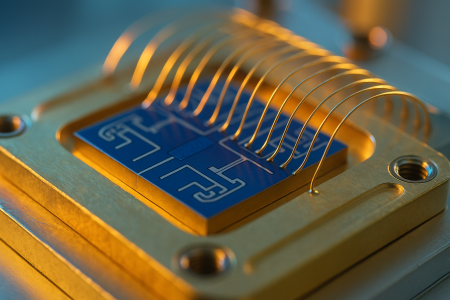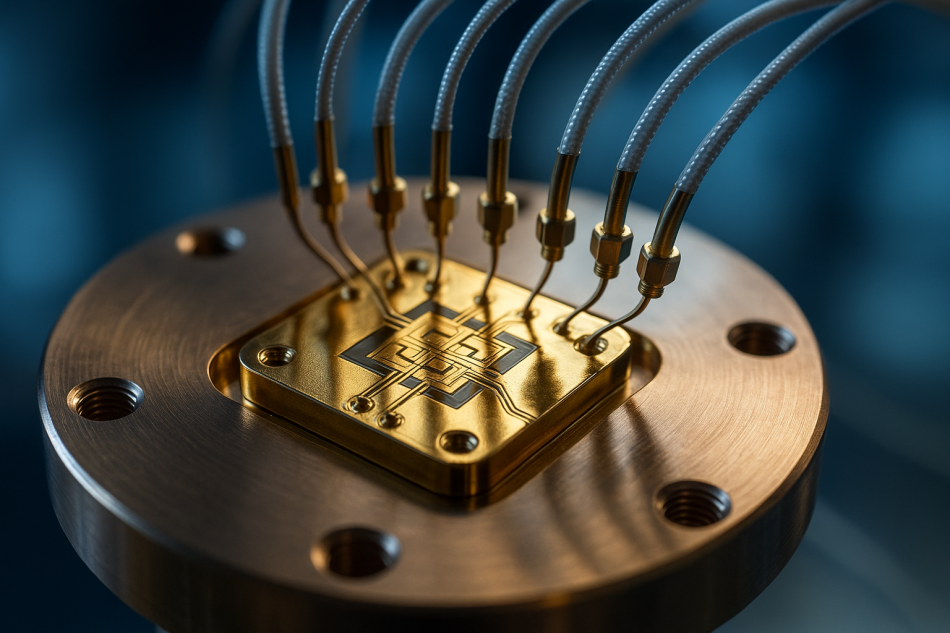

A qubit's worst enemy is not a dramatic failure. It is the slow, quiet drift of the world around it. Stray magnetic fields wobble, control lines carry faint electrical noise, and nearby defects breathe on and off. None of these knocks a qubit out in one blow. Instead they nudge its phase, over and over, until the delicate superposition the machine was counting on has smeared into garbage. The clock that measures how long a qubit can survive this is called T2, and for most technologies it is uncomfortably short.
One of the oldest tricks for stretching that clock did not come from quantum computing at all. It came from nuclear magnetic resonance in the 1950s, where physicists trying to measure atomic spins ran into the same problem: their signal faded faster than the physics said it should, because every spin sat in a slightly different local field and drifted at its own pace. The fix, discovered by Erwin Hahn, was the spin echo.
Turning drift against itself
The idea is almost suspiciously simple. Let a qubit accumulate phase for some time. Then flip it, so that whatever phase it gathered is now measured from the opposite side. Let it evolve for the same amount of time again. If the noise nudging the qubit was slow, meaning it barely changed between the two halves, the phase picked up in the second half exactly cancels the phase from the first. The qubit ends up back where it should be, as though the drift never happened.
Think of runners on a track who all move at slightly different speeds and start to spread apart. At the halfway whistle, everyone turns around and runs back. The fast ones, now behind, catch up; the slow ones fall back. They all cross the start line together. The spread that looked irreversible unwinds itself, because the disorder was fixed rather than random.
That last point is the whole game. The echo only rescues noise that changes slowly compared to the flip. Fast, jittery noise looks different in each half and does not cancel. So a single flip helps, but engineers quickly learned they could do better with many flips packed into a train of pulses. That is dynamical decoupling: a rhythmic sequence of rotations applied to the qubit throughout an idle period, each one folding the noise back on itself before it has time to do lasting damage.
From one flip to a filter
Sequences with names like CPMG, XY4, and XY8 differ in how the flips are spaced and which axes they rotate around. Alternating the rotation directions helps correct for the fact that the flips themselves are imperfect, so errors in the pulses do not pile up. Physicists often describe a decoupling sequence as a filter. Slow noise sits at low frequencies, and a well-chosen pulse train acts like a high-pass filter, blocking exactly the sluggish drift that does the most harm while leaving the faster noise it cannot fix.
On real machines this pays off in a concrete way. When a qubit is sitting idle, waiting for its neighbors to finish a gate, it is quietly decohering the whole time. Modern control systems now slip decoupling pulses into those idle windows automatically, so a qubit that would otherwise rot while it waits stays sharper for longer. Several cloud quantum platforms apply this behind the scenes, and users often see measurably better results with the feature switched on.
Where it helps and where it stops
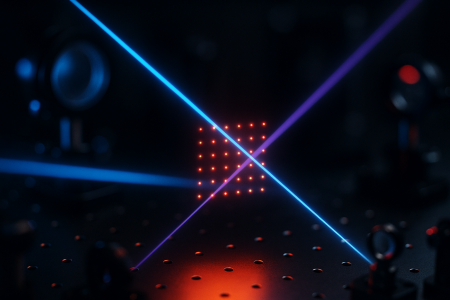
Dynamical decoupling is cheap. It needs no extra qubits, no elaborate encoding, just precisely timed single-qubit rotations the hardware already knows how to do. That makes it a favorite in the current era, where every physical qubit is precious and full error correction is still expensive. It is especially handy for qubits waiting between operations, and for extending the memory time of trapped ions and neutral atoms that store information for long stretches.
But it is a patch, not a cure. Decoupling cannot fix errors that happen during a gate, and it cannot protect against noise that flips too quickly for the pulses to catch. It also does nothing to correct an error once it lands; it only prevents certain slow errors from accumulating in the first place. That is the crucial line between error suppression, which decoupling does, and error correction, which detects and repairs faults using redundant qubits.
The two are not rivals. A fault-tolerant machine will almost certainly weave decoupling into the quiet moments of its error-correction cycle, squeezing out the slow drift for free so the heavier machinery has less to clean up. An idea born to measure atomic spins seventy years ago turns out to be one of the simplest levers we have for keeping tomorrow's qubits alive.