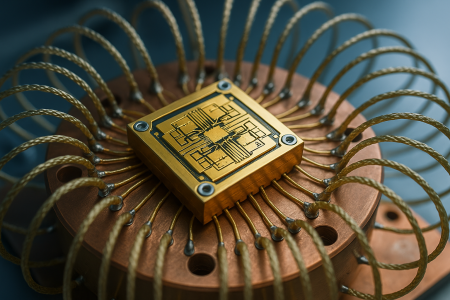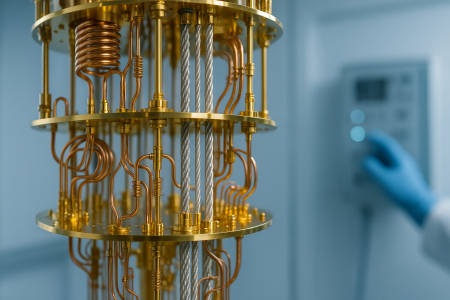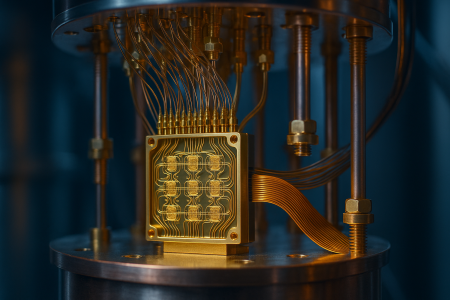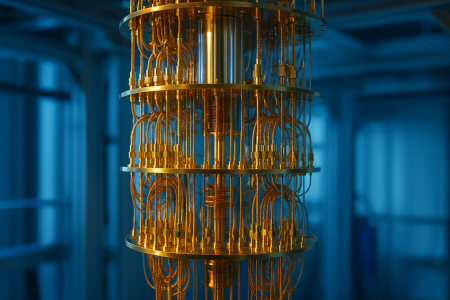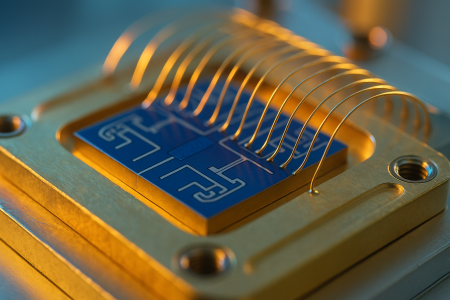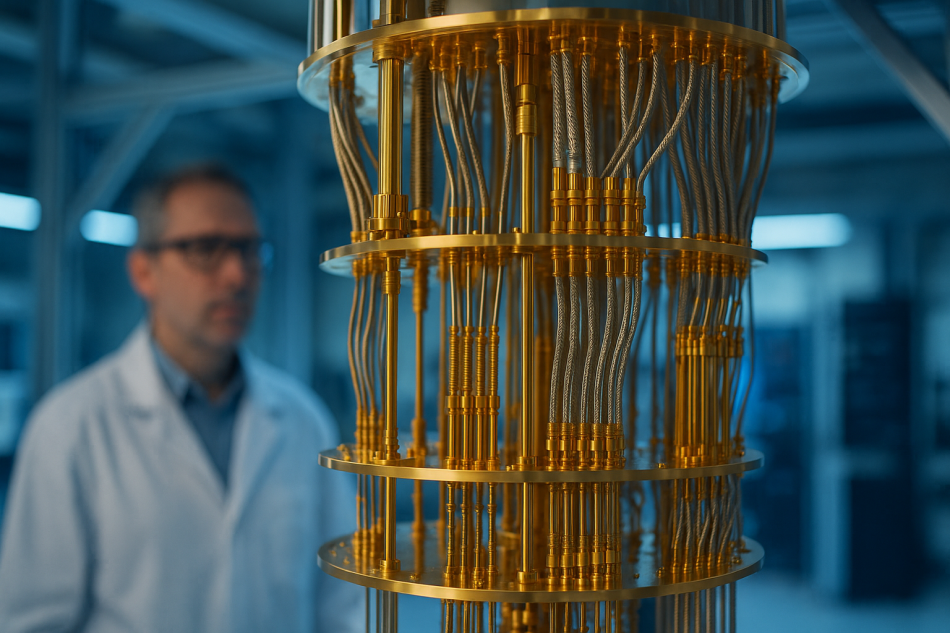

Look at almost any photo of a superconducting quantum computer and you are not really looking at the computer. The chip itself is a fingernail-sized square of silicon tucked at the very bottom of a tall golden chandelier of stacked plates and braided cables. That chandelier is a dilution refrigerator, and without it the qubits would not work for a single microsecond. It is arguably the most important, least discussed piece of hardware in the whole machine.
Why so cold in the first place
Superconducting qubits store quantum information in the energy levels of a tiny circuit built around a Josephson junction. The gap between the two lowest levels is minuscule, corresponding to a temperature of roughly a tenth of a degree above absolute zero. If the surrounding environment is warmer than that, stray thermal energy will randomly kick the qubit out of its ground state, scrambling any calculation before it begins. To keep the qubit reliably in a known starting state, the chip must sit at around 10 to 20 millikelvin, colder than the cosmic microwave background that fills the universe.
Ordinary cooling tricks cannot reach that far. A household fridge uses a compressor and refrigerant to reach a few degrees Celsius. Liquid helium gets you to about 4 kelvin. But the last stretch, from 4 kelvin down to a few thousandths of a degree, demands something stranger.
The dilution trick
The refrigerator earns its name from a quirk of helium. It uses a mixture of two isotopes, helium-3 and helium-4. Below about 0.87 kelvin, that mixture spontaneously separates into two layers, one rich in helium-3 floating on top of one that is mostly helium-4. The magic happens at the boundary. When a helium-3 atom crosses from the concentrated layer into the dilute layer, it absorbs heat, much as sweat cools your skin as it evaporates. By continuously pumping helium-3 across that boundary and recirculating it, the machine draws heat out of its coldest stage indefinitely. There is no moving part at the bottom, just a steady, silent flow of helium doing thermodynamic work.
Above that final stage sits a cascade of colder and colder plates, each visible as a disk in those iconic photographs. A pulse-tube cooler handles the first drop to around 3 or 4 kelvin. Successive stages step down to roughly 1 kelvin, then 100 millikelvin, then the mixing chamber at the bottom where the dilution process delivers the last, deepest chill. The gold plating is not decoration. Gold conducts heat well and does not tarnish, helping every stage stay uniformly cold.
The wiring tax
Cooling the chip is only half the battle. Every qubit needs microwave control lines to drive gates and read out results, and each of those coaxial cables is a highway for heat leaking down from room temperature. Engineers thread the cables through attenuators and filters bolted to each cold plate, so that heat is dumped progressively rather than dropping all at once onto the qubits. The result is a dense forest of cabling that grows with every qubit added.
That forest is where the fridge becomes a bottleneck. A processor with a few dozen qubits already fills the interior with cables. Scaling to thousands, let alone the millions that fault-tolerant machines will require, cannot be done by simply running more wires. The mixing chamber can only remove a few hundred microwatts of heat at its coldest stage, a budget that a swelling cable count would blow through fast.
Why the fridge shapes the roadmap
This cooling ceiling is one reason the industry is chasing ideas like cryogenic control electronics that live inside the fridge, superconducting cables that carry signals without carrying heat, and modular designs that link several refrigerators together rather than building one impossibly large unit. It also helps explain why competing qubit types are attractive. Trapped ions and neutral atoms operate in vacuum chambers at or near room temperature, and photonic approaches avoid the deep cold almost entirely.
None of that diminishes the dilution refrigerator's quiet achievement. These machines run for months at a time, holding a temperature a thousand times colder than interstellar space, all so a sliver of silicon can hold a fragile superposition long enough to be useful. The next time you see the golden chandelier, remember that the computer is the part you can barely see, and the rest is the extraordinary effort of keeping it cold.