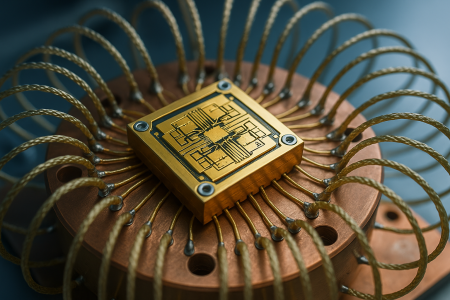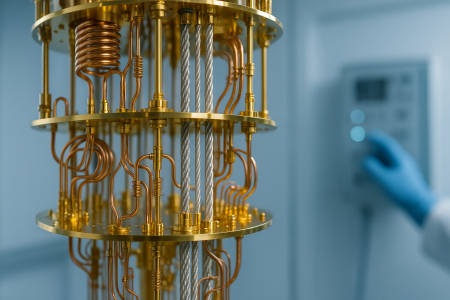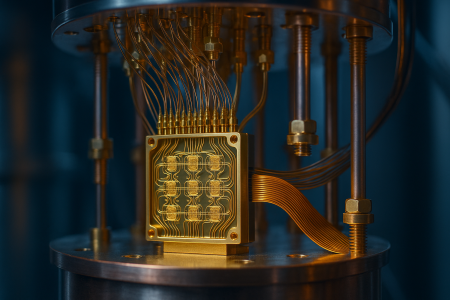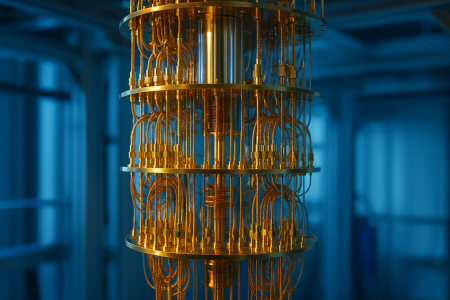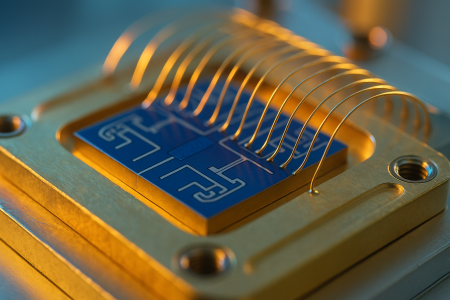

Ask most people to picture a quantum computer and they imagine a gold chandelier hanging inside a refrigerator, or a chip cooled to a whisker above absolute zero. That mental image belongs to the superconducting camp, the one IBM and Google made famous. But it is not the only design in the race, and one of the most interesting challengers barely needs a fridge at all. Companies like QuEra and Pasqal build their qubits out of individual neutral atoms, suspended in a vacuum and pinned in place by tightly focused beams of laser light.
What a neutral-atom machine actually is
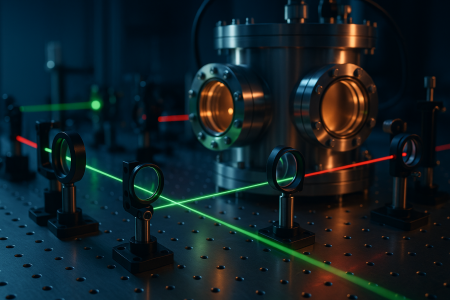
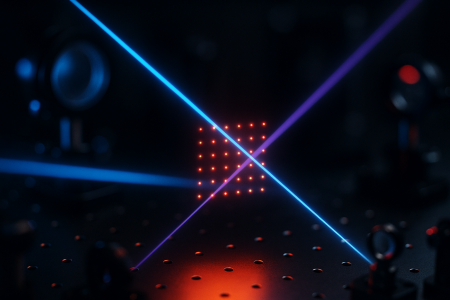
The recipe starts with a cloud of atoms, often rubidium or cesium, chilled with lasers until they barely move. Sharp beams called optical tweezers then reach into that cloud and grab atoms one at a time, arranging them into a grid the way a jeweler sets stones. Each atom becomes a qubit, with its two states encoded in stable internal energy levels. To make two atoms interact, the machine excites them into bloated, high-energy Rydberg states, where a single atom swells enough to influence its neighbor and block it from being excited too. That blockade effect is the engine behind entangling gates in these systems.
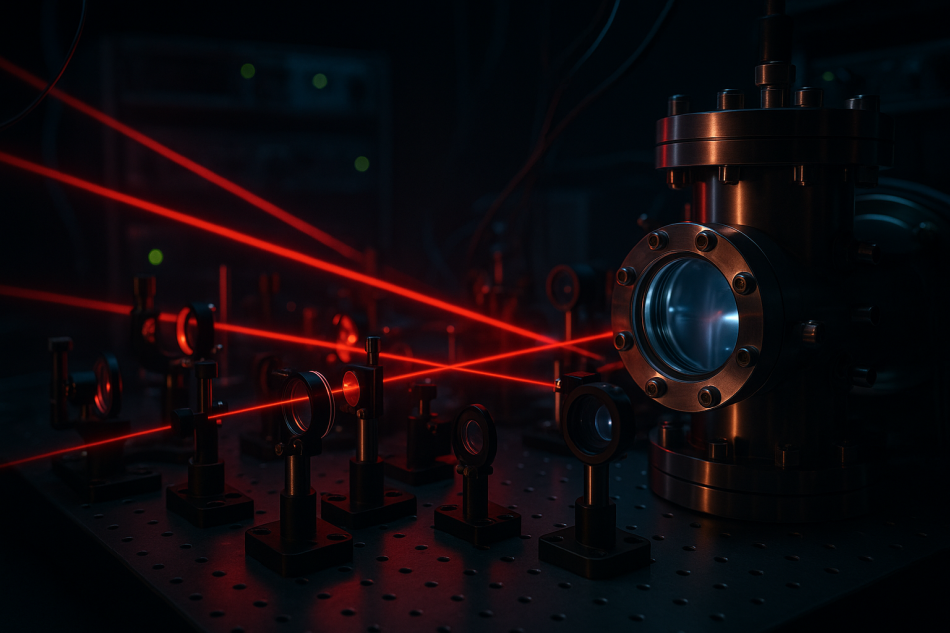
The appeal is threefold. Atoms are identical by nature, so there is no yield problem where fabrication leaves every qubit slightly different. The tweezers can be reconfigured in software, which means the connectivity of the machine is not frozen into a chip layout. And because the qubits live in a vacuum chamber at room temperature rather than on a chilled wafer, the hardware footprint looks more like an optical bench than a cryostat.
The companies making the bet
QuEra grew out of research at Harvard and MIT and has leaned into large arrays, publicizing machines with hundreds of atomic qubits available through cloud access. Its early flagship ran in an analog mode, essentially simulating physics problems by letting the atoms evolve under carefully tuned interactions, before the company pushed toward digital, gate-based operation and error correction.
Pasqal, based in France and co-founded by Nobel laureate Alain Aspect, has pursued a similar architecture with a strong European industrial angle, courting customers in energy, chemistry, and logistics. Other players including Atom Computing and Infleqtion round out the field, and Atom in particular drew attention by announcing arrays crossing the thousand-atom mark, a scale that superconducting chips have not matched qubit for qubit.
Why scale comes easier here
Adding qubits to a superconducting processor means adding wiring, control lines, and space inside a crowded refrigerator. Adding qubits to an atom array can be closer to shining more laser light and grabbing more atoms from the same cloud. That is an oversimplification, because the control lasers, imaging systems, and beam steering all grow more demanding as the array widens. But the underlying qubits do not need individual fabrication, and that changes the arithmetic of scaling.
The reconfigurable geometry also plays nicely with modern error-correcting codes. Recent demonstrations moved atoms around mid-computation to bring distant logical qubits together, a maneuver that would require fixed wiring in other platforms. That flexibility helped neutral-atom teams show some of the more striking logical-qubit results in the field.
The catches
None of this is free. Gates in atom arrays have generally been slower than in superconducting systems, where operations run in tens of nanoseconds. Shuttling atoms takes time, and every move risks losing one to the background vacuum or heating it out of its trap. Measuring the atoms typically means imaging their fluorescence, which can be slow and can disturb neighbors if not done carefully. Loss itself is a distinctive headache: an atom that wanders off is not just an error, it is a missing qubit that must be detected and replaced.
Still, the trajectory has been steep. A platform that a few years ago was mostly a physics-lab curiosity now offers cloud access, growing qubit counts, and credible error-correction experiments. Whether neutral atoms ultimately win, lose, or coexist with the superconducting and trapped-ion camps is unsettled. What is clear is that the quantum hardware race is not a single road, and the atom-array upstarts are running it with a very different vehicle.