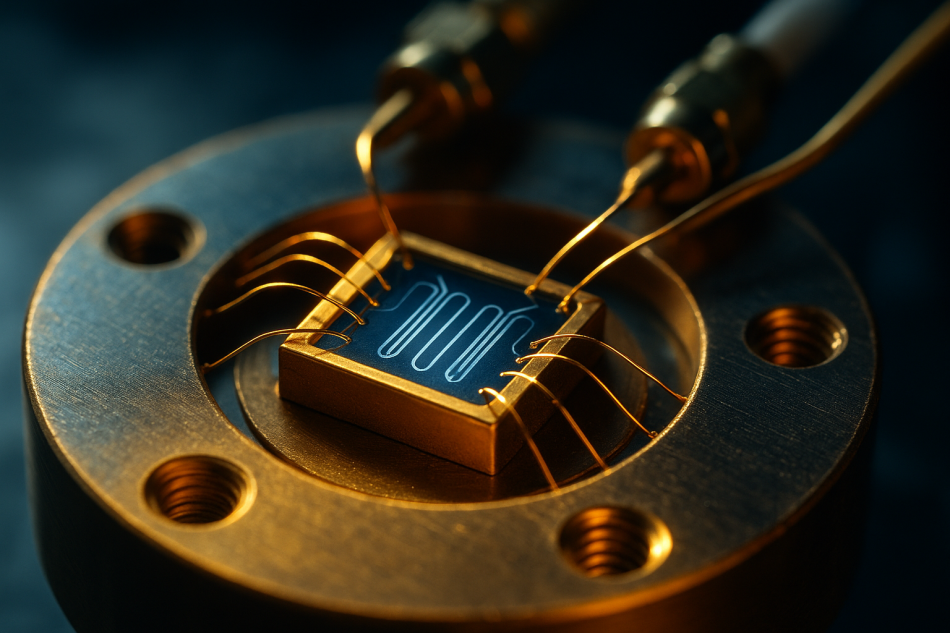

Most quantum computers fight noise from the outside in. Engineers wrap a fragile qubit in shielding, chill it near absolute zero, run constant error correction, and still watch information drain away in microseconds. Microsoft spent the better part of two decades on a different idea: build a qubit that resists noise from the inside out, by encoding information in a physical property that a stray vibration or magnetic ripple simply cannot see.
What topological means here
The word topology describes properties that survive stretching and bending. A coffee mug and a doughnut are topologically identical because each has exactly one hole, and no amount of squishing changes that count. Microsoft's wager is that quantum information can be stored in something equally robust, a global property of a system rather than the delicate state of a single particle.
The candidate particle is the Majorana zero mode, an exotic excitation predicted to appear at the ends of certain superconducting nanowires. A Majorana is not really a particle in the usual sense. It is half of one, in effect, and a single qubit's worth of information gets smeared across two of them sitting far apart. To corrupt the qubit, noise would have to disturb both ends at once in a coordinated way, which is vanishingly unlikely. The information is protected by geometry, not by brute-force error suppression.
Computing by braiding
The other appeal is how you would operate such a qubit. In conventional machines, gates are analog nudges: a microwave pulse of a precise length and phase, or a laser tuned to a hair's width. Get the amplitude slightly wrong and you get a slightly wrong rotation. Topological qubits promise something cleaner. You move the Majoranas around one another in space, swapping their positions in a sequence called braiding. The result of a braid depends only on the pattern of the crossings, not on how fast or how smoothly you did them. That discreteness is the whole point. A gate that depends on a count rather than a magnitude is far harder to botch.
If it works, the payoff cascades through the entire stack. Error correction, the expensive machinery that forces thousands of physical qubits to stand in for one reliable logical qubit, could shrink dramatically. A topological qubit that starts out with error rates orders of magnitude lower would need far less overhead, which is why Microsoft has framed the approach as a shortcut to a genuinely useful, fault-tolerant machine rather than a bigger noisy one.
Why it took so long
The catch is that Majorana zero modes are maddeningly difficult to confirm, let alone control. The signatures that suggest their presence, particular bumps in electrical conductance, can be mimicked by mundane material defects and disorder in the nanowires. The field learned this the hard way, with early claims that had to be walked back after closer scrutiny. Building the devices demands near-perfect interfaces between semiconductor and superconductor, grown atom by atom, because a single rough patch can drown the effect in noise.
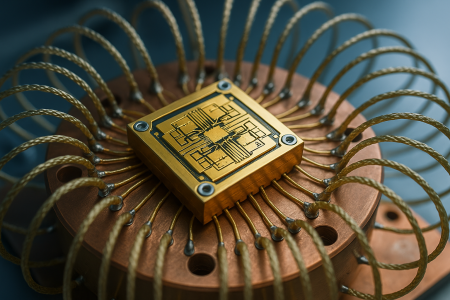
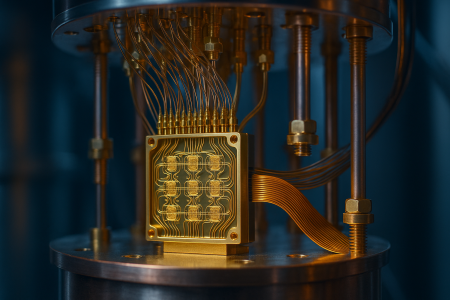
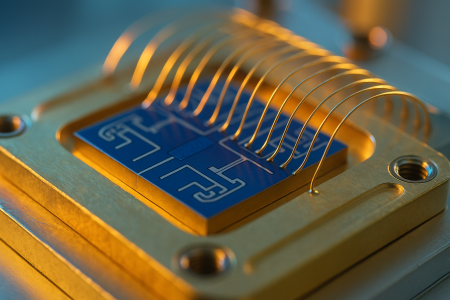
Microsoft's more recent work has centered on a chip architecture built from indium arsenide and aluminum, cooled and tuned to coax the wires into the topological regime, with a measurement scheme designed to read the qubit through the parity of electrons rather than by watching Majoranas move directly. The company describes this as a topological core intended to scale toward a million qubits on a single processor. Independent verification and reproducibility remain the fair questions any such claim invites, and the broader physics community continues to press on both.
The stakes of a contrarian bet
What makes the topological route worth watching is precisely that it is behind. IonQ ships trapped-ion systems today. IBM and Google run superconducting processors with hundreds of qubits and growing error-correction results. Microsoft chose to place fewer, harder qubits on the board, betting that quality bought at the hardware level beats quantity patched over with software.
If the physics holds, topological qubits could leapfrog the field, arriving with built-in stability that others must engineer at enormous cost. If it doesn't, the effort will stand as one of the more ambitious detours in quantum computing's history. Either way, the gambit is a reminder that there is more than one road to a working machine, and that the fastest early mover is not guaranteed to reach the finish line first.