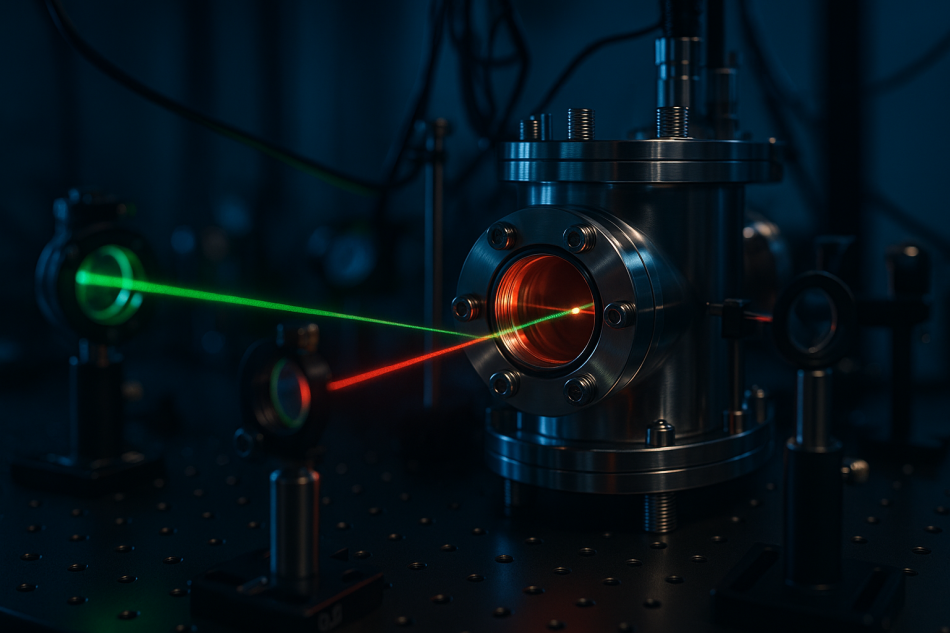

Every trapped-ion quantum computer starts with a choice most people never see: which atom to trap. The qubit is not built, it is borrowed from nature, an ion held motionless in a vacuum by electric fields and poked with lasers. For much of the field's history the atom of choice has been ytterbium. Lately a rival species has been gaining ground, and the reasons behind the shift reveal how much of quantum hardware progress is really about optics, wavelengths, and plumbing.
Why the atom matters
An ion qubit stores its zero and one in two long-lived internal energy levels of a single charged atom. To load the qubit, entangle it, and read it out, you shine precisely tuned laser light at it. The wavelengths that do those jobs are fixed by the atom's electronic structure, so picking the element locks you into a whole supporting cast of lasers, mirrors, fibers, and detectors.
Ytterbium-171 became popular for good reasons. It has a clean pair of hyperfine states that make a stable qubit, and it has been studied for decades in atomic clock research. But ytterbium has an inconvenient habit. The transitions used to prepare and read the qubit sit in the ultraviolet, near 369 nanometers. Ultraviolet light is demanding. It degrades optical fibers over time, scatters and gets absorbed more easily, and the components that generate and steer it tend to be finicky and expensive.
What barium brings
Barium changes the color palette. Its key transitions live in the visible range, green around 493 nanometers and red near 650 nanometers. That sounds like a cosmetic difference, but it ripples through the entire machine. Visible light travels happily through ordinary telecom-grade and standard optical fibers, so you can route it around the apparatus without exotic UV-rated hardware. The photodetectors and cameras that catch the light an ion emits during readout are more sensitive at these wavelengths, which means the machine can tell a zero from a one faster and with fewer mistakes.
Readout fidelity is the headline prize. When you measure an ion, one qubit state fluoresces and scatters photons while the other stays dark. Distinguishing bright from dark is easier when the light is a color your detectors love and when it isn't being lost to fiber absorption along the way. Higher-quality state detection with visible photons translates directly into lower error rates, and in a field where every fraction of a percent of fidelity is fought over, that is a real advantage.
There is a catch worth naming. The most convenient barium isotope for a hyperfine qubit, barium-133, is radioactive and not something you dig out of the ground in bulk. Working with it means handling small, carefully sourced quantities and depositing them into ion-trap chips. Other barium isotopes exist and can be used, but the trade-offs among nuclear spin, availability, and qubit quality are part of the engineering calculus.
A company-level wager
The move toward barium is not purely academic. Ion-trap companies have publicly explored it as a path to next-generation systems, treating the atom swap as one lever among many for pushing gate and measurement fidelities toward the levels error correction will demand. Because the qubit species dictates the laser stack, switching atoms is a serious commitment. You redesign light sources, re-engineer optical delivery, and re-tune the control software. Doing it signals confidence that the payoff, cleaner readout and more robust hardware, is worth tearing up a working recipe.
It also hints at where the whole architecture is heading. As trapped-ion designs move toward shuttling ions between zones on a chip and eventually linking separate traps with photonic connections, visible-wavelength light becomes even more attractive. Photons you want to send between modules are far easier to manage if they aren't ultraviolet. An atom that emits friendlier colors is an atom that plays better with fiber-based interconnects.
The bigger lesson
The barium story is a reminder that a qubit's quality is inseparable from the machinery around it. You can have a beautiful two-level system inside an atom, but if the light you use to talk to it is hard to make, hard to route, and hard to catch, your error budget suffers. Choosing barium over ytterbium is a bet that solving the boring problems of wavelength and optics pays off in the numbers that matter. In quantum hardware, the unglamorous decisions often decide who gets to fault tolerance first.







