
Ask most quantum hardware teams how many qubits their machine has and you will hear a number in the tens or low hundreds. Ask PsiQuantum the same question and the company points to a target that sounds almost reckless: roughly a million qubits, all of them working together inside a single fault-tolerant computer. The bet is not that the company can build a slightly better prototype than everyone else. It is that a genuinely useful quantum computer needs to be enormous, and that the only sane way to build something enormous is to manufacture it the way we already manufacture chips.
Photons instead of frozen circuits
The qubit at the heart of PsiQuantum's design is a single particle of light. That choice sets the company apart from the superconducting crowd at IBM and Google, the trapped ions at Quantinuum and IonQ, and the neutral atoms at QuEra and Pasqal. Photons do not need to be held in place by lasers or cooled to a few thousandths of a degree above absolute zero. They travel through tiny waveguides etched into silicon, the same material and roughly the same process used for the optical components inside data-center transceivers.
Working with light brings its own headaches. Photons barely interact with one another, which is wonderful for keeping quantum information from leaking away but terrible when you actually need two qubits to talk. PsiQuantum's answer is a scheme called fusion-based quantum computing. Instead of running gates in a long sequence, the machine prepares small entangled clusters of photons and then performs measurements, called fusions, that stitch them into a larger computation. The logic happens through measurement rather than through carefully timed pulses, a cousin of the measurement-based approach other photonic groups have explored.
Why the fab matters more than the physics
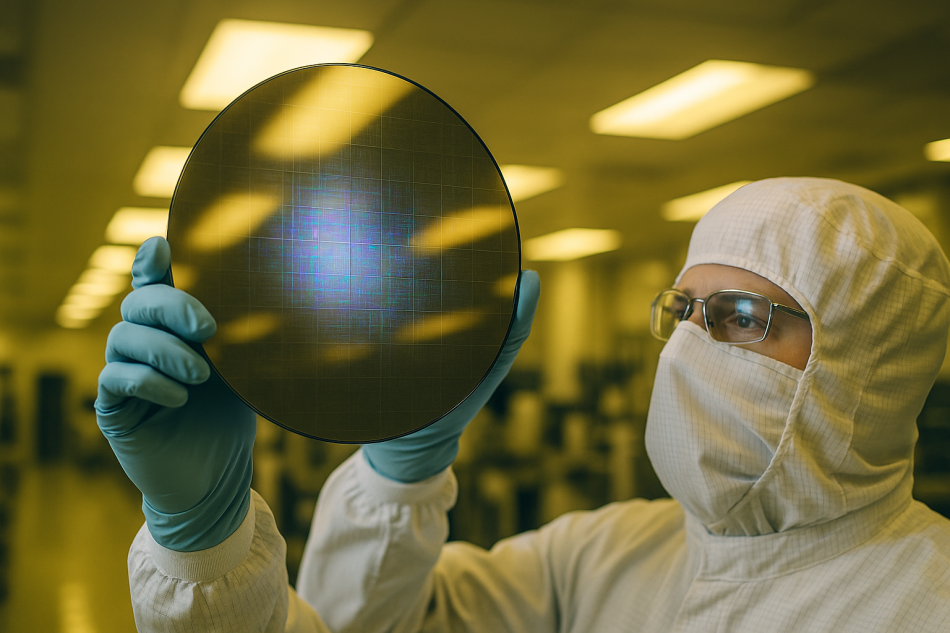
The most distinctive part of PsiQuantum's strategy is not a clever qubit trick. It is the decision to partner with GlobalFoundries, a contract chipmaker, and to make the quantum photonic wafers on an existing 300-millimeter production line. The reasoning is blunt. A million-qubit machine will need a staggering number of photon sources, waveguides, switches, and detectors. You cannot hand-assemble those in a lab. You have to print them by the wafer, test them the way the semiconductor industry tests everything, and accept that some fraction will be flawed.
That industrial mindset shapes the whole roadmap. Rather than publishing a steady march of intermediate machines with growing qubit counts, PsiQuantum has largely skipped the noisy, small-scale devices that dominate today's cloud services. The company argues that a machine with a few hundred error-prone qubits is a science demo, not a product, and that pouring years into it delays the only thing that matters: a system large enough to run error correction and solve problems classical computers cannot.
The cold parts that remain
Photonic does not mean warm all the way through. The single-photon detectors PsiQuantum relies on are superconducting nanowires, and those need cooling to a few kelvin. That is far friendlier than the millikelvin fridges superconducting qubits demand, but it still means cryogenic plumbing, and it still means the machine will fill a room rather than a rack. The company has talked about facilities on the scale of a small warehouse, with the photonic chips, control electronics, and cryogenics integrated into a single system.
Concrete ground, real money
The plan has moved off the whiteboard. PsiQuantum has committed to building utility-scale quantum computing facilities, including a flagship site in Brisbane, Australia, backed by Australian government investment, and a center in Chicago tied to a growing quantum campus in Illinois. Those are not research grants for a few racks. They are commitments to house large machines, which forces the company to answer unglamorous questions about power, cooling, and floor space that many rivals can still postpone.
The size of the wager
The obvious risk is that fault-tolerant photonic computing is harder than the pitch suggests. Photon loss is a relentless enemy, and every optical component nudges the odds of losing a qubit before it can be used. The company is betting that manufacturing quality, redundancy, and error-correcting codes designed for erasure will keep losses under control at scale. If it works, PsiQuantum will have leapfrogged straight to a useful machine while others were still counting qubits by the dozen. If it does not, the company will have spent years and a fortune building the infrastructure for a computer that never quite crosses the line. Few bets in quantum computing are placed with so little hedging.







