
Most quantum computers fight noise with brute force. You take a fragile physical qubit, surround it with dozens or hundreds of helpers, and run a constant error-correcting cycle to catch mistakes before they spread. Microsoft has spent a good part of two decades betting on a different idea: build a qubit that resists errors from the start, because the information is smeared across space in a way that local disturbances cannot easily corrupt.
That is the promise of the topological qubit. Instead of storing a bit in the state of a single particle, you store it in a global property of a system, something that stays fixed even when individual pieces get jostled. The physics term is topological protection. The everyday analogy is a knot: you can wiggle the rope all you like, but the knot stays a knot until you deliberately untie it.
Chasing a particle that acts like half of itself
The ingredient Microsoft needs is the Majorana zero mode, an exotic excitation predicted to appear at the ends of certain superconducting wires. A Majorana is strange because it behaves like half of an electron. Pair two of them, far apart along a wire, and together they encode a single quantum bit. The information lives in the relationship between the two ends, not at either end alone. A stray electric field nudging one spot should not, in theory, be able to read or wreck the stored value.
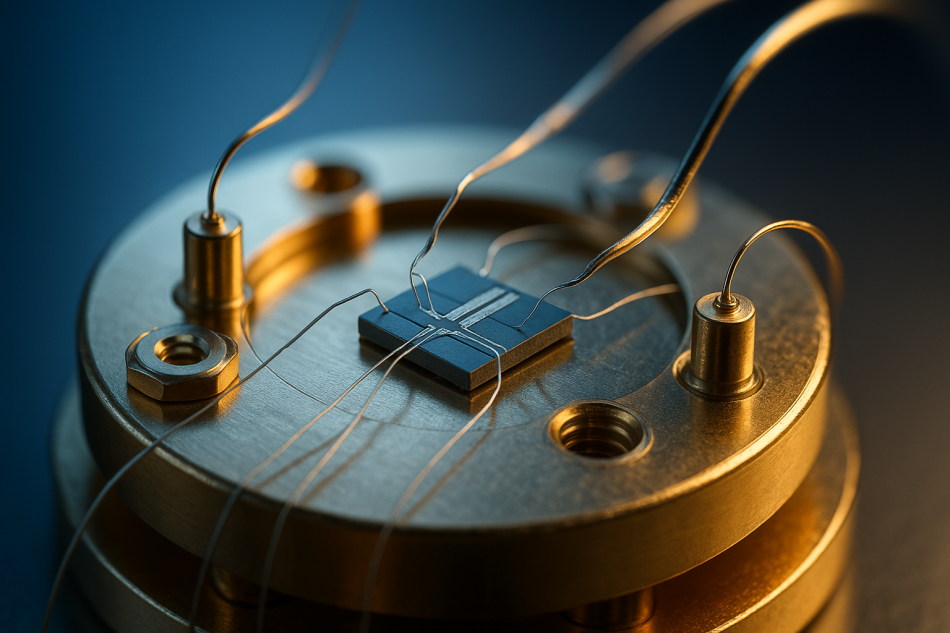
Cooking up these modes is delicate. The recipe involves a semiconductor nanowire, often made from indium arsenide, coated with a thin superconducting shell of aluminum, cooled to a fraction of a degree above absolute zero, and tuned with a magnetic field and carefully shaped voltages. Get the parameters right and the wire enters a topological phase with Majorana modes waiting at each tip. Microsoft has taken to calling the underlying material a topoconductor, a new class of device engineered to host exactly this behavior.
The credibility problem
The road has been rough, and honesty about that matters. A high-profile 2018 result claiming clear evidence of Majorana modes was later retracted after other physicists questioned the analysis. The episode taught the field a hard lesson: a bump in a measurement that looks like a Majorana signature can also be produced by ordinary, boring disorder in the wire. Distinguishing the real thing from an impostor became the central scientific fight.
Microsoft's answer was to define a strict protocol before declaring victory, a so-called topological gap protocol meant to rule out the mundane explanations. The company has since reported passing that bar and, more recently, unveiling a small processor built around the approach, presenting measurements it says demonstrate the ability to read out the qubit's state. Independent scientists remain cautiously skeptical, and reproducing these claims in outside labs is the step that will settle the debate.
Why bother when rivals are shipping qubits
It is a fair question. IBM, Google, Quantinuum, and others already run machines with dozens or hundreds of working qubits and are demonstrating error correction on hardware you can rent by the minute. Microsoft, by contrast, has almost no physical qubits to show. The bet is that a topological qubit, once it works, would be so stable that you need far fewer of them to build a useful, fault-tolerant computer. If each protected qubit needs ten helpers instead of a thousand, the whole engineering picture changes.
Braiding is the other draw. In theory you can perform logic gates by physically moving Majorana modes around one another, weaving their world-lines like strands. The outcome depends only on the pattern of the braid, not on the precise path, which makes the operation naturally resistant to small timing and control errors. That is a very different way to compute than firing carefully calibrated microwave pulses at superconducting circuits.
A high-variance wager
Topological quantum computing is the boldest gamble on the table. If the physics cooperates and the devices scale, Microsoft could leapfrog approaches that spend enormous resources correcting errors. If the Majorana modes prove too fragile, too hard to fabricate cleanly, or too slippery to distinguish from noise, the years of investment yield little. For now the company is doing the unglamorous work: growing better wires, cutting disorder, and trying to convince a skeptical field that the knot is really there.







