
For years the story of quantum computing had two chapters. In the first, machines were toys: a handful of qubits solving problems any laptop could crack in a blink. In the second, someday, fault-tolerant computers would run flawless algorithms and change chemistry, materials, and optimization forever. Between those chapters sat an awkward gap. The machines being built right now are large enough to be interesting but far too noisy to be trusted. The question of the moment is whether they can still be useful.
That question got a name: quantum utility. The term describes a computer that produces reliable results for a problem that stretches or exceeds what standard classical methods can do easily, even though the hardware still makes errors on nearly every operation. It is a deliberately modest goal. Nobody claims these machines are solving problems no classical computer could ever touch. The claim is narrower and more practical. On certain tasks, a noisy quantum processor can compete with, or beat, the brute-force classical approaches you would reach for first.
Why noise doesn't have to be fatal
A qubit that errs once in a hundred operations sounds hopeless when a program runs thousands of gates. Left alone, the noise would drown any signal in garbage. The trick is that you do not need every run to be correct. You need the average over many runs to point at the right answer.
This is where error mitigation comes in, a family of techniques distinct from full error correction. Instead of spending extra qubits to catch and fix mistakes as they happen, mitigation lets the errors occur and then corrects the statistics afterward. One popular method deliberately makes the noise worse in controlled steps, watches how the answer degrades, and extrapolates back to what a noise-free machine would have said. Another compares results against known reference circuits to calibrate away systematic bias. None of it is free. Mitigation typically demands far more repeated runs, and its cost grows sharply as circuits get bigger. But for a machine that already runs a program ten thousand times, more repetition is a price worth paying if it turns noise into a usable answer.
The experiment that set the bar
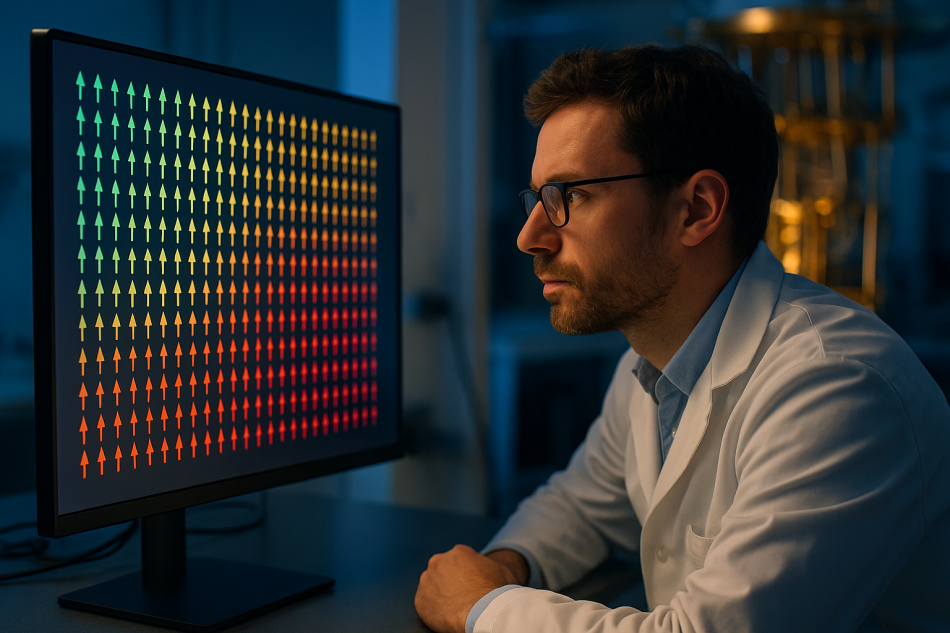
The idea gained real weight when researchers ran a physics simulation on a superconducting processor with well over a hundred qubits. The problem was a model of tiny magnetic spins interacting on a lattice, the kind of system condensed-matter physicists care about deeply. Crucially, the circuit was big enough that the usual classical shortcut, an approximate technique that tracks quantum entanglement only up to a point, started to buckle. The quantum machine, cleaned up with error mitigation, produced values that lined up with the exact answers where those were known and offered predictions where they were not.
What made the result land was not that classical computers could never reproduce it. Within months, several groups found clever classical methods that matched or beat the quantum run for that specific problem. That back-and-forth is exactly the point. Quantum utility is not a permanent trophy. It is a moving line, a challenge to classical algorithm designers to keep up, and every time they respond the bar for what counts as genuinely useful quantum computation rises.
What utility is not
It is easy to confuse this with the earlier headlines about quantum supremacy or quantum advantage, where a machine performed a contrived task astronomically faster than any supercomputer. Those demonstrations used problems with no practical value, chosen precisely because they were hard for classical hardware. Utility flips the emphasis. The task should resemble something a scientist actually wants to compute, and the comparison should be against the methods a working researcher would really use.
- Supremacy asked: can a quantum machine do something classically intractable, even if useless?
- Utility asks: can it do something worth doing, even if not classically impossible?
The bridge to fault tolerance
Skeptics fairly note that error mitigation cannot scale forever. The number of samples it needs eventually explodes, closing the window before you reach the truly transformative problems. That ceiling is real, and it is exactly why companies keep pouring effort into error correction and logical qubits. Utility is not the destination. It is the proving ground, a way to keep quantum processors doing real scientific work, and to keep the software and benchmarking maturing, during the years it takes to build machines that no longer need statistical rescue. When fault-tolerant hardware finally arrives, it will inherit a field that already learned how to ask useful questions.







