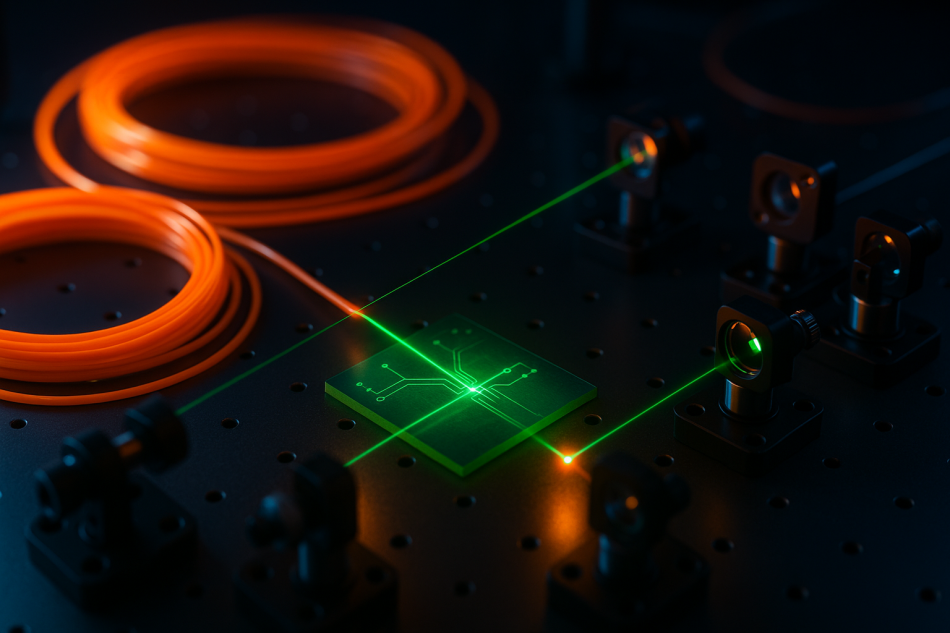

Walk into most quantum labs and you find the same centerpiece: a gold chandelier hanging inside a fridge colder than deep space, guarding a chip of superconducting metal. Xanadu, a company spun out of Toronto, is chasing a different picture entirely. Its qubits are not fixed objects at all. They are pulses of light, born from lasers, squeezed into strange quantum states, and sent racing through optical fiber and silicon-nitride waveguides. The bet is that if you can compute with photons, you can build a machine that scales the way the internet did: by connecting more boxes together.
What a photon qubit actually is
Photonic quantum computing does not store information the way a trapped ion or a transistor-sized spin does. Xanadu works with continuous-variable states, encoding quantum information in properties of light like its amplitude and phase. The raw ingredient is squeezed light, a state in which quantum noise is pushed down in one property at the cost of raising it in another. Squeezers on a chip generate this light, beam splitters and phase shifters mix it, and photon-counting detectors read out the result.
There is a payoff to this approach that hardware built from matter cannot match. Photons barely interact with their surroundings, so they do not need a dilution refrigerator to stay coherent. Much of the optical circuitry can run at or near room temperature. The catch is that the single-photon detectors at the end still need to be cooled to a few kelvin, so the fridge does not vanish so much as shrink and move to the edge of the system.
Borealis and the sampling milestone
Xanadu's most cited result came from a machine called Borealis. Instead of laying out hundreds of squeezers side by side, Borealis used a clever trick called time multiplexing: a single squeezed-light source fired pulses into loops of optical fiber, so the same hardware played the role of many modes as pulses circled around and interfered. With 216 squeezed modes, the team ran a Gaussian boson sampling task and reported a result that would take a classical supercomputer an impractically long time to reproduce. It was a demonstration of raw quantum sampling power rather than a useful program, in the same spirit as Google's early superconducting experiments, but it put photonics firmly on the map.
The real prize is modularity
Sampling headlines are not the endgame. Xanadu's longer argument is architectural. If a quantum computer is made of light moving through fiber, then joining two processors is closer to a networking problem than a fabrication one. You do not have to grow a single monstrous chip with millions of qubits and thousands of control cables fighting for space inside one fridge. You build a module, get it working, and link it to the next through optical connections.
To make that vision fault tolerant, Xanadu leans on a particular encoding: GKP states, which hide a logical qubit in the evenly spaced peaks of a light field's quantum ruler. These states are notoriously hard to produce reliably, and generating them on demand is one of the central engineering fights in the whole photonic program. The company has demonstrated a networked, modular system that stitches together the pieces of this architecture, an attempt to show the plumbing can be repeated and connected rather than just built once as a hero experiment.
The hurdles that will decide it
Photonics has a stubborn enemy: loss. Every fiber, every switch, every imperfect component nibbles at the photons passing through, and lost light means lost information. Keeping loss low enough for error correction to work is the make-or-break number for the whole approach. Detector efficiency, the purity of the squeezed light, and the speed of fast optical switches all feed into the same tight budget.
Xanadu has also tried to grow a software gravity well around its hardware, releasing open-source tools like PennyLane that let researchers write quantum programs regardless of which machine runs them underneath. That community play matters, because whoever wins the hardware race still needs people who know how to use it.
The honest verdict is that photonic quantum computing remains a wager, not a settled bet. Superconducting and trapped-ion machines are further along on qubit counts that actually run gate-based programs. But if light can be squeezed cleanly enough and switched fast enough, the reward is a machine that grows by connection rather than by cramming. That is the prize Xanadu is reaching for.







