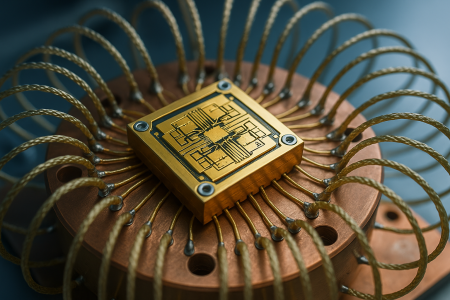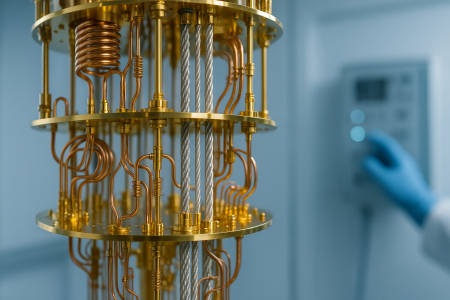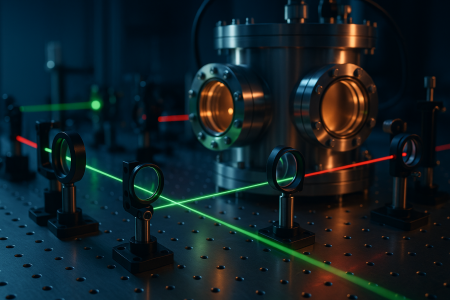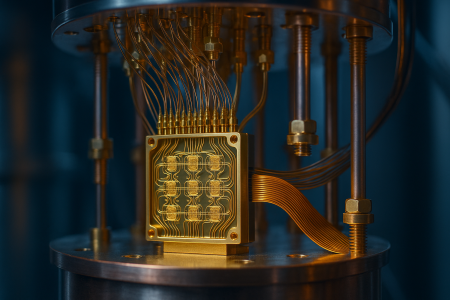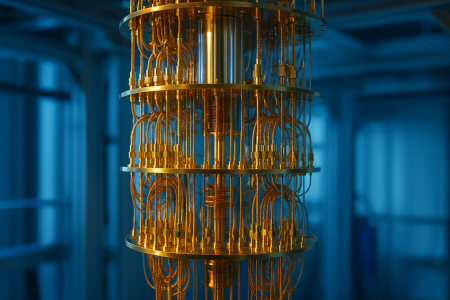

Picture a piano that slips out of tune not once a year but every few hours, with 100 keys that each drift in their own direction. Now imagine you cannot hear the notes directly and must infer each key's pitch from thousands of statistical measurements. That is roughly the daily reality of running a quantum computer. Behind the tidy cloud interface where a researcher submits a circuit sits a relentless background process: calibration. It is the least glamorous part of quantum computing and arguably one of the most important.
Why qubits refuse to stay put
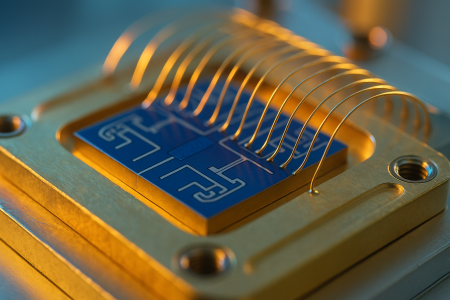
A qubit is defined by physical parameters that the control system needs to know precisely. On a superconducting chip, that means the exact frequency at which each qubit responds, the amplitude and duration of the microwave pulse that flips it, the timing that entangles it with a neighbor, and the readout signal that distinguishes a zero from a one. None of these numbers are constant. Frequencies wander as the local electromagnetic environment shifts. Two-level defects in the materials, sometimes called TLS, drift in and out of resonance and can swallow a qubit's energy. Temperature fluctuations in the dilution refrigerator, magnetic field changes, and even the aging of control electronics all nudge the parameters.
The consequences are unforgiving. A pulse that was a perfect flip yesterday might overshoot slightly today, and because circuits stack hundreds or thousands of gates, small errors compound fast. A gate that is off by a fraction of a percent can quietly ruin an entire computation. So the machine has to keep chasing its own moving target.
The pyramid of routines
Calibration is not a single measurement but a dependency chain. You cannot calibrate a two-qubit gate until each qubit's frequency and single-qubit pulses are dialed in, and you cannot trust readout until you have characterized the distinct signals for the ground and excited states. Operators build this as a tree of tasks, each feeding the next.
- Find each qubit's resonant frequency by sweeping a probe tone and watching where it responds.
- Tune the amplitude of the drive pulse so a single pulse rotates the qubit exactly half a turn, and a pair rotates it fully.
- Correct the phase and shape of the pulse to suppress leakage into unwanted energy levels.
- Calibrate entangling gates between coupled qubits, which are far more sensitive than single-qubit operations.
- Characterize readout so the classifier can tell the two states apart with the fewest mistakes.
Techniques with names like Rabi sweeps, Ramsey experiments, and randomized benchmarking do the heavy lifting. Each is itself a small quantum experiment repeated thousands of times, because a qubit only yields a probability, never a single clean reading. Calibrating a large processor can therefore consume enormous numbers of shots and a meaningful slice of the machine's uptime.
From overnight tuning to automated agents
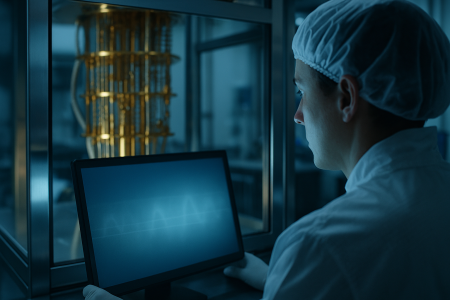
In the early days researchers tuned qubits by hand, one at a time, a process that could take an expert most of a day for a handful of them. That does not scale to chips with dozens or hundreds of qubits. The modern answer is automation. Frameworks that stitch calibration tasks into graphs, deciding what needs rechecking and what can be trusted, now run largely without human intervention. Some systems check a fast diagnostic and only trigger a deeper recalibration when performance drifts past a threshold, saving time when the chip is behaving.
This matters commercially. A cloud quantum computer that spends half its life recalibrating is a machine that earns nothing while it does so. Vendors treat calibration efficiency as a competitive metric, quietly optimizing how often and how deeply they retune. It also shapes the user experience: the gate fidelities published for a device are snapshots that may already be stale by the time your job runs, which is why serious users pull fresh calibration data alongside their results.
The stakes for error correction
As the field pushes toward error-corrected machines, calibration gets harder, not easier. Error correction assumes physical error rates stay below a threshold consistently. A qubit that drifts out of tune mid-computation can inject the very errors the code is meant to catch, and if drift is correlated across many qubits it can overwhelm the decoder. Keeping thousands or eventually millions of qubits simultaneously well-tuned, fast enough to outrun their drift, is an unsolved engineering problem. The calibration treadmill never stops. The trick is learning to run it faster than the hardware falls apart.