Most qubits fail in two ways. They can suffer a bit-flip, where a 0 quietly becomes a 1, and they can suffer a phase-flip, where the delicate relationship between the two states scrambles. Any full-blown error-correcting scheme has to guard against both, and that dual defense is a big part of why fault-tolerant quantum computers are projected to need thousands of physical qubits to protect a single logical one. What if you could design a qubit that almost never bit-flips, and only ever phase-flips? Then you would only need to fix one kind of error, and the whole machine could get dramatically smaller.
That is the promise of the cat qubit, named for Schrodinger's famous thought-experiment feline that is somehow alive and dead at once.
Living in a cavity
A cat qubit does not live in the two energy levels of a single superconducting circuit the way a transmon does. Instead, it lives in the oscillating microwave field of a resonator, a tiny cavity that can hold many photons at once. The information is encoded in two states of that field that point in opposite directions, like a pendulum caught swinging left and swinging right at the same time. These two "coherent states" are the alive and dead halves of the cat.
The clever part is what physicists call the size of the cat. The more photons you pump into the cavity, the further apart those two states sit in the abstract space that describes the field. To flip the qubit from one to the other, a stray disturbance would have to nudge the entire field across that gap, and the odds of that happening drop off exponentially as the cat grows larger. A phase error, by contrast, only requires the loss of a single photon, which happens far more often. So the qubit becomes lopsided by design: bit-flips are exponentially suppressed, while phase-flips stay common.
Why lopsidedness helps
Trading a balanced error problem for a lopsided one sounds like a lateral move, but it is a huge win for error correction. Standard codes like the surface code spend roughly half their resources hunting for each type of error. If you can trust that bit-flips essentially never happen, you can throw out that half of the machinery and use a simpler, cheaper code that only chases phase-flips. A one-dimensional repetition code, the kind that would be useless on ordinary qubits because it ignores bit-flips entirely, suddenly becomes viable.
The upshot is a potentially steep reduction in overhead. Instead of the sprawling two-dimensional lattices that dominate most fault-tolerance roadmaps, cat-qubit architectures aim for leaner layouts with far fewer physical components per logical qubit. Fewer qubits means fewer control lines, less wiring crowding the refrigerator, and a shorter path to a machine that actually corrects itself.
Keeping the cat alive
Nothing comes free. Holding a cat state steady requires constant stabilization. The cavity is coupled to specially engineered dissipation that continuously pushes the field back toward its two allowed states, a scheme often built around two-photon exchange so that photons leave and return in pairs rather than singly. That machinery has to be precisely tuned and does not stop running. Gates on cat qubits also have to be designed carefully so they do not accidentally reintroduce the bit-flips the whole approach was meant to banish, since a sloppy operation can undo the noise bias in an instant.
There is also the question of how large a cat you can practically maintain. Bigger cats suppress bit-flips harder but are more fragile against photon loss and harder to control cleanly, so designers hunt for a sweet spot.
Who is chasing it
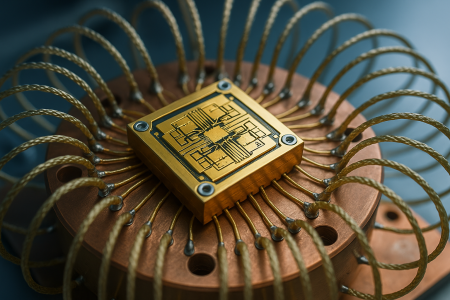
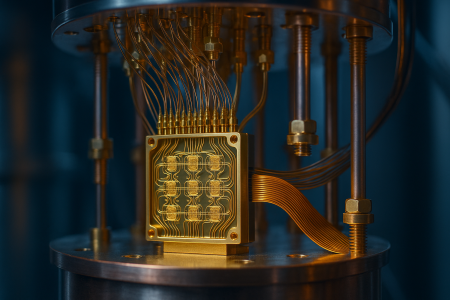
The cat qubit has moved from theory into hardware. Amazon's quantum team has built prototype chips that pair cat qubits with a phase-flip-correcting code to demonstrate the reduced-overhead idea in silicon. The French startup Alice and Bob has staked its entire company on the approach, publishing steady improvements in how long its cat qubits go between bit-flips, a headline number that stretches from milliseconds toward seconds as the designs mature. Both are essentially arguing that noise bias is a shortcut worth the engineering pain.
Whether it pays off depends on execution. A qubit that only makes one kind of mistake is still a qubit that makes mistakes, and the stabilization overhead has to stay cheaper than the error-correction savings it enables. But the underlying bet is elegant. Rather than fighting nature to make an even-handed qubit, cat-qubit builders lean into an imbalance and let the math of exponential suppression do the heavy lifting.