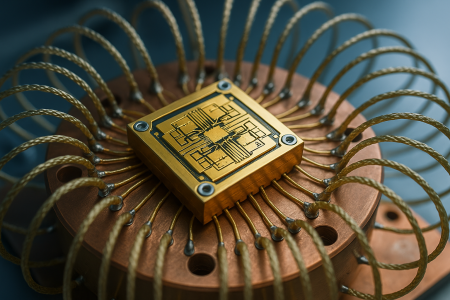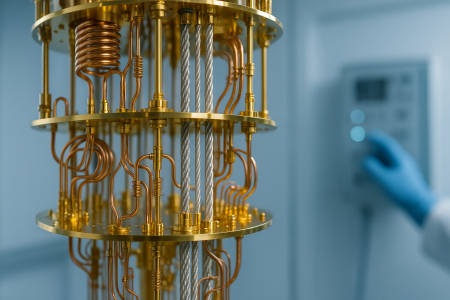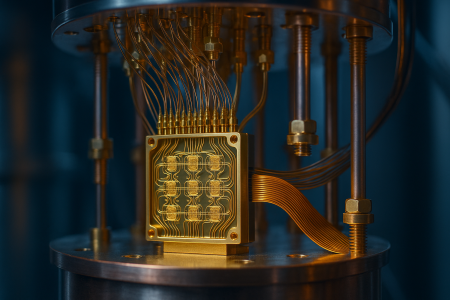

Most of the qubits that make headlines are exotic. Superconducting loops need dilution refrigerators, trapped ions float in ultra-high vacuum, neutral atoms are herded by lasers. Silicon spin qubits take a different tack. They store quantum information in the spin of a single electron, held inside a tiny pocket of semiconductor called a quantum dot. And the structure that traps that electron looks strikingly like the transistor at the heart of every processor ever made.
What a quantum dot actually is
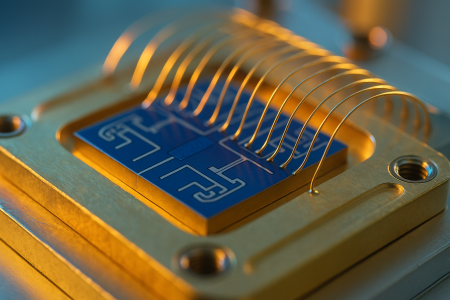
A quantum dot is a region so small that an electron confined there behaves like an artificial atom, with discrete energy levels. In a silicon spin qubit, metal gates sit above a clean layer of silicon and shape an electric field that corrals a single electron into that pocket. The information does not live in the electron's position or charge. It lives in its spin, which can point up, down, or into a quantum superposition of both. Control comes from microwave pulses or from oscillating the electron in a small magnetic gradient. Readout usually works by a clever trick called spin-to-charge conversion, where a spin-up and a spin-down electron are made to behave differently so a nearby sensor can tell them apart.
The appeal is size. A spin qubit can be tens of nanometers across, orders of magnitude smaller than a superconducting transmon, which sprawls across hundreds of microns. Pack qubits that tightly and a million of them starts to look less like science fiction and more like a floor plan.
The foundry argument
The loudest case for silicon spin qubits is economic. Intel has leaned into this, fabricating spin-qubit test chips on the same 300-millimeter wafers and similar tooling it uses for commercial logic. The Belgian research center imec and several university groups have done related work. The logic goes like this: the semiconductor industry has spent half a century learning to print billions of near-identical transistors with astonishing yield. If a qubit is basically a transistor operated in a strange regime, maybe it can inherit that manufacturing muscle instead of being assembled one delicate device at a time.
There are other perks. Silicon spin qubits can operate at temperatures a bit warmer than superconducting chips, sometimes above one kelvin rather than a few millikelvin. That sounds like a rounding error, but the cooling power available climbs steeply as you relax the temperature, which could ease the brutal problem of squeezing control wiring into a fridge. Purified silicon-28, an isotope with no nuclear spin, gives the electron a very quiet magnetic environment, and that has produced spin qubits with impressively long coherence and gate fidelities above 99 percent in the best two-qubit demonstrations.
Why it is still hard
The catch is that being small and manufacturable is not the same as being easy to control. Each quantum dot needs several gate voltages tuned with great precision just to hold one electron in the right place, and the sweet spots drift. Doing that by hand for a handful of dots is tedious. Doing it for thousands means automated tuning has to work flawlessly, and researchers are still building the software to make that routine.
Variability is the other headache. The chip industry tolerates transistors that vary slightly because circuits are designed with margin. Qubits have almost no margin. Two dots a few nanometers apart can have meaningfully different energies, and a stray charge trapped in the oxide can shift a qubit's frequency or scramble it entirely. The very fabrication process that promises scale also introduces defects that a qubit feels acutely. Getting high yield on qubits, not just transistors, is the real test.
Connectivity adds a wrinkle too. Spin qubits mostly talk to their immediate neighbors, so moving information across a chip means either shuttling electrons from dot to dot or engineering longer-range links through resonators, both of which are active research problems.
Where it sits in the race
Silicon spin qubits are behind superconducting and trapped-ion machines in raw qubit count today. A leading spin-qubit device might have a handful to a couple dozen qubits, while other platforms count in the hundreds. The bet is not about who leads this year. It is about which platform bends most gracefully toward the millions of physical qubits that error correction will eventually demand. If quantum computing really does need to be mass-produced, the technology that already knows how to mass-produce chips has a case worth watching.