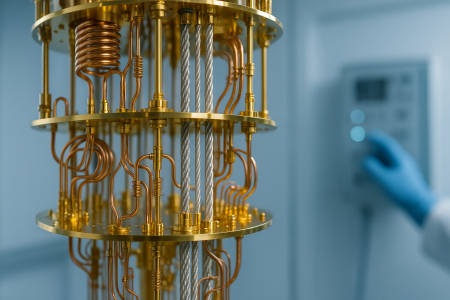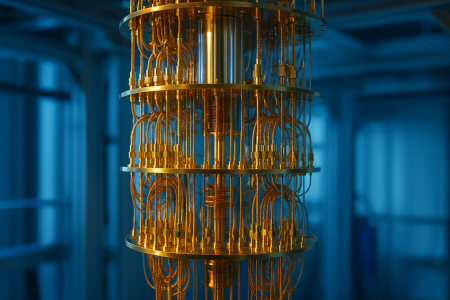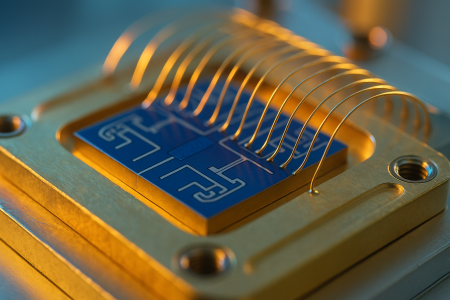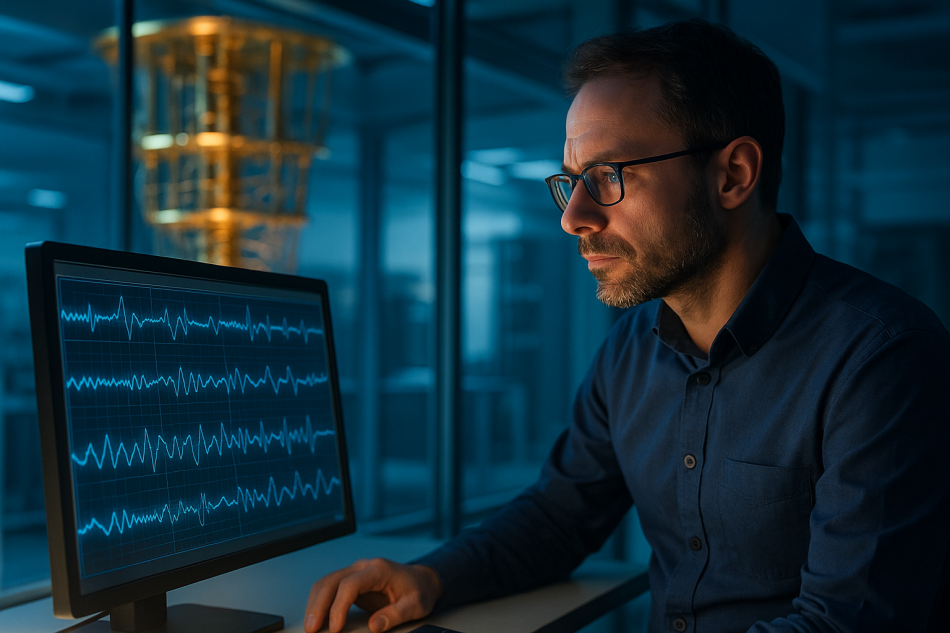

Walk into a lab that runs a superconducting quantum computer and you will not find a machine that boots up once and stays ready. The processor drifts. The frequency of a qubit today is not exactly the frequency it had this morning, the pulse that flipped it cleanly last night now overshoots a little, and the gate that worked beautifully yesterday produces slightly worse results. Before any serious computation can run, the system has to be measured, characterized, and retuned. That cycle never really stops. It is the calibration treadmill, and almost every hardware platform has to run on it.
Why qubits won't sit still
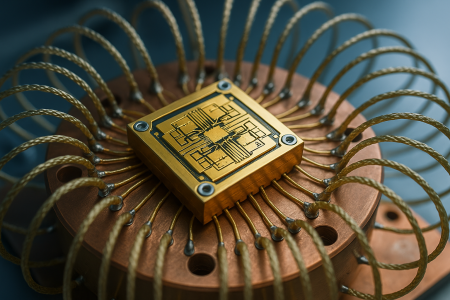
A qubit is an exquisitely sensitive object pretending to be a stable bit. In a transmon, the qubit's resonant frequency depends on tiny details of its Josephson junction and the electromagnetic environment around it. Those details shift with temperature fluctuations in the dilution refrigerator, with stray magnetic fields, with charge noise creeping across the chip surface, and with the slow settling of materials over hours and days. A change of a fraction of a percent in frequency is enough to throw a precisely timed control pulse off target.
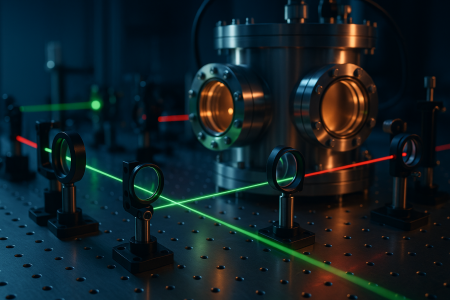
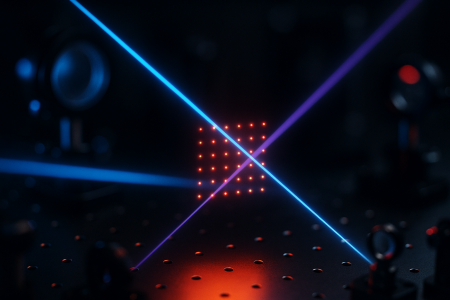
Trapped-ion and neutral-atom machines have their own versions of the same headache. Laser power drifts, beam pointing wanders by microns, magnetic fields fluctuate, and the frequencies that address individual atoms have to be re-locked. No matter the technology, the controls that manipulate qubits are analog signals tuned to physical parameters that refuse to hold perfectly steady.
What calibration actually involves
Tuning a quantum processor is a layered process. It starts with finding each qubit's frequency, then measuring how long it stays coherent, then shaping the microwave or laser pulses so that a single-qubit rotation lands exactly where it should. After that comes the harder work of calibrating two-qubit gates, where the interaction between neighbors has to be timed and amplitude-matched with great care. Readout has to be calibrated too, because the classifier that decides whether a qubit is a zero or a one depends on signal levels that move around.
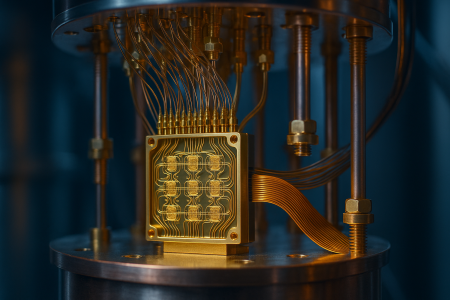
On a chip with dozens or hundreds of qubits, this becomes a sprawling optimization problem. Calibrate one qubit and you may nudge its neighbor through crosstalk. Tune a coupler and the qubits it connects shift slightly. The procedure has to be repeated across the whole device and rechecked often, because the parameters that were valid at the start of an eight-hour run may have wandered by the end.
The automation arms race
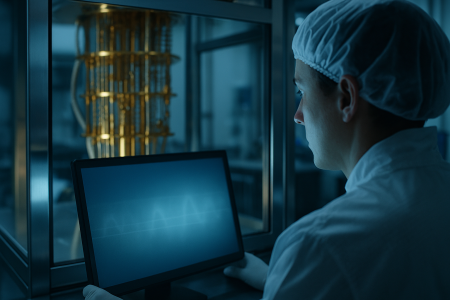
In the early days, researchers did much of this by hand, which made a single device a full-time job for a team of physicists. That does not scale to machines meant to serve cloud customers around the clock. So companies have built elaborate automated calibration pipelines, software that runs a battery of characterization experiments, fits the data, decides which parameters need updating, and pushes new pulse definitions to the control electronics without a human in the loop.
These systems borrow tricks from optimization and machine learning to search the parameter space efficiently. Some use directed graphs of calibration steps, so the software knows that if readout drifts it must recalibrate certain upstream values first. The goal is to keep the machine inside spec while spending as little time as possible offline, because every minute spent calibrating is a minute not spent running customers' circuits.
Why it matters for the roadmap
Calibration is not a footnote to the scaling problem; it is part of it. As qubit counts climb into the thousands and beyond, the time needed to characterize every component grows, and the chance that something has drifted out of tolerance somewhere on the chip grows with it. A machine that needs hours of recalibration for every hour of useful work has a serious throughput problem.
This bites hardest on error correction. A logical qubit built from many physical qubits assumes that the underlying gates perform consistently at their measured error rates. If those rates wobble because a few physical qubits drifted between calibrations, the error-correcting code has to work harder, and the promised improvement erodes. Stable, self-maintaining calibration is therefore a quiet prerequisite for the fault-tolerant machines everyone is chasing.
The flashy announcements tend to be about qubit counts and record fidelities. Those fidelities, though, are snapshots taken just after calibration, when the machine is at its best. The real engineering challenge is holding that performance steady, automatically, run after run, for a device that by its nature would rather drift away. Whoever masters the treadmill gains something more valuable than a higher peak number: a machine you can actually rely on.