
Most of the attention in quantum computing goes to the front of the calculation: how you make a qubit, how long it stays coherent, how cleanly you can entangle two of them. But none of that matters if you cannot reliably look at the qubit afterward and learn whether it landed on 0 or 1. That final act, called readout or measurement, is one of the most underrated engineering challenges in the field, and it quietly sets a ceiling on how good a processor can be.
Why looking is hard
A qubit in superposition holds a blend of 0 and 1. The instant you measure it, that blend collapses to a single classical outcome with a probability set by the quantum state. That is the rule, and it is unavoidable. So measurement is destructive by nature. You do not get to peek and continue. You get one answer, and the delicate state you spent so much effort building is gone.
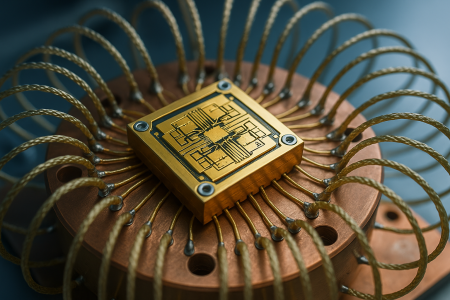
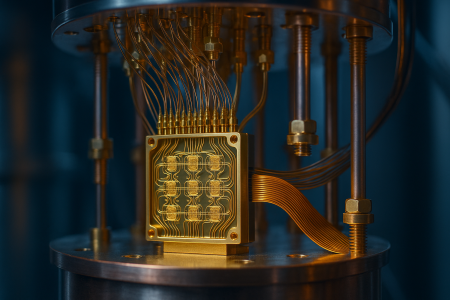
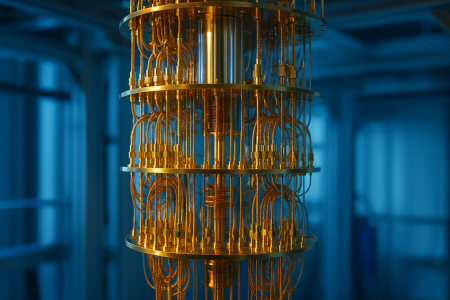
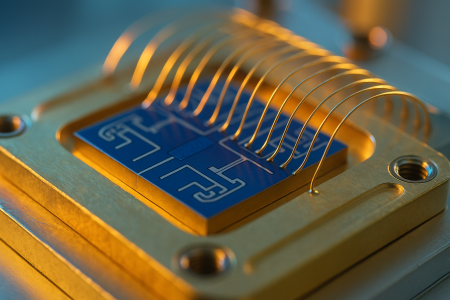
The deeper problem is that the signal you are trying to detect is faint and the act of detecting it is violent by quantum standards. A superconducting qubit lives in a circuit cooled to a few thousandths of a degree above absolute zero, holding energy differences measured in microwave photons. To read it, engineers couple the qubit to a separate microwave resonator. The qubit's state nudges the resonator's frequency by a tiny amount, and a probe tone bounced off the resonator comes back with a slightly different phase depending on whether the qubit is 0 or 1. Amplify that returning signal enough times and you can tell the two states apart.
The amplification chain
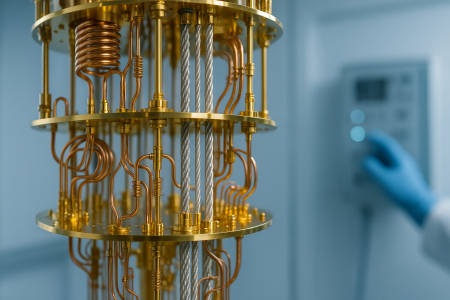
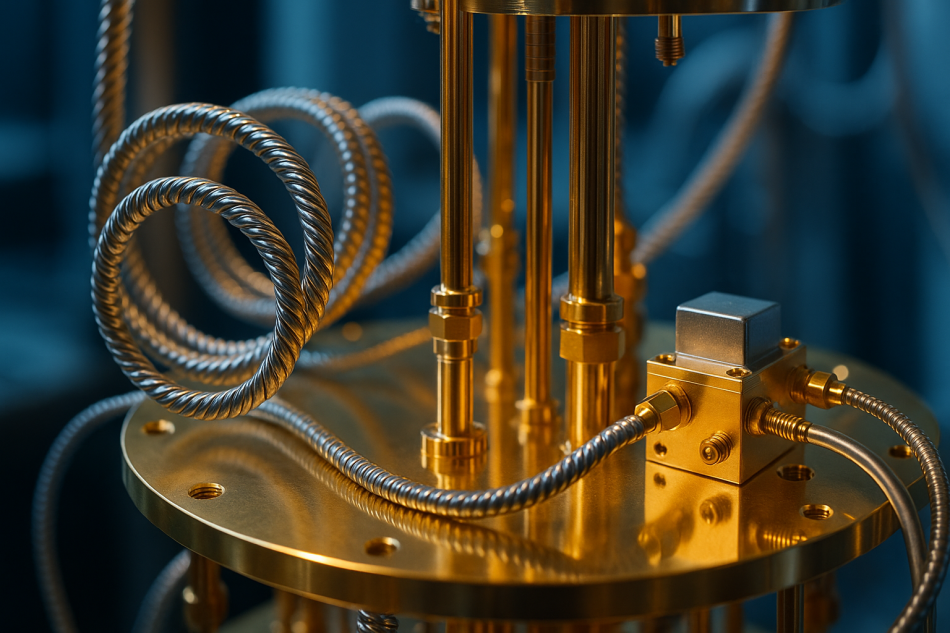
That amplification is its own saga. The first stage usually relies on a quantum-limited parametric amplifier sitting right next to the chip in the cold, because any ordinary amplifier would drown the signal in its own noise. The boosted signal then climbs through stages of the dilution refrigerator, picking up more amplification at progressively warmer levels, until it finally reaches room-temperature electronics that digitize it and decide: 0 or 1. Every link in that chain adds noise and latency, and every bit of latency matters.
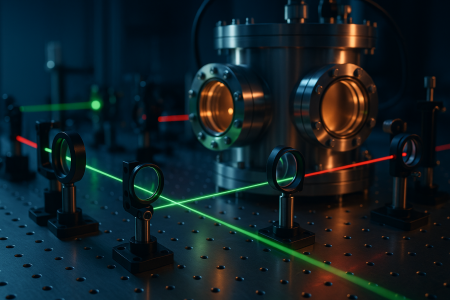
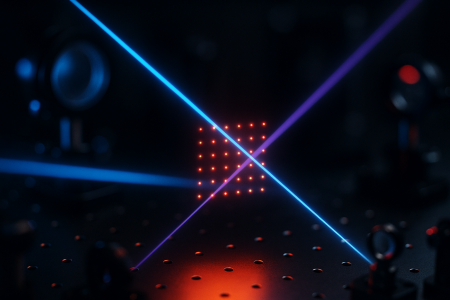
Different hardware platforms read out in completely different ways. Trapped-ion machines shine a laser at the ions and watch for fluorescence; a qubit in one state lights up like a tiny lamp while the other stays dark, and a sensitive camera or photomultiplier counts the photons. This optical approach can be extraordinarily accurate, with some systems reporting readout fidelities well above 99.9 percent. Neutral-atom processors use a similar fluorescence trick. Photonic machines detect single photons directly. Each method trades speed against accuracy in its own way.
Fast versus faithful
Here is the tension that defines readout. If you measure for longer, you collect more signal and your answer is more reliable. But the qubit is decaying the whole time, and a long measurement window invites the very errors you are trying to avoid. Measure too quickly and you save the state but risk misreading it. Engineers are constantly tuning this balance, and a typical superconducting readout now takes a few hundred nanoseconds while reaching fidelities in the high 99 percent range.
There is also crosstalk. Measuring one qubit can disturb its neighbors, either by leaking probe photons or by heating nearby parts of the chip. As processors pack in more qubits, isolating each readout becomes a layout and shielding problem as much as a physics one.
Why error correction makes it urgent
Readout used to be a one-time event at the end of a circuit. Quantum error correction changes that completely. Error-correcting codes work by repeatedly measuring special ancilla qubits during the computation to detect errors without disturbing the data qubits. That means a fault-tolerant machine performs millions of mid-circuit measurements, and each one must be fast, accurate, and non-destructive to the qubits that carry the actual information.
This is why mid-circuit measurement has become a headline capability on roadmaps from companies building superconducting and trapped-ion systems. It demands readout that can reset a qubit and reuse it within a single program, with classical electronics fast enough to feed the result back and choose the next operation. The control system effectively has to think in real time, on the scale of microseconds.
So when a company quotes a readout fidelity, it is reporting on the unglamorous machinery that decides whether all the elegant physics upstream produces a usable answer. A processor with brilliant gates and weak measurement is like a telescope with a perfect mirror and a foggy eyepiece. The race to scale quantum computers is, in large part, a race to read them faster and more faithfully than ever before.