
Most qubits fight two enemies. A bit flip turns a 0 into a 1, and a phase flip scrambles the delicate relationship between the two states. Any error-correcting scheme has to defend against both, which is a big reason the standard playbook demands hundreds or thousands of physical qubits to protect a single reliable logical one. Cat qubits start from a stubborn idea: what if you could make one of those errors almost impossible, and spend all your effort on the other?
Schrödinger's spare bit
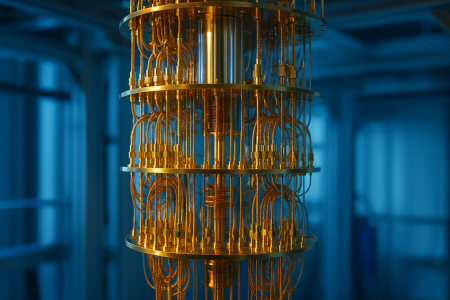
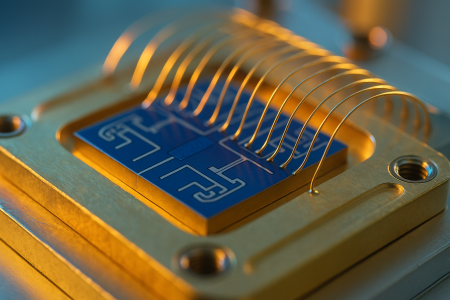
A cat qubit does not live in a single Josephson junction the way a transmon does. It lives in the electromagnetic field of a superconducting microwave cavity, where a specially engineered state can hold a superposition of two opposite-phase oscillations. Physicists nickname these Schrödinger cat states, after the famous thought experiment about a creature both alive and dead. The two "lobes" of the cat encode the qubit's 0 and 1.
The clever part is how far apart you push those two lobes in phase space. The bigger the cat, the more energy separates the two states, and the harder it becomes for random noise to knock the system from one to the other. A bit flip requires the field to hop across that gap, and you can make the gap exponentially punishing. In a good cat qubit the bit-flip rate can be suppressed by orders of magnitude, to the point where those errors happen so rarely you can nearly ignore them.
Trading one error for the other
Nothing is free. Making the cat bigger to crush bit flips makes it more vulnerable to phase flips, which grow only linearly with the cat's size. So the design deliberately lopsides the noise. Instead of two roughly equal error channels, you get one that is tiny and one that is dominant. Engineers call this biased noise, and it changes the arithmetic of error correction.
A conventional surface code has to protect against bit flips and phase flips symmetrically. If you already know bit flips are vanishingly rare, you can use a much cheaper code, a repetition code, that only worries about the phase errors. That can slash the number of physical qubits needed per logical qubit from the thousand-ish range toward something far smaller, at least on paper. The whole appeal of cat qubits is this promise of a lighter error-correction tax.
Keeping the cat alive
Holding a cat state steady is its own engineering feat. Left alone, the cavity would leak energy and the state would decay. Cat qubits are kept inflated by a process called two-photon stabilization, where a nonlinear element continuously pumps pairs of photons into and out of the cavity. The pumping locks the field into its two-lobed shape and automatically nudges it back if it drifts, a kind of built-in, always-on correction happening at the hardware level rather than in software. This is sometimes described as autonomous error correction, because the machinery fixes small deviations without a decoder ever getting involved.
Who is betting on it
The French startup Alice & Bob has built its entire company around cat qubits, arguing that the noise bias will let them reach useful, fault-tolerant machines with far fewer physical qubits than rivals chasing transmons. Amazon Web Services has pursued the same physics, and its Ocelot prototype chip combined cat qubits with a repetition code to demonstrate the biased-noise approach in hardware. Both efforts are still early, with a handful of qubits rather than the large arrays a real algorithm would need, but they share a thesis: attack the resource problem at its root instead of scaling brute-force redundancy.
The catch
Phase errors do not go away, and they are the ones the cat leaves exposed. The repetition code that handles them still needs many physical cat qubits per logical qubit, and each cat qubit is a nontrivial microwave cavity with its own stabilization hardware. Gates between cat qubits have to preserve the noise bias, or the whole advantage collapses. And measuring these states cleanly, without accidentally triggering the errors you were trying to avoid, remains delicate.
Cat qubits are one of several bosonic approaches, alongside GKP grid states, that try to encode protection into the physics of an oscillator rather than piling up more junctions. None has yet proven it can scale to a full fault-tolerant machine. But the underlying wager is easy to state and hard to dismiss: if you can make one whole class of errors nearly disappear, the rest of the problem gets a great deal cheaper.