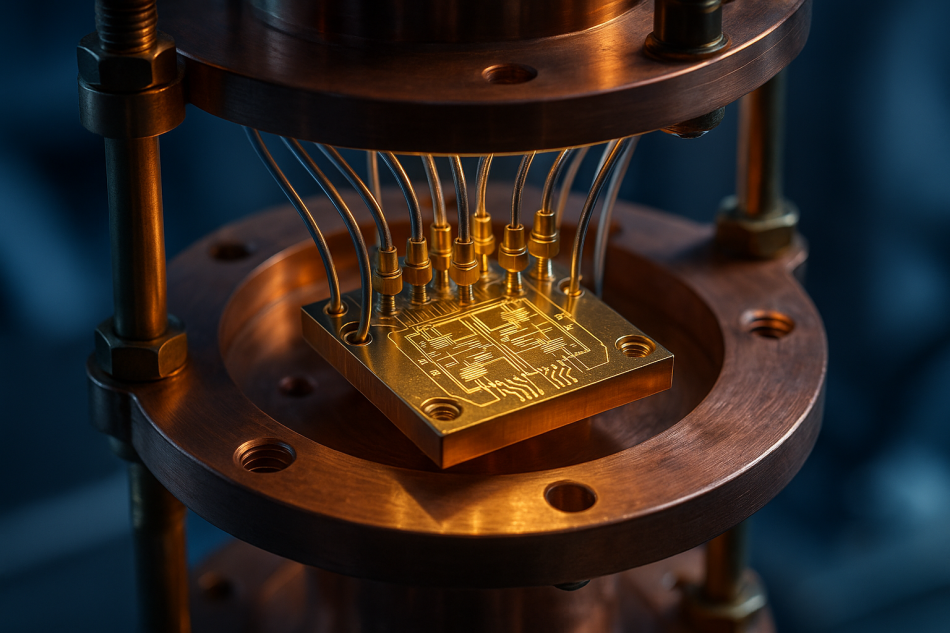

Buy a laptop and it behaves the same on Tuesday as it did on Monday. A quantum processor does not offer that courtesy. Left alone for a few hours, a chip that ran a clean two-qubit gate this morning will start returning garbage by afternoon. Nothing broke. The machine simply drifted, and someone (or something) has to tune it back into shape. This is calibration drift, and fighting it is one of the least glamorous but most constant chores in quantum computing.
What is actually drifting
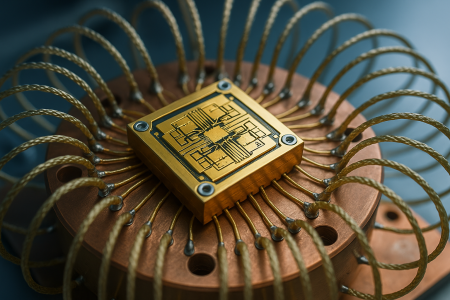
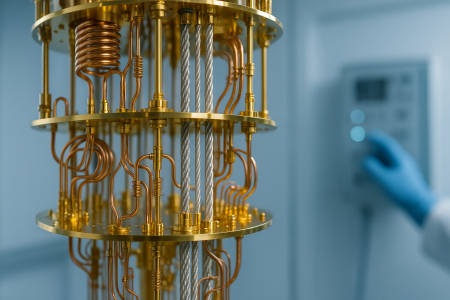
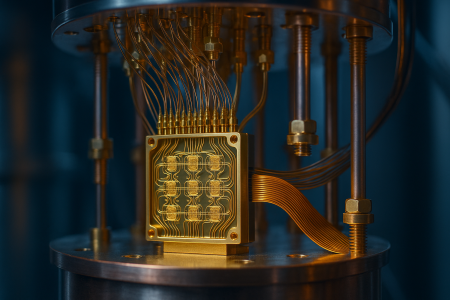
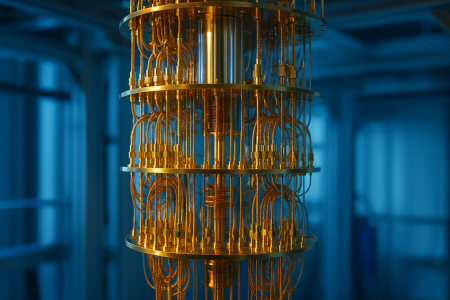
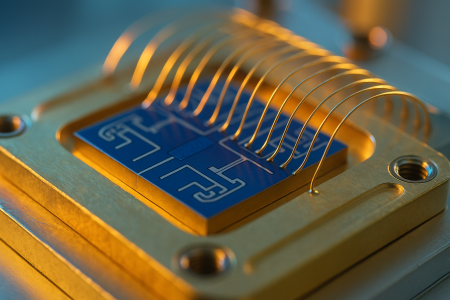
Every qubit has a resonant frequency, the pitch at which it responds to control pulses. On a superconducting chip that frequency depends on the exact properties of a Josephson junction, on tiny stray magnetic fields, on the temperature of the mixing chamber, and on the microscopic defects sprinkled through the materials. None of those things hold perfectly still. A junction ages. A defect near a qubit flickers between states and nudges its frequency. The fridge warms by a few millikelvin after a helium top-up. Each shift is minuscule, but a control pulse tuned to yesterday's frequency now lands slightly off target.
The knock-on effects compound. Single-qubit gates rely on pulses of a precise amplitude and duration. If the qubit frequency moves, the pulse over- or under-rotates, and errors creep in. Two-qubit gates are worse, because they depend on the relationship between two qubits that may drift in different directions. Readout drifts too: the signal that distinguishes a 0 from a 1 shifts, and the classifier that sorts them starts making mistakes.
The tuning routine that never sleeps
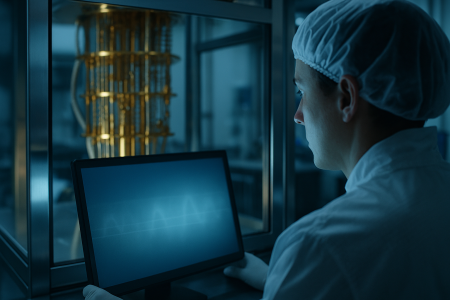
In the early days, a graduate student would sit at a control rack and hand-tune a qubit, sweeping frequencies and pulse amplitudes until the numbers looked right. That does not scale past a handful of qubits. Modern systems automate the whole cycle. The machine periodically runs a battery of characterization experiments on itself: it measures each qubit's frequency, its coherence time, the fidelity of its gates, and the reliability of its readout. Software compares the results against targets, adjusts the pulse parameters, and stores the new settings.
The clever part is deciding what to check and how often. Recalibrating every parameter on a large chip from scratch would eat hours you could have spent running customer jobs. So calibration is arranged in a hierarchy. Cheap, fast checks run frequently to catch obvious problems. Expensive, thorough recalibrations run only when a check fails or on a longer schedule. Some systems borrow ideas from control theory, tracking how each parameter tends to drift so they can predict and pre-empt the wandering rather than chase it after the fact.
Why you should care as a user
If you rent time on a cloud quantum computer, calibration drift is the hidden reason your results can vary between sessions. A circuit that returned a crisp answer at noon might look noisier at 4 p.m. because the machine drifted and the automated tuner has not yet caught up, or because it just recalibrated and moved the goalposts slightly. Providers publish calibration data alongside their processors precisely so users can see the current gate fidelities and readout errors, which change from one calibration cycle to the next.
- The two-qubit gate errors you see quoted are snapshots, valid until the next recalibration.
- A qubit that looks strong today may be flagged as degraded tomorrow and routed around by the compiler.
- Long-running experiments can straddle a recalibration event, which is why reproducibility takes extra care.
The scaling headache
Drift is annoying at fifty qubits. At a thousand it becomes an engineering problem in its own right. The time spent calibrating cannot grow faster than the number of qubits, or the machine will spend all day tuning and never compute. Vendors treat calibration throughput as a real metric, and some of the effort going into cryogenic control electronics and faster measurement is aimed squarely at keeping the tuning loop short. Error correction changes the picture but does not remove it: a fault-tolerant machine still needs its physical qubits calibrated well enough to stay below the error threshold, and the calibration system itself has to run reliably underneath the correction layer.
The romantic image of a quantum computer is a frozen chip humming in perfect stillness. The reality is closer to an orchestra that keeps slipping out of tune, with a tireless conductor retuning every instrument between movements so the music never quite falls apart.