
Walk into a modern semiconductor fab and you find an industry that has spent decades learning to print features smaller than a virus, millions of times over, with near-perfect repeatability. Intel's quantum bet starts from a simple question: what if the qubit could ride on top of all that? Instead of trapping ions in vacuum or cooling superconducting loops, Intel is chasing a qubit made from a single electron parked in silicon, controlled by the same lithography that makes ordinary chips.
What a spin qubit actually is
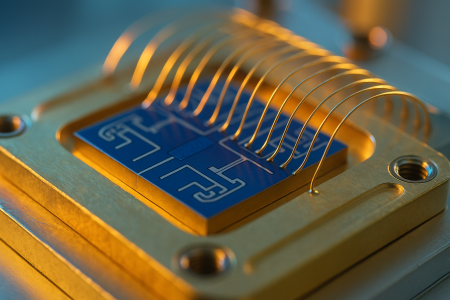
The idea is almost austere. Take a tiny pocket of silicon, called a quantum dot, and coax exactly one electron into it. That electron has a property called spin, which behaves like a microscopic magnet that can point up, down, or a quantum blend of both. Up is a zero, down is a one, and the blend is where the quantum magic lives. To do anything useful you build two dots side by side, let the electrons feel each other, and use magnetic and electric fields to rotate and entangle their spins.
What makes this appealing is the size. A superconducting transmon qubit is a comparatively giant structure, hundreds of micrometers across. A silicon spin qubit is closer to the scale of a transistor, tens of nanometers. If you want a million qubits someday, packing them densely matters a great deal, and silicon spins are among the smallest candidates on the table.
The fab advantage
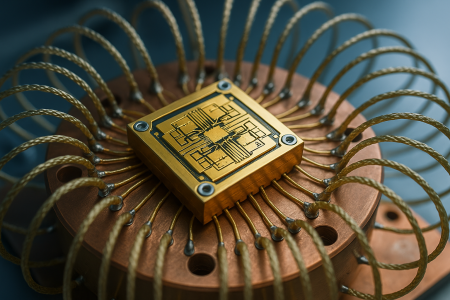
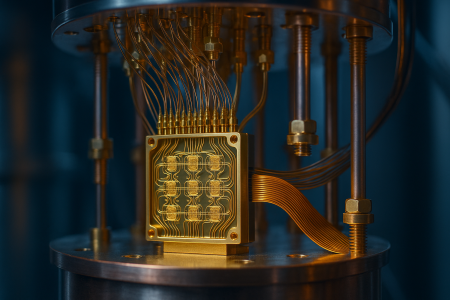
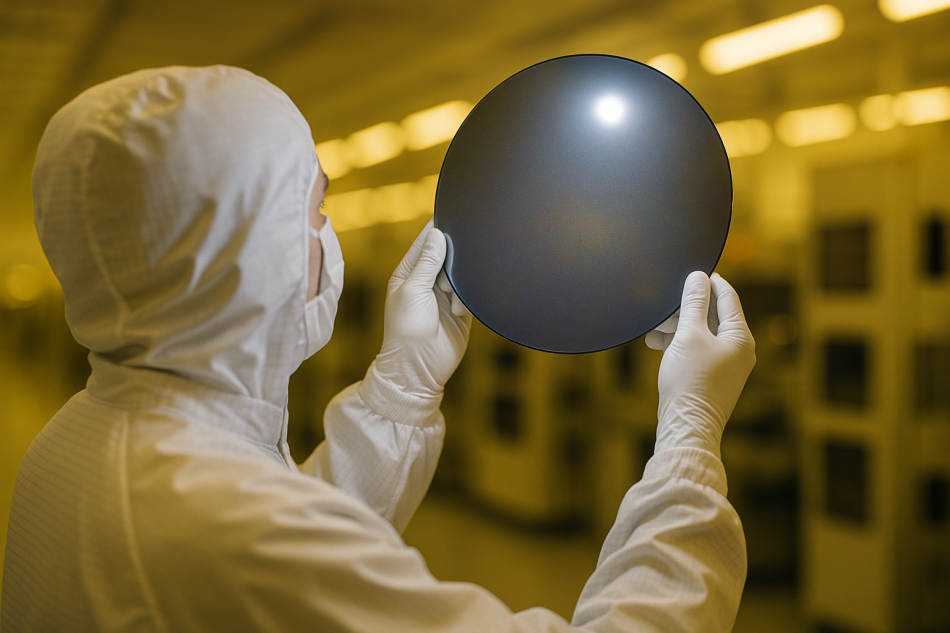
Intel's real pitch is not the physics, which many labs study, but the manufacturing. The company has framed silicon spin qubits as something it can build on existing 300-millimeter wafers using tools it already owns. Its research chip, named Tunnel Falls, put thousands of quantum dots on a single wafer and shipped them to university and government labs as a shared research platform. The point was less about record-breaking performance and more about proving that a qubit could roll off a production-style line at volume, with the kind of consistency chipmakers take for granted.
That matters because scaling is where most quantum architectures start to hurt. Wiring, cooling, and packaging get harder with every qubit added. Intel's argument is that half a century of accumulated fab expertise, from clean-room discipline to defect metrology, is a head start no one else has. If qubits can be manufactured like transistors, the reasoning goes, they can eventually be manufactured in the numbers error correction demands.
Why it is not easy
The catch is that silicon is a messy neighborhood for a lone electron. Natural silicon contains an isotope, silicon-29, whose nuclei carry their own tiny magnetic spins. Those nuclei jostle the qubit and scramble its state. The workaround is isotopically purified silicon-28, a nearly spin-free material that gives the electron a quiet place to live. Coherence times improved dramatically once researchers made this switch.
Uniformity is the harder problem. A fab can print a billion transistors that behave almost identically, but a qubit is far more sensitive to the exact atomic arrangement around it. Two dots meant to be twins can end up with different operating frequencies because of a stray defect or a nanometer of misalignment. Tuning each qubit into its sweet spot, and keeping neighboring dots from interfering, becomes a serious engineering chore as the count grows. The very sensitivity that makes spin qubits small also makes them finicky.
Where it stands in the race
Silicon spin qubits trail superconducting and trapped-ion machines in headline qubit counts and in demonstrated two-qubit gate quality, though academic groups have pushed spin gate fidelities above the levels error correction requires in small systems. The near-term story is not about beating IBM or Quantinuum on a benchmark. It is about betting that the winning architecture will be decided by manufacturability rather than by whoever crosses a hundred qubits first.
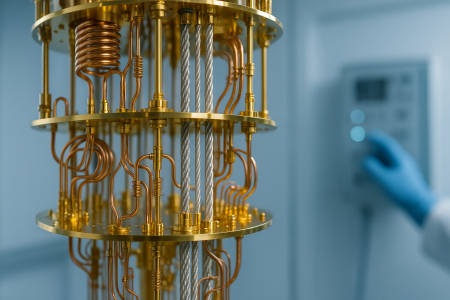
There is a further sweetener. Spin qubits can operate at slightly warmer temperatures than superconducting qubits, potentially above one kelvin instead of a few millikelvin. That sounds trivial, but it opens the door to placing conventional control electronics next to the qubits inside the fridge, easing the tangle of wires that chokes other designs. Intel has explored exactly this kind of cryogenic control chip.
The wager is long and far from settled. But the logic is coherent: if quantum computers ever need to be mass produced, the company that already prints silicon at planetary scale would like to be holding the recipe.