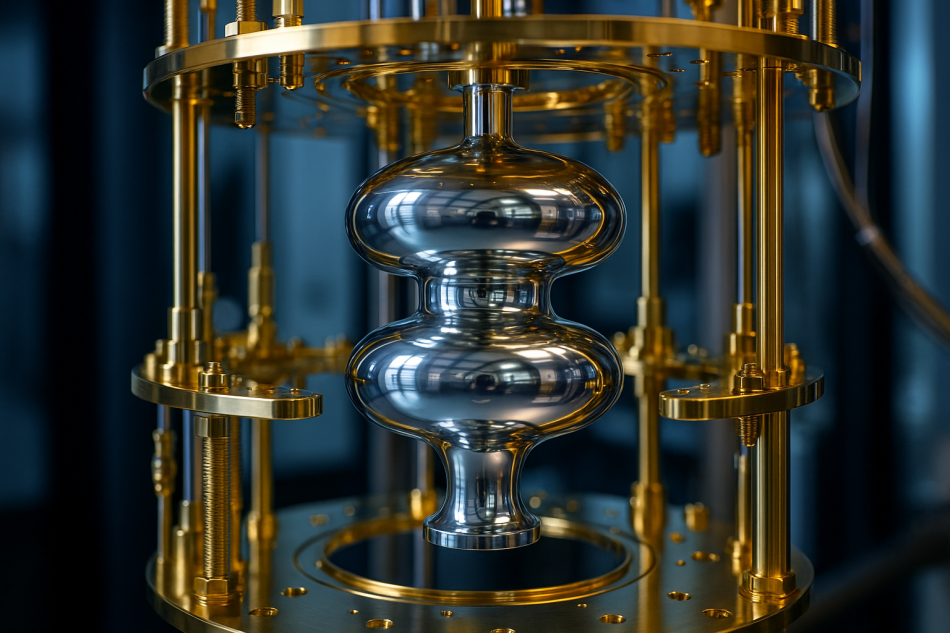

Most qubits forget in a hurry. A good superconducting transmon holds its quantum state for a few hundred microseconds before noise erases it. That is long enough to run short circuits, but it leaves error correction gasping for margin. At the Superconducting Quantum Materials and Systems Center, a collaboration led by Fermilab, researchers chased a different number entirely. They wanted coherence measured not in microseconds but in whole seconds, and they found a candidate in a piece of hardware physicists already knew intimately: the superconducting radio-frequency cavity.
From particle accelerators to quantum memory
Fermilab did not set out to build cavities for quantum computing. For decades its engineers refined hollow chunks of superconducting niobium that ring with microwave fields and shove particle beams to higher energies. The craft that goes into those cavities is obsessive. The inner surfaces are polished, etched, baked, and cleaned until stray electrons and surface defects are nearly gone, because any imperfection bleeds energy out of the resonating field. That energy loss is captured by a figure called the quality factor, and accelerator cavities routinely reach values in the tens of billions.
A quantum engineer reads that same number differently. A field that rings for a long time without decaying is, in effect, a place to store a quantum state. If you can load a single microwave photon into that pristine cavity and keep it coherent, you have a qubit that lives orders of magnitude longer than one etched onto a chip. The SQMS team took the accelerator recipe and pointed it at quantum information, and the cavities responded with coherence times stretching toward a second or more.
Why a hollow box beats a flat chip
The advantage comes down to where the electromagnetic field spends its time. On a planar superconducting chip, the field is crammed against surfaces and interfaces, exactly the places where two-level defects and oxide layers lurk and sap energy. Inside a three-dimensional cavity, the field fills a large empty volume and barely touches the walls. Less contact with messy materials means fewer channels for the quantum state to leak away. The cavity becomes a quiet room where a photon can sit undisturbed.
That quiet is not free. A bare cavity cannot do anything useful on its own. It stores, but it does not compute. To manipulate the state, the team couples a small transmon chip to the cavity, using the chip as a control knob and a readout port. The transmon is noisy and short-lived, but it only has to touch the cavity briefly to steer it. The long-lived quantum information stays in the clean resonator, and the fragile chip does the talking. This split of labor, storage in one place and control in another, is the heart of the approach.
Qubits that hide in a wave
A cavity is not limited to holding a single bit. Because a microwave field can carry many photons in superpositions of different amplitudes, researchers can encode information across those states in clever patterns. Encodings like cat states and grid states spread one logical qubit across the many levels of a single oscillator, which opens a path to catching and correcting errors inside one physical object rather than across a sprawling grid of chips. A cavity that already holds its state for a long time gives those schemes room to breathe.
There are real costs to weigh. The cavities are bulky compared with the micron-scale features of a chip, which makes packing millions of them a daunting prospect. Operations that involve the coupled transmon inherit some of its noise. And every cavity still has to sit inside a dilution refrigerator chilled to a fraction of a degree above absolute zero. Scaling from a handful of exquisite resonators to a full machine is an open engineering question.
A different bet on the roadmap
What SQMS represents is a wager that quality can substitute for quantity. Instead of fighting errors purely by multiplying noisy qubits and burying them under layers of correction, the cavity approach tries to make each qubit so stable that the correction burden shrinks. It leans on half a century of accelerator metallurgy, on the national-lab tradition of building big, precise hardware, and on the hope that a hollow piece of niobium, borrowed from a machine meant to smash atoms, might turn out to be one of the calmest places in the universe to keep a quantum thought.







