
Most quantum computers work the way a classical computer does, at least in spirit. You break a problem into a sequence of discrete logic gates, apply them one after another, and read out the result. Pasqal, a French company spun out of the Institut d'Optique near Paris, thinks there is a faster route to something useful. Instead of chopping every calculation into gates, it lets its hardware evolve naturally, like a physical system settling toward a solution. That choice, called analog quantum computing, sits at the center of the company's identity.
Atoms held by light
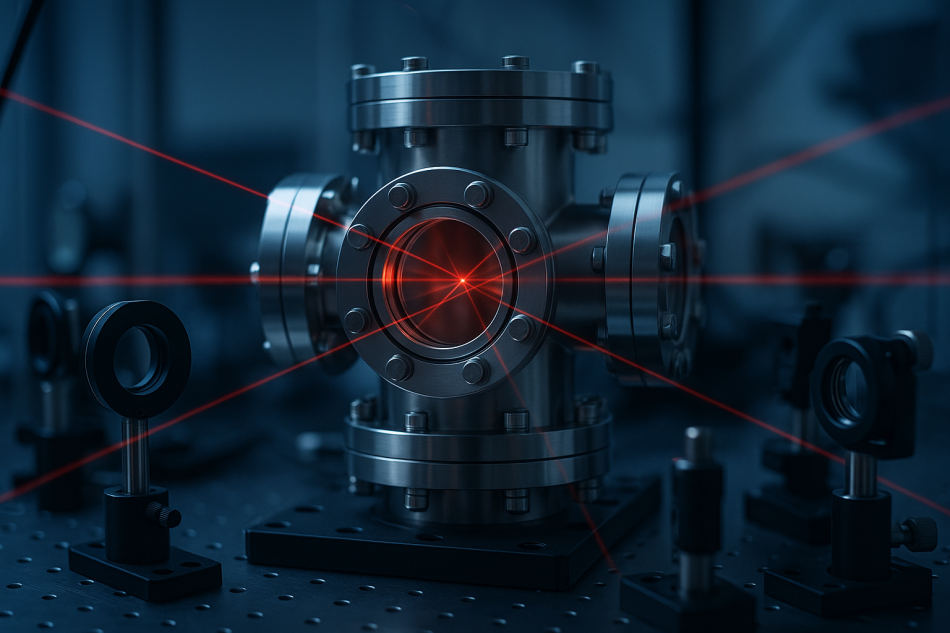
Pasqal builds its machines from neutral atoms, usually rubidium, suspended in a vacuum and pinned in place by tightly focused laser beams known as optical tweezers. Hundreds of atoms can be arranged into programmable patterns, grids, triangles, rings, whatever the problem calls for. Each atom is a qubit. To make them interact, the machine excites them into Rydberg states, bloated electronic configurations in which the outer electron orbits far from the nucleus. In that puffed-up condition, nearby atoms feel each other strongly, and the famous Rydberg blockade kicks in: two atoms sitting close together cannot both be excited at once.
That blockade is not just a quirk of physics. It is a computational resource. The rule that neighboring atoms refuse to light up together maps almost directly onto a classic optimization problem, finding the largest set of points in a graph with no two connected. Arrange the atoms to mirror the graph, let the system evolve, and the final pattern of excited atoms encodes a candidate answer. The hardware is doing the math by simply being itself.
Why skip the gates
The appeal of the analog approach is that it sidesteps a lot of overhead. Gate-based machines need precise control pulses for every operation, and errors accumulate with each one. An analog evolution replaces thousands of individual gates with a single smooth process, shaped by tuning laser intensities and the geometry of the atom array. For certain problems, especially simulating how quantum materials behave or hunting for low-energy configurations in optimization, that can be a more natural fit than translating everything into a circuit.
The trade-off is generality. A purely analog machine is not a universal computer. It is tuned to a family of problems rather than any arbitrary program. Pasqal's answer is that neutral-atom hardware can do both. The same platform that runs analog evolutions can, with more sophisticated control, perform digital gates. The company's stated plan is to grow qubit counts into the hundreds and beyond while gradually adding digital capability, so that early analog applications fund the harder climb toward fault-tolerant, gate-based computing.
A company with academic roots
Pasqal's pedigree runs straight through the physics of cold atoms. Among its co-founders is Alain Aspect, who shared a Nobel Prize for experiments on quantum entanglement, alongside researchers who spent years perfecting tweezer arrays in the lab. That lineage shows in the technology choices. Neutral atoms offer a few structural advantages over rival approaches. Every atom of a given element is identical, so there is no fabrication variation to calibrate out the way superconducting chips demand. The arrays can be reconfigured in software rather than etched permanently into silicon. And the atoms operate without the sprawling refrigeration that superconducting qubits require, though the laser and vacuum systems are hardly simple.
To broaden its reach beyond hardware, Pasqal absorbed Qu&Co, a Dutch quantum software firm, folding algorithms and applications work into the business. The company has also pushed to install machines where customers can actually use them, including placements tied to high-performance computing centers in Europe, rather than keeping everything in a single lab.
The test ahead
The analog bet only pays off if it produces answers that matter before the fully error-corrected era arrives. That means finding problems where a few hundred noisy atoms, evolving under carefully shaped lasers, beat or at least rival what a classical server can grind out. Materials simulation and specific optimization tasks are the most cited candidates, because they map cleanly onto what Rydberg arrays do well.
If those applications hold up, Pasqal will have shown that the road to quantum usefulness does not have to run through gates at all, at least not at first. If they do not, the company still owns one of the more scalable qubit platforms in the field, ready to pivot toward the digital future everyone is chasing. Either way, the atoms held by light are a wager worth watching.







