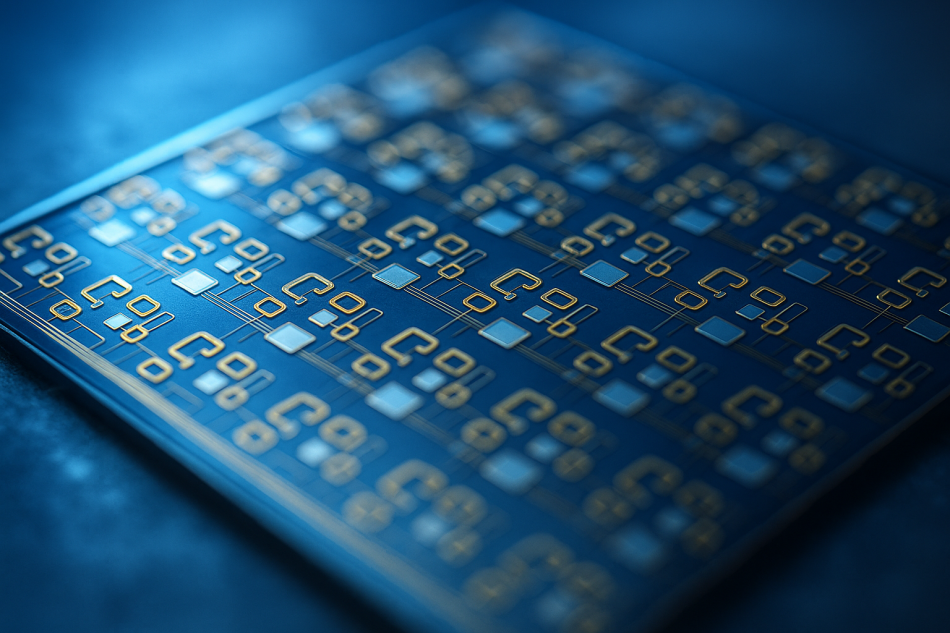

Ask an engineer at Google, IBM, or almost any lab building superconducting qubits which error-correcting code they plan to run, and you will hear the same answer. The surface code. It is not the most efficient scheme on paper, and it is not the newest. But it has one property that outweighs almost everything else: it only asks each qubit to talk to the four sitting next to it. On a chip where wiring is a nightmare and long-range connections are expensive, that local habit is worth a great deal.
A grid with two kinds of citizen
Picture a checkerboard. On this board, qubits come in two roles. Some hold the actual quantum information you want to protect. These are the data qubits. Interleaved among them sit the measure qubits, also called ancillas, whose only job is to interrogate their neighbors. The genius of the arrangement is that the measure qubits never read the data directly. If they did, they would collapse the fragile superposition and destroy the very thing you are trying to save.
Instead, each measure qubit checks a relationship. It asks whether a small group of neighboring data qubits agree with one another according to a fixed rule. There are two flavors of these checks. One type watches for bit-flip errors, the kind where a zero silently becomes a one. The other watches for phase-flip errors, the subtler mistake where the sign of a quantum state inverts. A qubit can suffer both at once, and the surface code is built to catch both without ever peeking at the underlying value.
Reading the smoke, not the fire
Every cycle, the machine measures all the ancillas and produces a pattern of ones and zeros called the syndrome. A quiet syndrome means nothing has gone wrong recently. A change in one of those measurements is a flag: an error happened somewhere between the last check and this one. Crucially, the syndrome does not tell you the value of any data qubit. It tells you only that a fault occurred and roughly where. You are reading the smoke, not the fire.
A classical computer then takes that stream of syndromes and tries to work out what physical errors most likely produced them. This decoding step is a matching puzzle, and it has to keep pace with the quantum hardware in real time, cycle after cycle. Get it right and the correction can be applied, or simply tracked in software, without disturbing the computation.
The price of protection: distance
The strength of a surface code is measured by its distance, usually written as d. A distance-3 code can survive a single error. A distance-5 code can survive two. The larger the distance, the more physical qubits you spend and the more errors you can absorb before a logical mistake slips through. Here is the catch that keeps hardware teams awake: the number of physical qubits grows with the square of the distance. A single well-protected logical qubit at a useful distance can swallow hundreds or even a thousand physical qubits.
That overhead is the central tension of the whole approach. The surface code is generous with qubits and stingy with connectivity, which is exactly backwards from what you want if qubits are scarce. But it works only if the physical error rate sits below a threshold, roughly one percent for realistic noise. Cross that line and adding more qubits actually helps. Stay above it and more qubits just add more places for things to break. Google's demonstration that a larger patch produced fewer logical errors than a smaller one was celebrated precisely because it showed the code was on the right side of that line.
Why it won by default
Newer codes, such as the low-density parity-check families, promise the same protection with far fewer qubits. They are attractive, and several companies are chasing them. But they demand connections between qubits that are not physically adjacent, which superconducting chips cannot easily provide today. The surface code asks for nothing exotic. A flat grid, nearest-neighbor gates, fast measurement, and a decoder that never falls behind.
For now that pragmatism wins. The surface code is not the endpoint of quantum error correction. It is the scaffold most builders trust while they figure out how to spend qubits more cheaply. If the first genuinely fault-tolerant machine arrives on schedule, odds are good it will be tiling its logic across a checkerboard that quietly watches itself.







