
Rent time on a commercial quantum computer and you get a tidy experience. You submit a circuit, the machine compiles it, runs it thousands of times, and returns a column of results. What happens between submission and answer is a sealed box. The vendor decides how your gates are built, how the qubits are calibrated, and which tricks quietly clean up the output. For a customer trying to price a portfolio, that opacity is fine. For a physicist trying to understand why a gate misfires, it is a wall.
The Quantum Scientific Computing Open User Testbed, known as QSCOUT, was designed to knock that wall down. Funded by the U.S. Department of Energy and built at Sandia National Laboratories, it is a trapped-ion machine offered free to researchers whose proposals get selected. The pitch is not raw power. It is transparency.
Ions on display
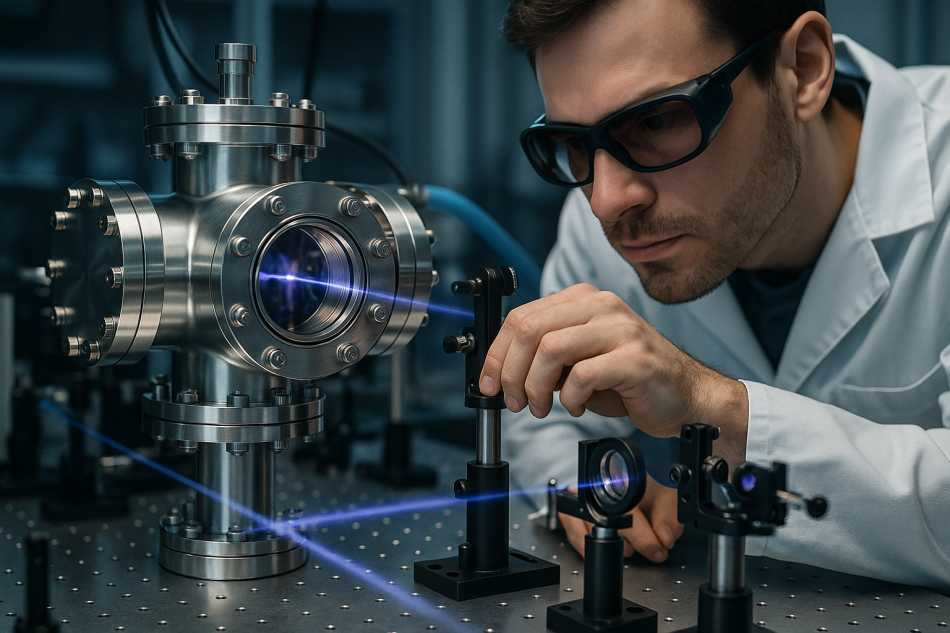
QSCOUT stores its qubits in individual ytterbium ions, suspended in a vacuum by oscillating electric fields on a surface trap. Each ion is a nearly identical atomic clock, its quantum state encoded in two long-lived energy levels and manipulated with precisely timed laser pulses. Trapped ions are prized because they hold information for a long time and because every qubit is fundamentally the same, with no fabrication variation to average over.
The machine started small, on the order of a few qubits, and grew from there. That modest count is not the point. Sandia is not chasing a record. It is running a facility where academic and national-lab teams can test ideas that would be impossible on a black box.
Why access to the plumbing matters
The distinguishing feature of QSCOUT is how deep users are allowed to reach. Instead of being limited to a fixed menu of gates, researchers can specify operations at the pulse level, shaping the actual laser waveforms that drive the ions. They can insert custom sequences, probe the machine mid-computation, and read detailed diagnostics about how the hardware is behaving.
That kind of control is exactly what you need to study the problems the whole field cares about. Someone investigating a new error-correction scheme wants to know precisely how errors enter, not a cleaned-up summary. Someone designing a novel two-qubit gate needs to sculpt the pulses themselves. Someone building a compiler wants to see how their instructions map onto real physics. On a commercial cloud service, those layers are off-limits by design. On QSCOUT they are the product.
To make this usable, Sandia developed programming tools that let users describe experiments at both the circuit level and the pulse level, then hand the instructions to the physical apparatus. The idea is that a graduate student across the country can write a low-level experiment and run it on a research-grade ion trap without owning one, which would otherwise cost millions and demand a specialized lab.
The role of a national lab
QSCOUT reflects a broader logic behind government investment in quantum computing. Private companies have strong reasons to keep their calibration secrets and their error-suppression methods hidden, because those are competitive advantages. That secrecy is rational, but it slows the shared scientific work of figuring out how these machines fail and how to make them better. A publicly funded, openly documented testbed fills the gap. It is closer in spirit to a synchrotron or a telescope than to a product, a piece of shared infrastructure meant to advance the field rather than a single balance sheet.
There is also a practical benefit for the United States government. By running its own transparent machine, the DOE builds in-house expertise, trains people who will staff the next generation of quantum efforts, and keeps a clear-eyed view of what the technology can and cannot yet do, independent of any vendor's marketing.
A different kind of benchmark
QSCOUT will never top the leaderboards for qubit count. That was never the assignment. Its contribution is measured in the experiments it enables, the error models it exposes, and the students and staff scientists who learn to control quantum hardware down to the waveform. In a field where most machines guard their inner workings, an ion trap that invites people to open the hood is quietly valuable.







