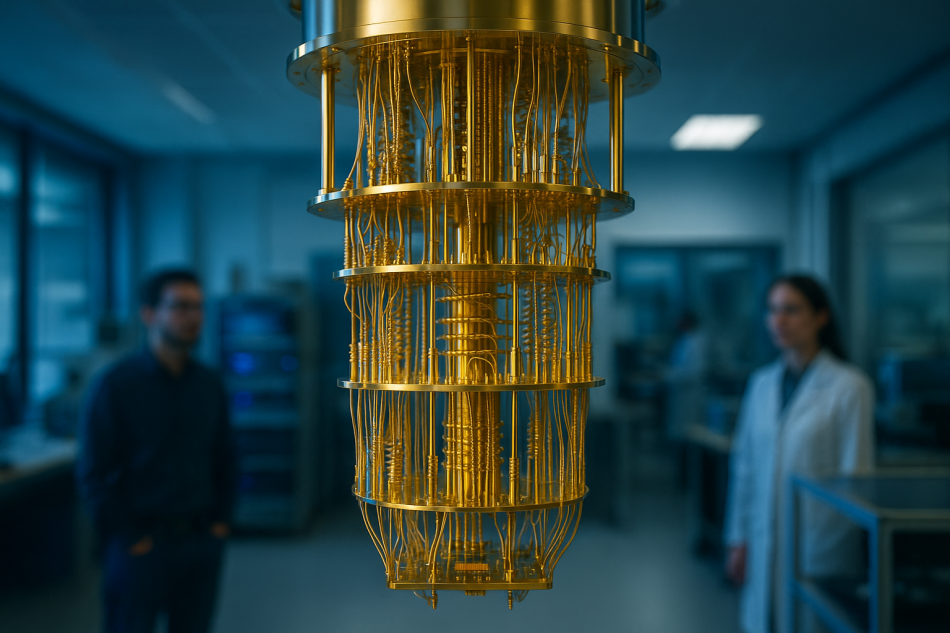

When people talk about the race to a useful quantum computer, the conversation usually orbits a handful of American and European names. But one of the loudest claims of quantum advantage in the past few years came out of Hefei, China, from a superconducting machine named after Zu Chongzhi, the fifth-century mathematician who calculated pi to seven decimal places long before anyone in Europe managed the feat. The homage is deliberate. The team behind the processor, led by Jian-Wei Pan at the University of Science and Technology of China, wanted a name that signaled precision and national pedigree.
The benchmark it was built to beat
Zuchongzhi is a superconducting processor built to run one specific, deliberately artificial task: random circuit sampling. The idea, borrowed from the same playbook Google used with its Sycamore chip, is to apply a long sequence of random quantum gates and then measure the output. The resulting distribution of bit strings is fiendishly hard for a classical supercomputer to reproduce, because tracking the interference of so many entangled qubits blows up the memory and time any conventional machine can offer.
The task has no practical use. Nobody needs the random numbers it spits out. The point is to demonstrate that the quantum device is doing something a classical computer simply cannot follow in reasonable time. It is a stress test and a statement, not a product.
Zuchongzhi 2.1 carried 66 transmon qubits arranged in a two-dimensional lattice, with tunable couplers between neighbors to switch their interactions on and off. The team ran random circuits on a subset of those qubits across many layers of gates, then argued that reproducing the sampled distribution would take a classical supercomputer an impractically long stretch of time. A later generation pushed the qubit count higher and improved gate fidelities, keeping pace with the moving target as classical algorithms grew cleverer at simulating these circuits.
Why the hardware looks familiar
If you have read about Google's or IBM's machines, the ingredients here will ring a bell. Zuchongzhi uses transmon qubits, the charge-insensitive superconducting design that dominates the field. It relies on Josephson junctions for its nonlinearity, tunable couplers to control qubit chatter, and a dilution refrigerator to chill everything to a few thousandths of a degree above absolute zero. Microwave pulses drive the gates, and dispersive readout measures the results.
What the Zuchongzhi effort demonstrates is not a wholly new physics but a mastery of engineering that only a handful of groups worldwide have achieved. Fabricating dozens of qubits with consistent frequencies, wiring them out through the cold stages of a fridge, calibrating hundreds of control channels, and squeezing two-qubit gate errors down toward a fraction of a percent is brutally hard. Doing it at scale, repeatedly, is the barrier that separates a laboratory curiosity from a machine that can make a credible advantage claim.
The claim and its critics
Quantum advantage claims never stand unchallenged, and that is healthy. Every time a group announces that a classical computer would need years to match its quantum sampling run, classical theorists sharpen their algorithms and shrink the estimate. Tensor-network methods and smarter simulation tricks have repeatedly clawed back ground, forcing quantum teams to run deeper, wider circuits to stay ahead. The Zuchongzhi results drew exactly this kind of scrutiny, with rival researchers publishing faster classical simulations that narrowed the gap.
This back-and-forth is not a sign the experiments failed. It is the sampling benchmark doing its job. Each round pushes both sides to be more precise about what advantage really means and how long it lasts.
Part of a larger program
Zuchongzhi does not stand alone. The same USTC group runs Jiuzhang, a photonic machine that pursues advantage through Gaussian boson sampling rather than superconducting circuits. Betting on two very different hardware paths at once mirrors the hedging strategy playing out across the global industry, where nobody is yet certain whether superconducting, photonic, trapped-ion, or neutral-atom qubits will win the long race.
The larger lesson is that the frontier of quantum hardware is genuinely international. The techniques that make Sycamore and Willow work in California are being matched, and in some benchmarks extended, in China. Random circuit sampling remains a demonstration rather than a deliverable, but the engineering muscle it takes to run one is exactly what a future fault-tolerant machine will demand. The names on the fridges differ. The physics inside them, for now, is remarkably shared.







