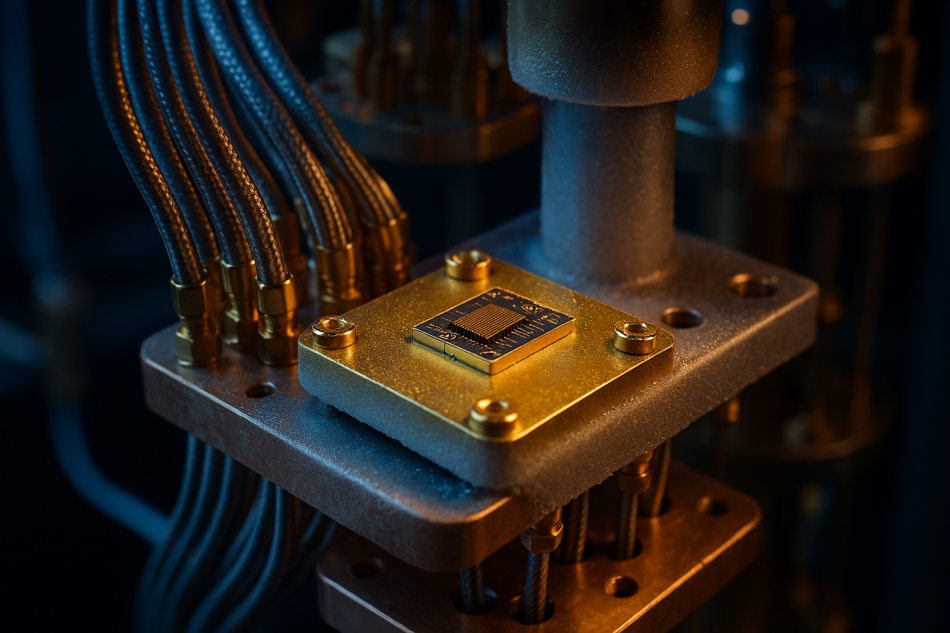

Every superconducting or spin qubit lives at the bottom of a dilution refrigerator, a few thousandths of a degree above absolute zero. But the electronics that tell those qubits what to do have traditionally sat at room temperature, racks of signal generators connected to the chip by long coaxial cables. Each qubit needs its own control line, sometimes several. Scale to a thousand qubits and you have a forest of wire snaking through the fridge, each strand carrying heat down and noise up. The whole arrangement does not grow gracefully.
Why the cables have to go
A cable is not free. It leaks heat from the warm world above into the cold stage below, and the fridge has only so much cooling power to spare. It also takes up physical space, and a cryostat's inner chamber is small. Perhaps worst of all, running analog microwave pulses over a meter of cable invites signal degradation and timing drift. The field has started calling this the wiring bottleneck, and it is one of the more stubborn obstacles between today's machines and the million-qubit systems that fault tolerance will demand.
The obvious fix is to move the control electronics closer to the qubits, ideally onto a chip sitting inside the fridge. Instead of one cable per qubit, a single cold controller could generate the microwave pulses locally and address many qubits at once. That is the bet behind Intel's Horse Ridge, a cryogenic control chip built in the company's standard CMOS process, the same kind of silicon manufacturing that makes ordinary processors.
What Horse Ridge actually does
Horse Ridge is a radio-frequency transceiver designed to operate at cryogenic temperatures, generating the shaped microwave tones that rotate qubits and tune their frequencies. The first version ran at around four kelvin, the temperature of a higher stage in the fridge rather than the ultracold bottom where the qubits live. A later revision pushed functionality further and added the ability to handle qubit control with tighter integration. The appeal is that one such chip can manage dozens of qubits through a handful of lines, collapsing a sprawling cable bundle into something far more compact.
Intel is not alone in chasing this. Google has published work on cryogenic control circuits, Microsoft has explored cold CMOS as part of its broader program, and academic groups in the Netherlands, Australia, and elsewhere have built custom cryo-electronics for spin qubits. The common thread is a conviction that a scalable quantum computer cannot carry its brain at room temperature forever.
The trouble with cold silicon
Running transistors near absolute zero sounds like it should be easy. It is not. Standard CMOS models that chip designers rely on were never calibrated for such extreme cold, where the physics of how electrons move through silicon shifts. Threshold voltages change, noise behaves differently, and components that work fine on a lab bench can misbehave at four kelvin. Designers have had to characterize their transistors all over again at cryogenic temperatures and build new models from scratch.
Heat is the other hard limit. Even an efficient control chip dissipates power as it switches, and the coldest stage of a dilution fridge can remove only a tiny trickle of heat, measured in microwatts to milliwatts. A control chip that burns too much power will warm the very qubits it is supposed to command. That is why Horse Ridge sits at the four-kelvin stage rather than beside the qubits themselves. Bridging that remaining gap, getting control silicon close enough to the qubits without cooking them, remains an open engineering problem.
A different kind of roadmap
What makes the cold controller interesting is that it reframes the scaling challenge. For years the headline number has been the qubit count. But a machine with a million qubits and a million warm cables is not a machine anyone can build. Integrating the control layer is as much a part of the path to fault tolerance as better coherence times or lower error rates.
None of this is solved. Cryogenic control chips today handle modest numbers of qubits in the lab, and the designs are still maturing. Yet the direction is clear. The quantum computers that eventually matter will likely carry much of their control circuitry inside the cold, sharing the chill with the qubits they steer. The cable forest has to thin out, and the cold controller is one of the sharpest tools for clearing it.







