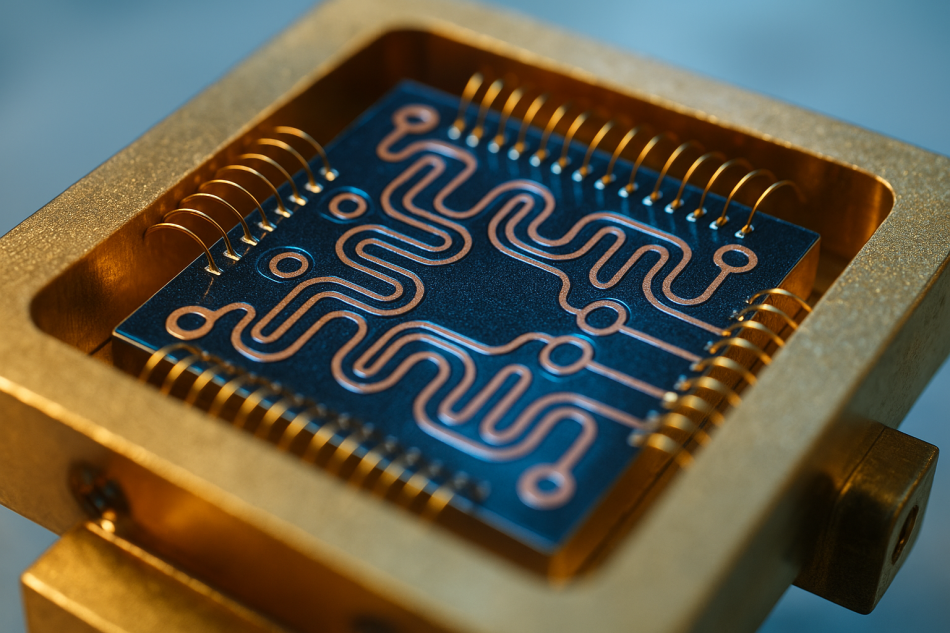

Put two superconducting qubits close enough to talk and you have the beginning of a quantum processor. The trouble is that they never stop talking. A fixed capacitor or wire between two transmons creates a permanent conversation. That is useful when you want them to entangle, but the rest of the time it is a liability. Qubits that are supposed to sit idle slowly pull on each other, smearing their frequencies, leaking small errors into every calculation. On a chip with dozens or hundreds of qubits, that constant background chatter becomes one of the hardest problems to control.
The dimmer switch idea
A tunable coupler solves this by inserting a controllable element between the two qubits instead of a fixed link. In most superconducting designs, that element is itself a small tunable circuit, usually built around a loop with a Josephson junction whose frequency can be shifted by a magnetic flux. By adjusting that flux with a current in a nearby wire, engineers change how strongly the two qubits feel each other.
The elegant part is that the coupling can be tuned all the way to zero. At one flux setting, the direct interaction between the qubits and the indirect path through the coupler cancel each other out. The qubits effectively stop talking. At another setting, the coupling switches on hard, and a two-qubit gate runs in tens of nanoseconds. One knob, two states: entangle now, or leave them alone.
Why fixed coupling held chips back
Early superconducting processors leaned on always-on coupling and clever pulse sequences to paper over the problem. Gates like cross-resonance were designed specifically to work with qubits that are permanently linked. They work, but they force compromises. Neighboring qubits have to be spaced carefully in frequency so their constant interaction does not cause collisions, where two qubits drift into the same note and corrupt each other. The more qubits you pack on, the harder that frequency puzzle becomes.
Tunable couplers loosen the puzzle. If the interaction is off by default, qubits can share frequencies without immediately interfering. That gives chip designers more freedom to lay out a large grid without hunting for a magic combination of frequencies that keeps everyone out of everyone else's lane. It also makes gates faster. When you can crank the coupling up to a strong value for the duration of a gate, you do not have to wait around for a weak, always-on interaction to slowly do its work.
Who bet on it
Google's processors, from Sycamore onward, are built around tunable couplers, and the company has credited them with the high gate fidelities behind its error-correction demonstrations. Rigetti moved to tunable couplers in its later chip generations to push two-qubit gate speed and reduce the idle crosstalk that plagued earlier designs. The approach has become close to standard for anyone building a large superconducting grid, precisely because the alternative does not scale gracefully.
The payoff shows up in the numbers that matter for error correction. A surface code only works if the physical error rate stays below a threshold, and idle crosstalk is one of the sneakiest contributors to that error budget. Being able to switch a qubit's neighbors off while it waits is not a cosmetic improvement. It directly lowers the noise floor that a fault-tolerant machine has to beat.
The cost of another knob
Nothing in quantum hardware is free. Every tunable coupler adds a control line, which means more wiring down into the dilution fridge, more digital-to-analog channels generating flux pulses, and more calibration. The coupler itself is a circuit that can drift, pick up noise, and introduce its own leakage pathways if a qubit's energy wanders into the coupler's frequency band. Teams have to characterize and tune each one, adding to the daily maintenance that large processors already demand.
There is also a design tension. A coupler strong enough to drive fast gates is also strong enough to leak more when it is supposed to be off, unless the cancellation is precise. Getting the geometry right, so that the off state is genuinely quiet and the on state is genuinely fast, is an engineering art that separates a good chip from a mediocre one.
Still, the direction is clear. As superconducting processors grow past the point where clever frequency planning can tame fixed coupling, the ability to silence a qubit's neighbors on demand has moved from a nice feature to a structural requirement. The tunable coupler is the quiet switch that lets a crowded chip stay calm until it is told to compute.







