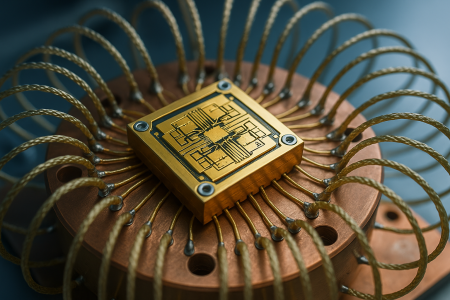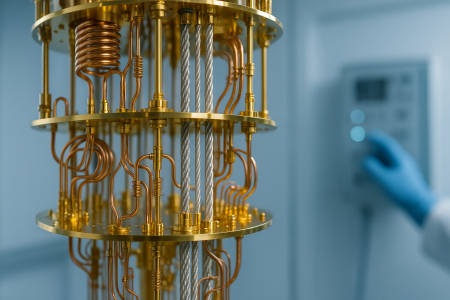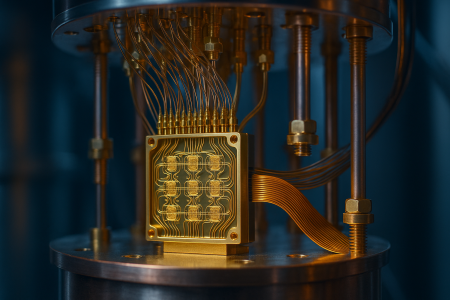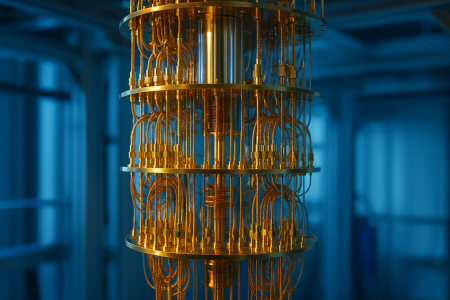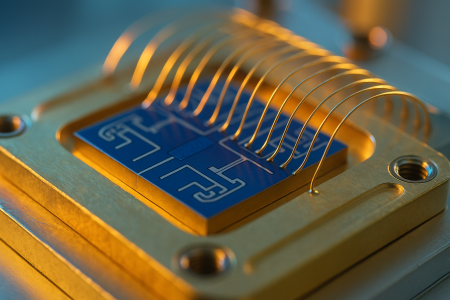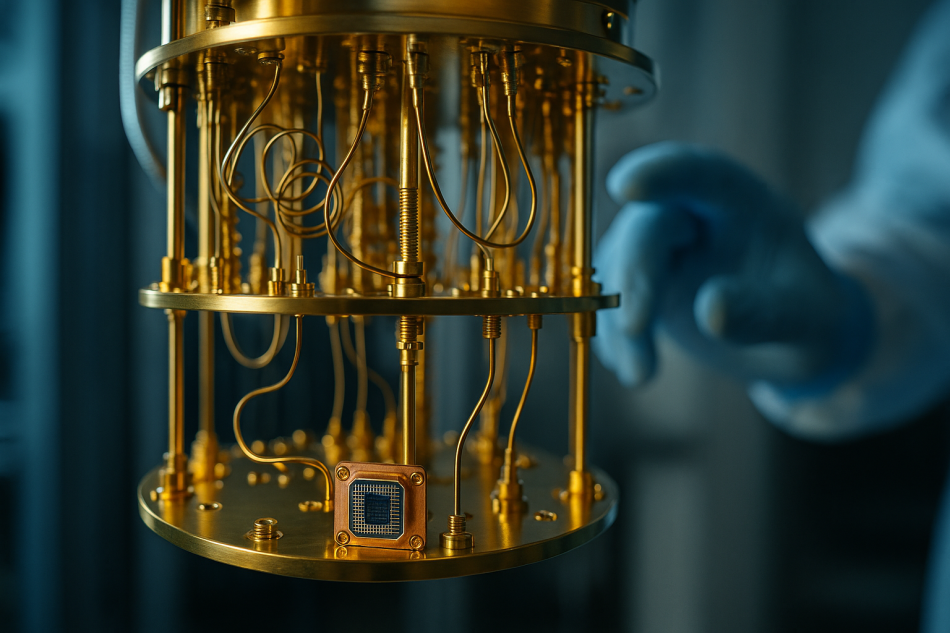

A superconducting quantum computer looks, from the outside, like a chandelier of gold-plated plates hanging inside a refrigerator the size of a fridge crossed with a jet engine. The qubits sit at the very bottom, a few thousandths of a degree above absolute zero. The machinery that actually tells them what to do, though, tends to live upstairs at room temperature. Racks of microwave generators and digital-to-analog converters shape the pulses, and coaxial cables carry those pulses down through the cold stages to the chip.
That arrangement works today, when a processor has a few hundred qubits. It starts to look impossible when you imagine a million. Every qubit needs its own control and readout lines, and every cable that runs from warm to cold also carries heat down into a place where a single stray watt is a catastrophe. The wiring problem is real, but there is a second problem lurking behind it: the electronics themselves. You cannot fit a warehouse of signal generators next to a machine and hope to address a million channels one cable at a time.
Bringing the controller down the cold
Cryo-CMOS is the bet that you can shrink the controller onto an ordinary silicon chip and put it inside the refrigerator, close to the qubits. CMOS is the same transistor technology that runs your laptop and your phone. The twist is designing it to operate at cryogenic temperatures, somewhere in the range of a few kelvin, rather than the balmy conditions chips are normally built for.
The appeal is straightforward. If the controller sits at 4 kelvin, a stage that has far more cooling power than the millikelvin base, you replace a thicket of long coaxial cables with a short hop and a handful of digital lines feeding a local chip. The controller generates the microwave tones itself, right where they are needed. You trade a wiring nightmare for an integration problem, and integration is something the semiconductor industry happens to be very good at.
Intel has been one of the loudest voices here. Its Horse Ridge chips were built specifically to control qubits from inside the cryogenic environment, generating the microwave pulses that manipulate spin and superconducting qubits without a separate box per channel. Google, IBM, and a number of university groups have pursued similar cryogenic control and readout circuits. The common thread is that the future of scaling may depend less on better qubits and more on better plumbing for the signals.
Why it is harder than it sounds
Cold silicon does not simply behave like warm silicon that got chilly. Transistor thresholds shift, models that engineers rely on stop being accurate, and materials expand and contract in ways that stress delicate connections. Designers have had to characterize their own devices at temperature almost from scratch.
Then there is heat, the constant enemy. A control chip that dissipates a few milliwatts is trivial at room temperature and a serious burden at 4 kelvin, where cooling budgets are measured in watts, not hundreds. Push that chip down to the millikelvin stage where the qubits actually live and the budget collapses to microwatts. Every clever circuit has to justify its power draw. That is why most cryo-CMOS efforts park the electronics at the 4-kelvin stage as a compromise, close enough to shorten the cabling but far enough to breathe.
Noise is the other tax. Qubits are exquisitely sensitive, and a nearby chip full of switching transistors is a potential source of interference and stray photons that can knock a qubit off course. The controller has to be quiet as well as cold and compact, which is a demanding combination.
A quieter kind of progress
Cryo-CMOS will not make headlines the way a new qubit count does. It is infrastructure, the sort of engineering that decides whether a roadmap survives contact with reality. The companies chasing large superconducting and spin-qubit machines have mostly concluded that they cannot cable their way to a million qubits, and that some of the control has to move into the cold.
The question that remains open is how much. A fully integrated controller sitting beside the qubits is the dream. A partial version, handling multiplexing and signal shaping at 4 kelvin while leaving the most sensitive work outside, is the more likely near-term answer. Either way, the fate of large-scale quantum hardware may be settled not at the qubit but a few centimeters away, on a slab of very cold silicon.