
Ask most engineers how a quantum computer will protect its fragile information, and they will point to the surface code, the checkerboard lattice that has become the default answer to quantum error correction. But it is not the only game in town. A close relative, the color code, trades some of the surface code's forgiving math for a talent the checkerboard lacks: the ability to perform certain logical operations almost for free. For hardware where qubits can reach many neighbors at once, that trade can look very tempting.
Tiles in three colors
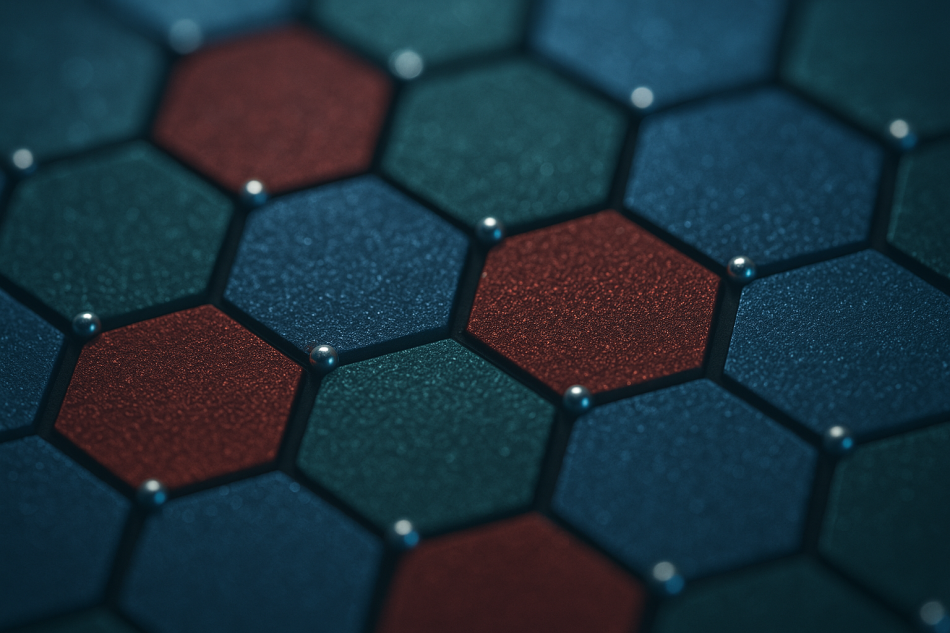
The color code was introduced in 2006 by Hector Bombin and Miguel Martin-Delgado. Picture a lattice where physical qubits sit on the corners of tiles, and every tile can be painted one of three colors so that no two touching tiles share a color. The lattice is trivalent, meaning exactly three edges meet at each corner. That coloring is not decoration. It is the bookkeeping that lets the code stitch its protection together.
On the surface code, each little square checks either for bit-flip errors or for phase-flip errors, and the two types live on separate sub-lattices. The color code is denser. Every colored tile hosts both an X-type and a Z-type stabilizer, the parity checks a quantum computer measures over and over to catch errors without reading the data itself. Packing both jobs onto the same tiles means the color code squeezes a logical qubit out of fewer physical ones than a surface code at the same protective distance.
The gate that comes for free
The real prize is what the color code does with logical gates. A fault-tolerant machine needs to apply operations to its protected qubits without spreading a single error into a cascade. The gentlest way to do this is a transversal gate, where you act on each physical qubit independently and errors have nowhere to jump. The surface code can perform some gates transversally, but it stumbles on the phase gate known as S, and has to fall back on slower, resource-hungry workarounds.
The two-dimensional color code can implement the entire Clifford group transversally, including the Hadamard, the S gate, and the entangling CNOT. That family of operations is the backbone of error-corrected circuits. Getting all of it cheaply, without expensive detours, is a genuine architectural advantage. The color code still needs a magic-state factory for the final non-Clifford gate that unlocks universal computing, but so does every other code. It simply hands you more of the easy gates up front.
Why it is harder to run
Nothing is free. Those combined tiles carry heavier stabilizers. On a hexagonal color-code lattice each check touches six qubits, compared with four on the surface code. More qubits per check means more chances for a measurement to go wrong, and it demands richer connectivity to gather all those qubits together. The practical consequence is a lower error threshold, the ceiling on how noisy your hardware can be before error correction stops helping. The surface code tolerates physical error rates around one percent. Color-code thresholds tend to land noticeably lower, which is a steep ask for today's devices.
Decoding is thornier too. Reading out a round of color-code checks and inferring where the errors actually happened is a harder classical puzzle than the neat matching problem the surface code offers. That matters because the decoder has to keep pace with the machine in real time. There is a mathematical curiosity underneath all this: a 2D color code is equivalent to two copies of a surface code folded together, which is one reason the two schemes trade strengths so cleanly.
Where it fits
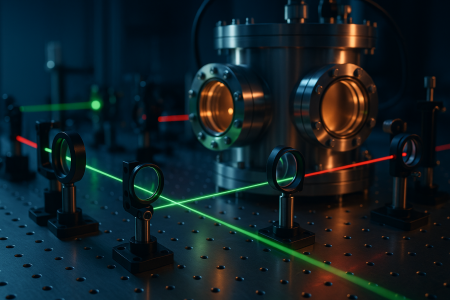
The color code shines on hardware that is not stuck with nearest-neighbor wiring. Trapped-ion systems, where qubits can be shuttled and coupled across a register, and neutral-atom arrays, where tweezers can rearrange atoms into whatever pattern the code needs, are natural homes. Groups working with those platforms have already run small color-code experiments, encoding logical qubits and demonstrating transversal operations that would be awkward on a rigid superconducting grid.
No single code has won the argument. Superconducting-chip builders still lean toward the surface code because its low-weight, local checks match a fixed two-dimensional layout. Teams chasing higher connectivity keep the color code close, betting that its cheaper gates will pay off once qubit quality clears the higher bar it demands. The choice of code is really a choice about which problem you would rather fight, and the color code is a reminder that the surface code's dominance was never the only path.