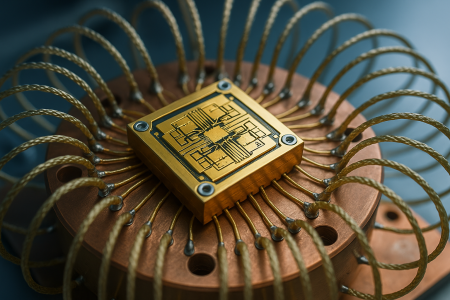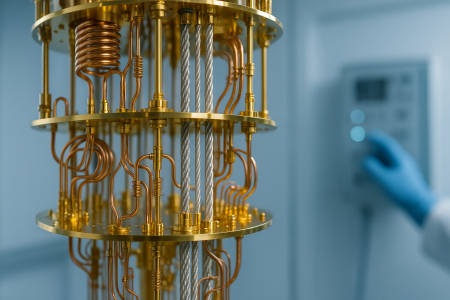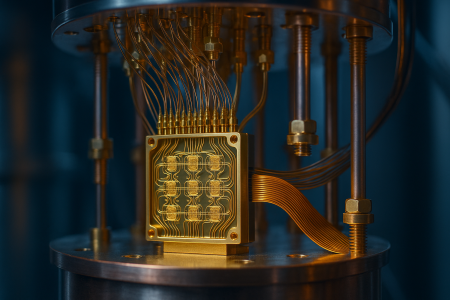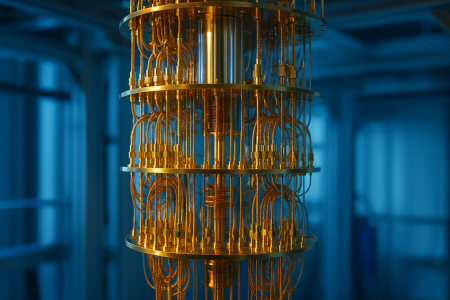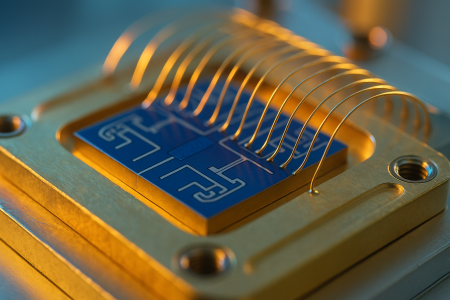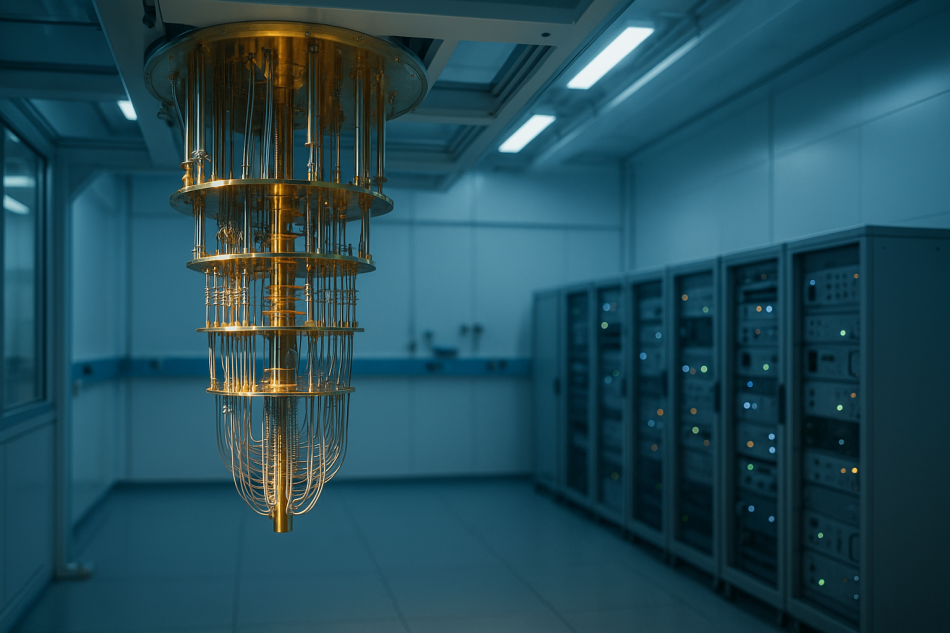

Walk into a room housing a superconducting quantum computer and your first assumption is probably wrong. The gleaming gold chandelier hanging inside the fridge looks like it must draw enormous power. It does not. The qubit chip at the bottom of that structure dissipates almost nothing, measured in nanowatts to microwatts. The whole machine, fridge and control racks included, runs on roughly the electricity of a handful of kitchen ovens.
Now picture the machine it hopes to outrun. A flagship exascale supercomputer like Frontier at Oak Ridge draws on the order of 20 megawatts, enough to power thousands of homes. That contrast, tens of kilowatts against tens of megawatts, is one of the quieter arguments for quantum computing. If a quantum processor can ever do useful work that a classical machine cannot, it might do so while sipping a rounding error's worth of energy.
Where the watts actually go
The counterintuitive part is that the qubits are not the power hogs. Almost all of a superconducting quantum computer's electricity bill comes from keeping things cold and talking to the chip.
The dilution refrigerator itself needs a pulse-tube cryocooler and a set of compressors to reach the millikelvin range. Those compressors run continuously, circulating helium and doing the heavy lifting of pulling heat out of the system. They account for the bulk of the draw. Then come the control electronics: the microwave sources, arbitrary waveform generators, and readout amplifiers that send and receive the pulses steering each qubit. Add it up and a single fridge-based system typically lands somewhere in the tens of kilowatts, roughly comparable to a large commercial air conditioner rather than a data center.
The qubits, ironically, are the most energy-frugal component in the building. A superconducting circuit carries current with no resistance, so the computation itself burns essentially nothing. The energy cost is entirely infrastructure, the price of manufacturing and maintaining a pocket of the universe colder than deep space.
The fine print nobody prints on the brochure
Before anyone declares quantum computing the green future of computation, the caveats deserve equal billing. Today's machines are not doing useful work at scale. Comparing a fridge that runs a research-grade circuit against a supercomputer chewing through climate simulations is comparing a prototype to a workhorse.
The bigger question is how the energy story scales. Useful, error-corrected quantum computing is expected to demand enormous numbers of physical qubits, possibly a thousand or more for every logical qubit a real algorithm needs. That means more chips, more fridges, and far more control wiring. Each coaxial line running into the cold stage carries a heat load, and each qubit needs its own generators and amplifiers upstairs at room temperature. The wiring and control electronics, not the qubits, are what threaten to inflate the power budget as machines grow.
There is also the classical shadow. A fault-tolerant quantum computer leans on a small army of classical processors to decode errors in real time, fast enough to keep up with the qubits. That decoding hardware draws its own power, and as qubit counts climb, so does the computational burden of watching them. The clean image of a nearly free quantum computation gets muddier once you count everything bolted to the side.
Why the comparison still matters
Even with the caveats, the energy angle is not marketing fluff. If a quantum computer can solve a specific problem, say simulating a stubborn molecule or a chunk of a materials calculation, in hours where a classical cluster would grind for weeks or fail entirely, then the total energy spent per useful answer could be dramatically lower. Energy is a resource cost like any other, and data centers are already straining power grids.
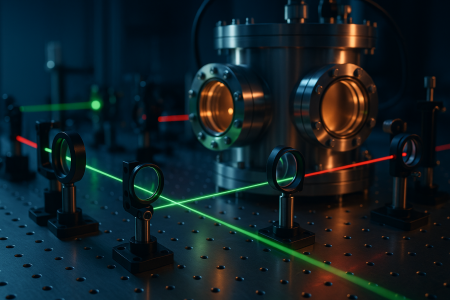
Other qubit platforms tilt the math further. Trapped-ion and neutral-atom machines run at or near room temperature for their vacuum chambers, trading the dilution fridge for lasers and optical tables that carry a different power profile. Photonic approaches make similar arguments about avoiding deep cryogenics altogether.
None of this makes quantum computers a solution to computing's energy appetite yet. But the watt gap is a genuine feature of the technology, one worth watching as machines move from lab curiosities toward the day they earn their keep.