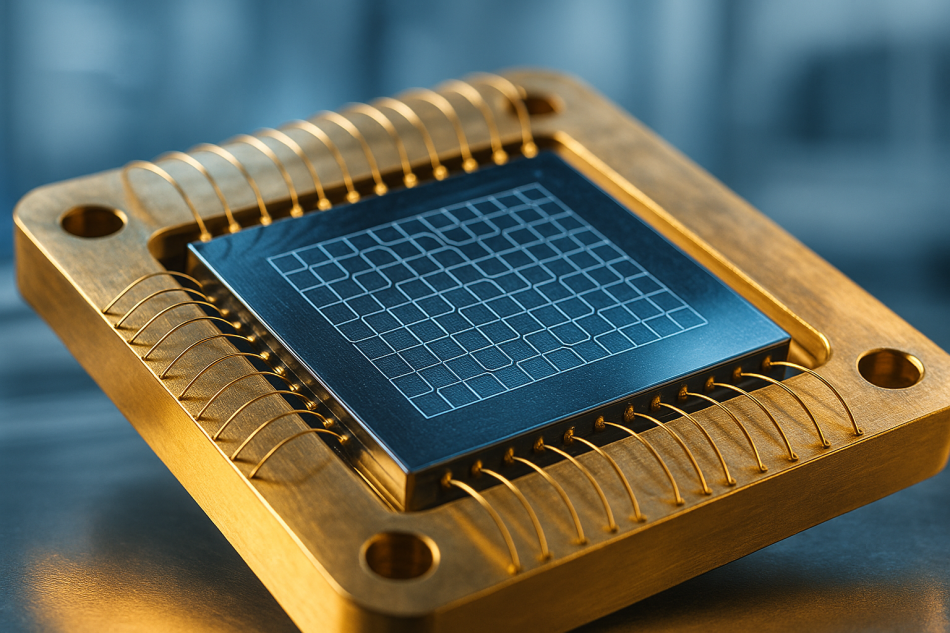

Every serious plan for a large quantum computer, from Google's superconducting chips to the neutral-atom machines being built by startups, leans on the same underlying idea: the surface code. It is the error-correcting scheme that most of the industry has quietly agreed is the safest bet, and understanding it explains why companies keep talking about needing a thousand physical qubits to get one good one.
Why a single qubit can't be trusted
A physical qubit is a jittery thing. It loses its state in microseconds, it drifts out of tune, and any attempt to look at it destroys the information it holds. Classical computers dodge this with brute repetition: store a bit three times, and if one copy flips, majority vote wins. That trick is illegal in quantum mechanics. You cannot copy an unknown qubit, and you cannot peek at it to check for errors without collapsing the very superposition you are trying to protect.
The surface code threads that needle. Instead of copying one qubit into three, it spreads the information of a single logical qubit across a whole two-dimensional grid of physical qubits, and it never measures the data directly.
The checkerboard layout
Picture a grid arranged like a checkerboard. Half the squares hold data qubits, the ones that actually carry the information. The other half hold measurement qubits, often called ancillas. Each ancilla sits among four neighboring data qubits and repeatedly asks them a careful question: not "what is your value?" but "do you agree with each other?"
These questions come in two flavors, checking for the two ways a qubit can go wrong. A bit-flip error turns a 0 into a 1. A phase-flip error scrambles the relationship between superposition states, a uniquely quantum failure with no classical cousin. The surface code interleaves two types of parity checks across the grid so that both kinds of error leave a trace. Crucially, the answers reveal only whether something changed between neighbors, never the underlying data, so no information leaks out and no superposition collapses.
Reading the smoke, not the fire
Run these checks over and over, and errors announce themselves as changes in the parity results. A software layer called a decoder takes the stream of check outcomes and works backward to figure out what most likely went wrong and where. It does not need to fix the physical qubit on the spot; often it just keeps a running tally of corrections to apply in bookkeeping. The logical qubit, the abstract one you care about, sails on undisturbed.
The elegance is that a single stray error produces a distinctive local signature, easy to identify. To actually corrupt the logical information, errors have to line up in a chain that stretches all the way across the grid, and that is exponentially unlikely if the physical error rate is low enough.
The distance dial
The surface code has a knob called the code distance. Make the grid bigger, and you can tolerate more simultaneous errors before the logical qubit fails. A distance-3 patch corrects one error; a distance-5 patch corrects two; and so on. The catch is cost. A distance-d surface code needs roughly 2d squared physical qubits. Push toward the low logical error rates that useful algorithms demand and you land at hundreds or even a thousand physical qubits per logical qubit. That ratio is the reason roadmaps from IBM, Google, and others sound so hungry for raw qubit counts.
Why it won the popularity contest
The surface code became the default for a practical reason: it only needs qubits to talk to their nearest neighbors on a flat grid. That matches how superconducting and atom-based chips are naturally laid out, without the long-range wiring that fancier codes demand. It also has one of the most forgiving error thresholds known, tolerating physical error rates around one percent, a bar that leading hardware has recently begun to clear.
Its weakness is that appetite for qubits, which is why researchers are chasing leaner alternatives like quantum low-density parity-check codes. But for now the checkerboard remains the workhorse. When a company demonstrates that adding more physical qubits makes its logical qubit better rather than worse, it is almost always the surface code doing the guarding underneath.