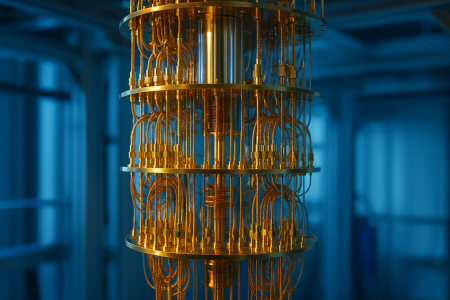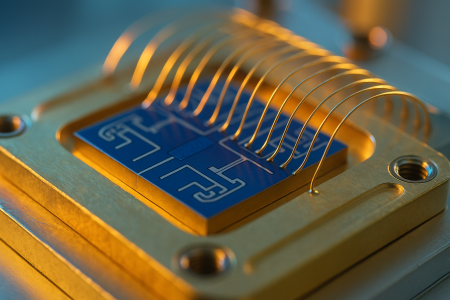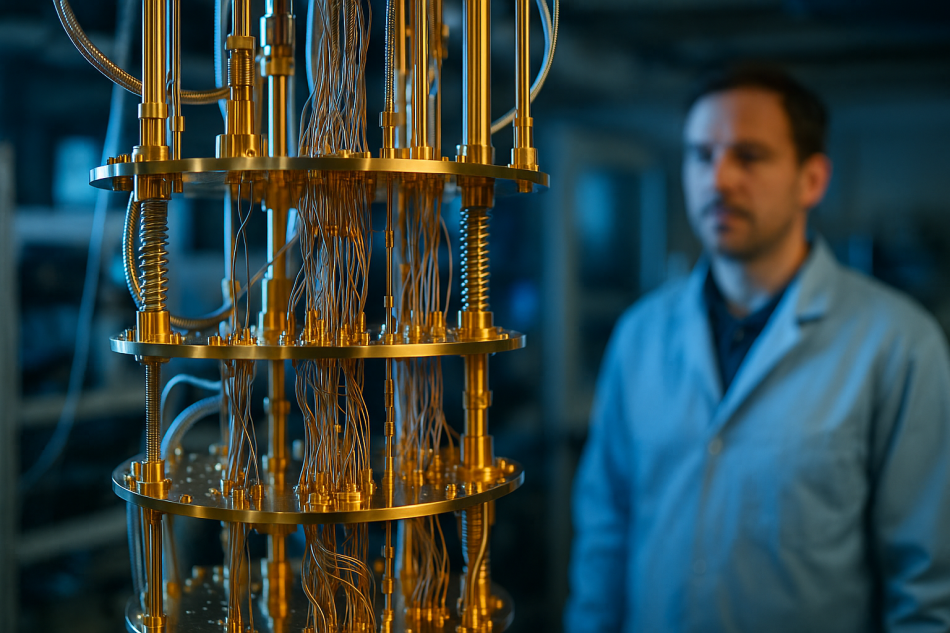

Ask what limits the growth of a superconducting quantum computer and you will hear about qubit counts, error rates, and wiring. Further down the list, rarely mentioned in press releases, sits a supply-chain problem measured in liters of gas. The machines that keep transmon qubits near absolute zero run on helium-3, an isotope so scarce that its price and availability are set less by physics than by the aftermath of the Cold War.
Why the fridge needs it
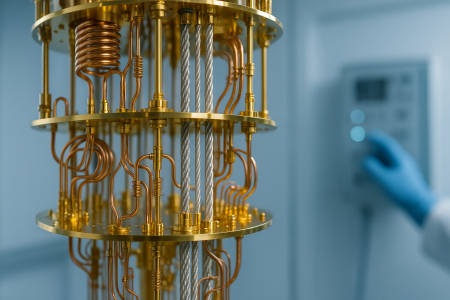
Superconducting and some spin-qubit processors only behave quantum mechanically at temperatures a few thousandths of a degree above absolute zero. The workhorse that gets them there is the dilution refrigerator, and its cooling power comes from a mixture of two helium isotopes: ordinary helium-4 and the lighter, rarer helium-3. Below about 0.87 kelvin the mixture separates into two phases, one rich in helium-3 and one dilute. Forcing helium-3 atoms across the boundary from the concentrated side into the dilute side absorbs heat, the way sweat cools skin by evaporation. Pump the circuit continuously and the cold plate can hold at ten millikelvin indefinitely.
The trick is elegant and, crucially, the only practical continuous method for reaching those temperatures at the scale a quantum computer demands. That makes helium-3 non-optional. A single large research fridge is charged with a substantial volume of the gas, and the isotope stays in the machine, circulating in a sealed loop. But every new fridge that comes online needs its own charge, and the world is not making much more helium-3.
Where it comes from
Natural helium is already rare, and helium-3 is a vanishing fraction of it, present at roughly one part in a million in the helium pulled from gas wells. Extracting it from that dilute background is not economical. Almost all the helium-3 used in laboratories comes from a stranger source: the radioactive decay of tritium, a hydrogen isotope produced in nuclear reactors and used in nuclear weapons. Tritium decays with a half-life of about twelve years into helium-3, which is then harvested from stockpiles.
That origin ties the supply to weapons programs that have shrunk since the Cold War. Meanwhile demand jumped for reasons unrelated to physics. Neutron detectors, prized for scanning cargo for smuggled nuclear material, use helium-3 heavily, and a surge in that market strained the supply. Prices that had been modest climbed sharply, and buyers faced allocation rather than open sale. For a physics lab ordering one fridge, that was an annoyance. For a company planning to install dozens or hundreds of dilution refrigerators, it becomes a strategic risk.
How the industry copes
The most important defense is that helium-3 in a working fridge is recycled, not consumed. The isotope circulates in a closed loop, and a well-maintained system loses almost none of it. Charging a new machine is the expensive moment; keeping it running is not. Fridge makers and their customers have grown careful about recovery, capturing gas during maintenance and reclaiming charges from decommissioned units rather than venting them.
Vendors have also worked to reduce the amount each fridge needs. Refinements in the design of the mixing chamber and the heat exchangers let newer systems reach base temperature with smaller helium-3 inventories than earlier generations required. Some operators stockpile the gas years ahead of installation, treating it as a capital reserve.
There is also interest in cooling technologies that sidestep the isotope entirely. Adiabatic demagnetization refrigerators, which use the alignment of magnetic salts to pull heat out, can reach millikelvin temperatures without any helium-3 at all. They are already common for single-shot cooling in space instruments and some detectors. The catch is continuous operation: dilution units run steadily for months, while magnetic coolers have historically needed to recycle. Continuous magnetic refrigeration is an active engineering target precisely because it could free large quantum installations from the helium-3 leash.
A bottleneck worth watching
None of this is a crisis today. The leading approaches to fault tolerance still assume superconducting qubits living inside dilution fridges, and the isotope is available to those who plan for it. But the roadmaps that promise thousands of logical qubits imply warehouses full of cold machines, and each one is a claim on a resource made mostly by waiting for weapons material to decay. The quantum industry spends enormous effort on the exotic physics of the chip. The unglamorous question of what keeps it cold, and whether there is enough of the gas to go around, deserves a place in the same conversation.