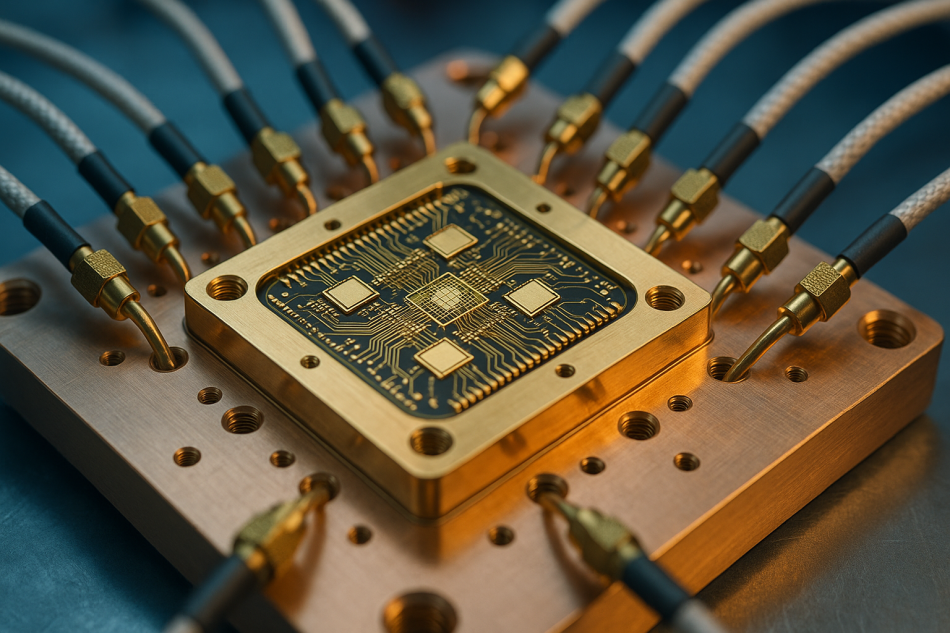

Every quantum computer needs a way to make two qubits talk to each other. Without a reliable two-qubit gate, you can flip individual qubits all day and never build the entanglement that gives a quantum computer its power. The catch is that the most obvious ways of coupling qubits usually mean making them tunable, and tunability comes at a price. Cross-resonance is the answer one camp of engineers landed on: entangle two qubits that never move on the frequency dial at all.
The problem with tunable qubits
Superconducting qubits have a natural frequency, set by the size of their capacitor and the properties of their Josephson junction. One popular way to make two of them interact is to build a knob into the hardware so you can slide one qubit's frequency until it briefly matches its neighbor's. When their frequencies line up, energy sloshes between them and entanglement forms. This works, and fast tunable gates are among the quickest in the business.
But every knob is also a leak. A qubit you can tune with a magnetic flux line is a qubit that is sensitive to noise in that flux line. Stray magnetic fluctuations wobble the frequency, and the qubit forgets its state faster. Fixed-frequency transmons, by contrast, sit at a sweet spot where they are far less sensitive to that kind of noise, which is why they tend to hold onto quantum information longer. The trade is obvious: you get better coherence, but you lose the easy handle for making qubits interact.
Driving one qubit at another's tune
The cross-resonance gate threads that needle. Take two fixed-frequency qubits that are permanently connected by a small coupling, usually a simple resonator or capacitor. Instead of moving either qubit, you hit the first qubit, the control, with a microwave drive tuned to the second qubit's frequency. It sounds like a mistake. Why drive one qubit at a tone it does not resonate with?
Because the two qubits share a coupling, that off-target drive leaks through. The control qubit acts as a relay, and the target qubit feels a weak driving force whose direction depends on the state of the control. If the control is in its ground state, the target rotates one way. If the control is excited, the target rotates the other way. That state-dependent rotation is exactly the conditional logic you need. Run it for the right amount of time and you get the equivalent of a controlled-NOT, the workhorse entangling gate of quantum computing.
The elegant part is what the hardware does not need. No flux line, no frequency excursion, no fast-moving knob to stabilize. The gate is delivered entirely through the same kind of microwave control electronics already used to flip single qubits. Fewer control lines per qubit means a simpler chip and fewer noise channels.
Taming the messy parts
Cross-resonance is not free of headaches. The raw interaction comes bundled with unwanted terms, including a direct rotation of the target that has nothing to do with the control's state. Engineers cancel these out with an active echo sequence and a compensating tone applied to the target, a technique often described as an echoed cross-resonance gate. Getting the timing and amplitudes right is a calibration chore, and the gate is slower than the fastest tunable schemes, typically running for a few hundred nanoseconds.
There is also a frequency-matching demand. For the gate to work cleanly, the control and target need their frequencies spaced within a workable window, not too close and not too far. That constraint feeds directly into how a chip is laid out, because you cannot just place any two qubits next to each other and expect them to cooperate.
Why it shaped a roadmap
This gate is the reason IBM leaned so heavily on fixed-frequency transmons and the sparse connectivity of its heavy-hexagonal lattice. Giving each qubit only two or three neighbors reduces the frequency-crowding and always-on coupling problems that cross-resonance is sensitive to. The choice cascades through everything: how the qubits are wired, how the compiler routes operations, how errors accumulate across a circuit.
Other companies made different bets. Groups that prize gate speed built tunable couplers and accepted the extra control complexity. Trapped-ion machines entangle through shared motion and lasers instead. Cross-resonance represents a distinct philosophy: keep the qubits still, keep them quiet, and coax them into talking with a microwave tone aimed slightly off target. It is a reminder that in quantum hardware, the way you make two qubits interact quietly dictates the shape of the entire machine.