
Building a reliable qubit is only half the battle. Once you have wrapped a fragile piece of quantum information inside a surface code, spreading it across a patch of hundreds of physical qubits, you face a new and awkward problem. How do two of these protected qubits do anything together? A quantum computer that cannot entangle its logical qubits is just an expensive memory. The answer that most fault-tolerant roadmaps rely on has a suitably surgical name: lattice surgery.
Why you cannot just wire them up
In an ordinary computer, combining two bits is trivial. You route wires into a logic gate and read the result. Logical qubits refuse to cooperate that way. Each one is a two-dimensional grid of physical qubits whose collective state encodes a single protected bit of quantum information. The whole point of the code is that no small group of physical qubits reveals what the logical qubit is doing. That secrecy is exactly what keeps errors from spreading, but it also means you cannot reach in and grab the logical state to feed it into a gate.
Worse, the naive approach of physically moving qubits until two patches overlap would smear the protected information across a shifting boundary, and any noise picked up along the way could corrupt both qubits at once. Fault tolerance demands that a single physical error never cascade into a logical failure. So the interaction has to happen through the same machinery of repeated stabilizer measurements that already keeps each qubit alive.
Merging and splitting
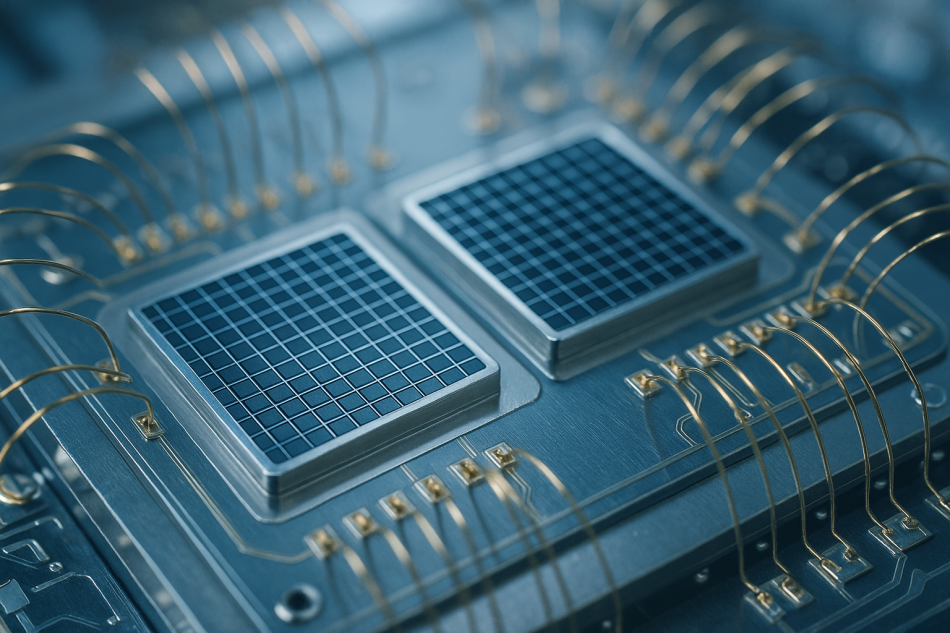
Lattice surgery treats a logical qubit as a tile that can be temporarily fused to its neighbor. Picture two surface-code patches sitting side by side with a thin gap between them. To perform a joint operation, the machine switches on a new row of stabilizer measurements along that boundary, stitching the two patches into one larger code for a few rounds. This merge measures a joint property of the two logical qubits, something like the product of their operators, without ever revealing either one individually.
After the merge, the boundary measurements are switched off in a controlled way, splitting the combined patch back into two separate qubits. The net effect of a merge followed by a split is a genuine two-qubit interaction, the kind of entangling operation you need to build any algorithm. Crucially, everything is done by measuring stabilizers, the same low-drama operation the hardware performs constantly anyway. There is no exotic new gate to calibrate on the logical level, only a choreographed sequence of turning boundaries on and off.
The cost of a boundary
Lattice surgery is elegant, but it is not free. Merging two patches takes several rounds of measurement, roughly proportional to the code distance, so a single logical two-qubit operation can consume many microseconds of the machine's time. The merged region also needs its own space on the chip. Architects who plan future processors treat the layout like a factory floor, reserving empty patches of qubits as scratch space where merges can happen and where results can be routed.
This is why lattice surgery shows up so often in the resource estimates behind big quantum roadmaps. When a company projects that breaking a cryptographic key will take millions of physical qubits, a large fraction of that budget is not the qubits holding data. It is the ancillary patches, routing channels, and merge regions that let logical qubits reach each other, plus the magic-state factories that supply the ingredients lattice surgery cannot produce on its own.
- Merges measure joint operators without exposing individual logical states.
- Splits return the patches to independent qubits, completing an entangling step.
- The whole dance runs on stabilizer measurements, so it inherits the code's fault tolerance.
- Time and chip area scale with code distance, which is why it dominates resource estimates.
Why it matters now
For years lattice surgery lived mostly in theory papers and architecture diagrams. That is starting to change as hardware groups demonstrate small logical qubits that actually suppress errors as they grow. Once you have two of those, the obvious next question is whether you can make them interact while keeping the protection intact. Early experiments merging and splitting small code patches are the first steps toward that goal.
The appeal is that lattice surgery scales the way a chip should. It uses only nearest-neighbor operations on a flat grid, which matches how superconducting and neutral-atom processors are physically built. No long-distance wiring, no qubits shuttling across the device. If fault-tolerant machines arrive on schedule, the moment two logical qubits first shake hands, they will most likely do it by stitching themselves together and pulling apart again.