
Build a superconducting quantum processor out of fixed-frequency transmons and you inherit a problem that has nothing to do with quantum mechanics and everything to do with real estate. Every qubit on the chip resonates at its own microwave frequency, somewhere in the neighborhood of five gigahertz. Those frequencies are not just labels. They are how the control electronics talk to each qubit, and they are how two neighbors get entangled. When two qubits end up too close in frequency, the machine misbehaves in ways no amount of clever software can hide. Engineers call this a frequency collision.
Why the notes have to be different
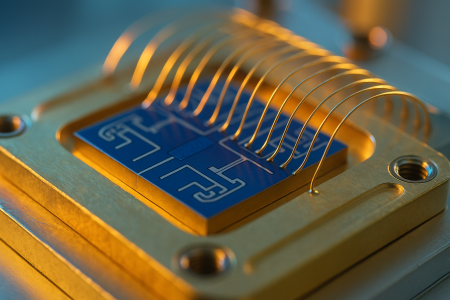
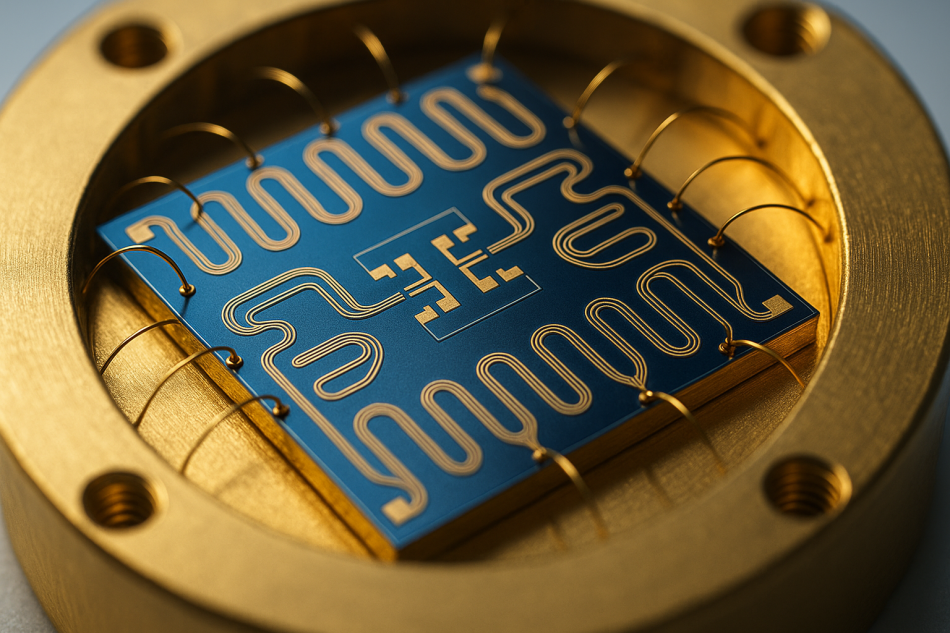
A transmon is tuned during fabrication. Its frequency is set by the size of its Josephson junction and the capacitor around it, both etched into metal on a silicon or sapphire wafer. Once the chip is cold and running, that frequency is fixed. To read a qubit, control hardware sends a pulse at its resonant frequency. To drive a two-qubit gate like cross-resonance, one qubit is prodded at the frequency of its neighbor, exploiting the small difference between the two.
All of that depends on the frequencies being distinct and spaced just right. If two coupled qubits share nearly the same frequency, they hybridize. Energy sloshes between them uninvited, gates leak population into the wrong states, and a pulse meant for one qubit tickles another. The result is a device that looks fine on paper but has dead spots, pairs of qubits that simply cannot run a clean gate together.
A packing puzzle with no easy answer
You might think the fix is obvious: just assign every qubit a different frequency, well separated from the rest. The trouble is that the usable band is narrow, and the constraints multiply as the lattice grows. Cross-resonance gates want a specific detuning between neighbors, not too large and not too small. Second-neighbor pairs, and even qubits that share a control line, impose their own rules. On a two-dimensional grid where each qubit touches several others, finding a frequency for everyone that satisfies every constraint becomes a genuine combinatorial headache.
Now add the cruelty of fabrication. Junction sizes come out of the manufacturing process with spread. A design that spaces frequencies perfectly on paper produces a real wafer where the actual values wander by tens or hundreds of megahertz. Some of that wander is enough to turn a carefully planned spacing into a collision. This is why frequency collisions and the broader yield problem are cousins: a chip can be a total loss not because a qubit is broken, but because two good qubits landed on the same note.
How chipmakers fight back
There are a few strategies, and most large superconducting programs use several at once.
- Tighter fabrication. Better lithography and process control narrow the spread of junction sizes, so chips land closer to their intended frequencies. Every megahertz of reduced variation raises the odds that a full chip comes out collision-free.
- Post-fab trimming. One influential approach uses laser annealing to nudge a junction's resistance after the wafer is made, shifting a qubit's frequency toward its target. Instead of praying the wafer comes out right, you measure each qubit and then tune the outliers into their slots.
- Tunable qubits. Add a flux loop and you can move a qubit's frequency electronically while it runs. This sidesteps collisions elegantly, but the loop opens a new door for noise to sneak in, so it is a trade rather than a free win.
- Smarter layouts. Choosing a coupling map and a frequency plan together, so the design tolerates realistic spread, reduces how often a small manufacturing error becomes a fatal collision.
Why it matters for scaling
Frequency crowding is a quiet ceiling on how big a fixed-frequency processor can get. Cram more qubits into the same band and the spacing between neighboring notes shrinks, which makes collisions more likely and gates slower or noisier. Every additional qubit tightens the packing puzzle. It is one reason different companies have made different architectural bets. Fixed-frequency designs lean on precise fabrication and post-fab tuning. Tunable designs accept extra control wiring and noise in exchange for room to maneuver.
None of this shows up in a headline qubit count. A press release can say a chip has hundreds of qubits without mentioning how many pairs can actually run a reliable gate. Frequency collisions are part of the gap between a lattice that exists and a lattice that works, and closing that gap is as much a manufacturing discipline as a physics one.