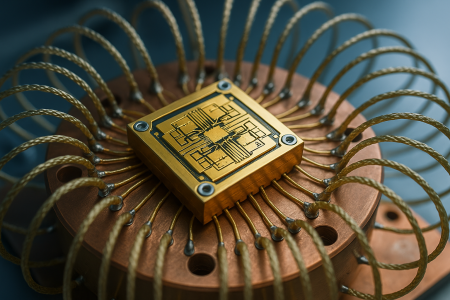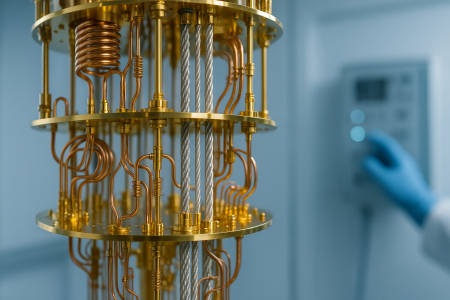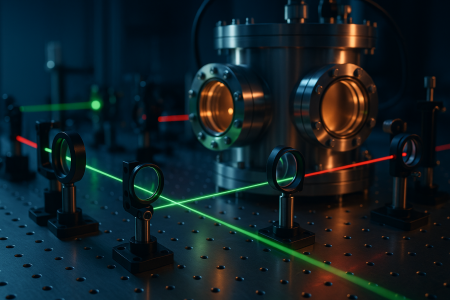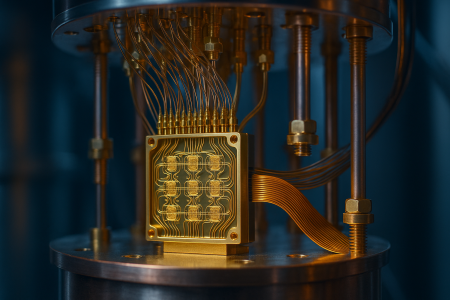

Every quantum program, no matter how elaborate, bottoms out in the same humble act: pushing one qubit from where it is to where you want it. On a superconducting chip, that push is a burst of microwave energy delivered through a control line. On a trapped-ion machine, it is a pulse of laser light. Either way, the qubit responds by doing something that has no everyday analogue. It does not jump. It rolls, smoothly and continuously, between its two states. Physicists call that rolling a Rabi oscillation, named for Isidor Rabi, who worked out the underlying math in the 1930s while studying how atoms react to oscillating fields.
Driving the qubit
Picture a qubit as an arrow that can point up (the 0 state) or down (the 1 state), or anywhere in between on an imaginary globe known as the Bloch sphere. Left alone, the arrow just sits there. To move it, you apply a drive tone whose frequency matches the qubit's own natural frequency, the energy gap between its two levels. When the tone is on resonance, the arrow begins to precess, sweeping down from the north pole through the equator and on toward the south pole, then back again. Keep the drive on and the arrow circles endlessly. That circling is the Rabi flop.
The speed of the flop depends on how hard you drive. A stronger microwave amplitude makes the arrow rotate faster; a gentler one slows it down. This gives the control engineer a simple dial. To perform a full flip from 0 to 1, you leave the drive on for exactly half a Rabi cycle, a duration known as a pi pulse. Cut that in half and you get a pi-over-two pulse, which parks the arrow on the equator in an equal superposition of 0 and 1. Almost every single-qubit gate in a quantum computer is built from pulses of these carefully chosen lengths and phases.
Calibrating the pulse
The catch is that the exact pulse duration and amplitude are not known in advance. They drift with temperature, with the electronics, and with the individual quirks of each qubit. So operators run a Rabi experiment: they sweep the drive duration or amplitude and measure the probability of finding the qubit in 1. The result traces out a clean sinusoid, oscillating between 0 and 1. The point where that curve first peaks tells you the pi pulse. From that single measurement, the whole family of rotations can be scaled. This calibration is repeated constantly, because a pulse that was perfect an hour ago may be slightly off now.
Timing matters enormously. If your pi pulse is even a few percent too long or too short, the arrow overshoots or undershoots, and that error compounds across the thousands of gates in a real circuit. Worse, driving too hard to make gates faster can excite a qubit out of its two intended states entirely, a problem called leakage. Engineers fight this with shaped pulses rather than blunt square ones. A widely used trick called DRAG adds a carefully tuned correction to the pulse envelope that cancels the tendency to leak, letting gates run fast without spilling the qubit into unwanted energy levels.
Why the flop sets the clock
Rabi oscillations also anchor how fast a machine can compute. A single-qubit gate takes a slice of one Rabi period, typically tens of nanoseconds on superconducting hardware and microseconds on trapped ions. That gate time, multiplied across a deep circuit, determines whether the computation finishes before the qubit forgets its state. Coherence times are finite, so every nanosecond spent flopping is a nanosecond stolen from the qubit's memory. The art lies in driving hard enough to beat the clock but softly enough to keep the rotation clean.
There is a quiet elegance to all this. The grandest claims about quantum computing rest on a phenomenon as basic as an arrow tipping over in response to a nudge. Get the nudge right, repeated billions of times a second across a chip full of qubits, and you have the raw motion from which entanglement, interference, and eventually useful computation are assembled. Get it wrong by a hair, and the whole delicate structure blurs into noise.