
Read a paper on a quantum algorithm for searching a database, recommending products, or running machine learning on a big dataset, and somewhere in the fine print you will find an innocent-looking phrase: "assume access to QRAM." Those three words are doing an enormous amount of work. QRAM, short for quantum random access memory, is a piece of hardware that can take an ordinary index and return the data stored at that address, but in quantum superposition over many addresses at once. It is the bridge between classical data and quantum computation. And for the most part, it does not exist.
What QRAM is supposed to do
Classical RAM is familiar. You hand it an address, it hands you back the byte stored there. QRAM is meant to do the same thing, except the address can be a superposition. Feed it a quantum state that is spread across addresses one, two, and three at the same time, and it should return a state entangled with the contents of all three locations at once. That single capability is what lets an algorithm reach into a large classical dataset without reading every entry one by one.
The trouble is that this is far more demanding than it sounds. To be useful, a QRAM addressing N items should respond in time that grows roughly like the logarithm of N, not linearly. If loading a billion-entry dataset takes a billion operations, the quantum speedup you were chasing evaporates before the real computation even begins. Many algorithms that look exponentially faster on paper are only faster if the data can be loaded cheaply. Take that assumption away and the advantage often shrinks or disappears.
The bucket-brigade design
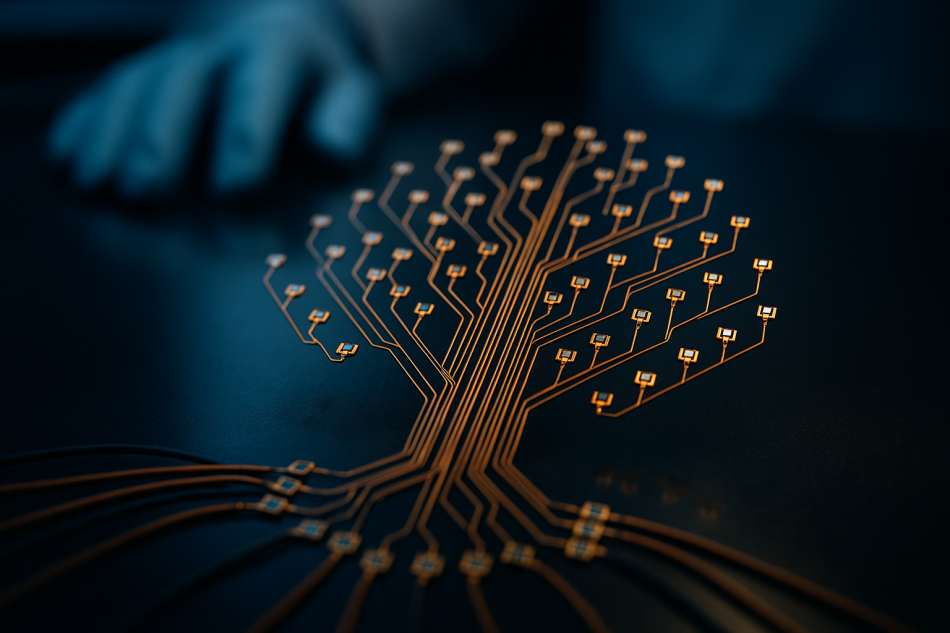
The most cited proposal is the bucket-brigade architecture. Picture a binary tree of switches. An address enters at the root, and each bit of the address flips a routing node that sends the query down the left or right branch. After enough levels, the query arrives at exactly one leaf, grabs the stored value, and the answer retraces its path back up. The clever part is that most of the switches stay idle for any given query, which limits how badly errors can spread.
On paper this needs a number of memory cells that scales with the dataset, but only a logarithmic number of them are active during a single lookup. That property matters enormously for error, because a component that never activates cannot corrupt the computation. The bucket brigade was designed specifically to keep the noise footprint small even when the memory is large.
Why it stays on the drawing board
The catch is that keeping millions of quantum components coherent, even if most are quiet, is brutally hard. Every switch is a physical device that can decohere, leak, or fail. To run a genuinely useful lookup you likely need those components to be error corrected, and error correction multiplies the physical hardware by a large factor. Suddenly the "memory" costs as much as a full processor.
There is a second, sharper problem. A superposition query is fragile. Any stray interaction that reveals which address is being accessed collapses the superposition and destroys the very parallelism QRAM was built to provide. The memory has to route quantum information through a huge structure without accidentally measuring it along the way. That is a tall order for hardware that struggles to keep a handful of qubits coherent through a modest circuit.
The workarounds
Because full QRAM is so distant, researchers have looked for ways around it. One approach is to prepare the needed data state directly with a quantum circuit rather than a dedicated memory, trading hardware for gate depth. Another is to focus on problems where the input is generated by a formula rather than stored as raw data, so no bulk loading is required at all. Some of the most defensible near-term use cases, like simulating molecules or materials, sidestep QRAM entirely because their input is a compact physical description, not a giant table.
This is why the QRAM question sits at the center of debates about quantum advantage for data-heavy tasks. The algorithms are elegant, but they lean on an input assumption that the hardware community has not delivered and may not deliver for a long time. When someone claims a quantum computer will revolutionize big-data analytics, the honest follow-up is simple: how does the data get in? Until QRAM or a convincing substitute arrives, that question does more to sort hype from substance than any qubit count.