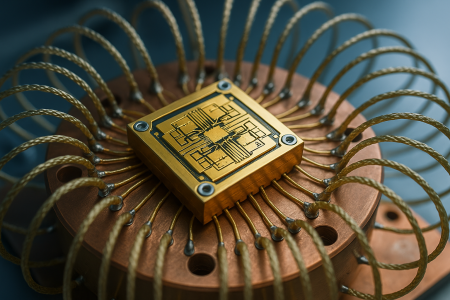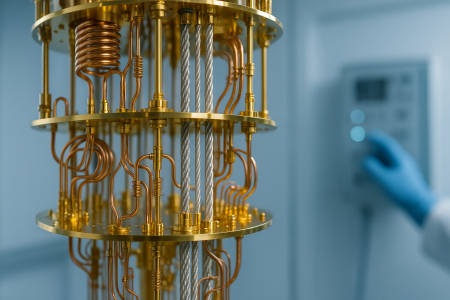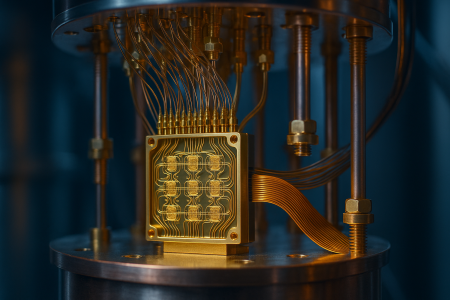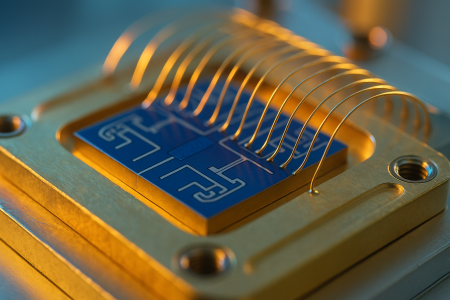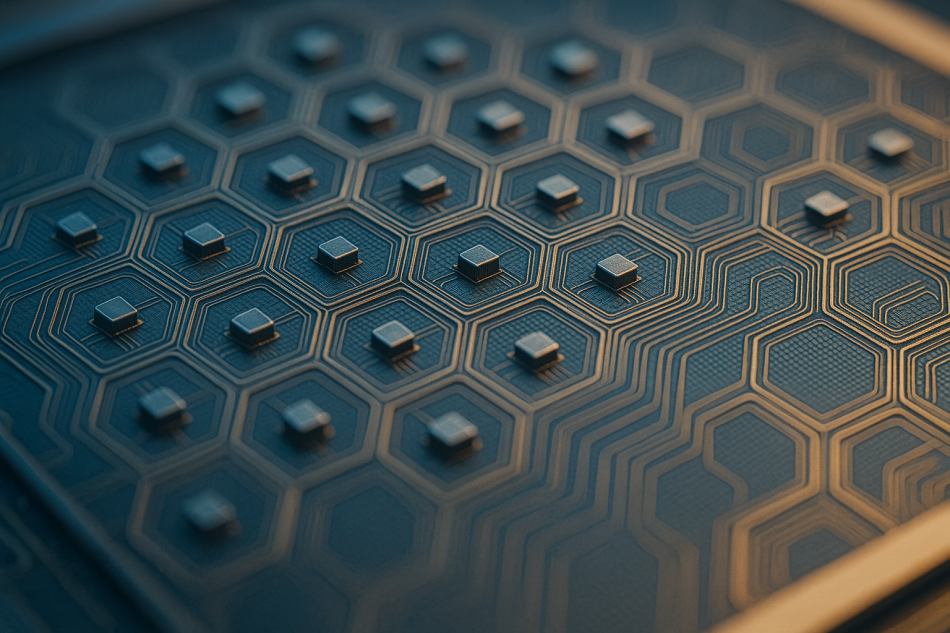

Look at a photograph of one of IBM's superconducting quantum chips and you might expect a dense mesh, every qubit shaking hands with as many neighbors as possible. Instead you find something that looks almost sparse: qubits sitting on the corners and edges of hexagons, most of them touching only two or three others. This is the heavy-hexagonal lattice, and it is one of the more counterintuitive design choices in quantum hardware. In a field obsessed with scaling up, IBM chose to wire its qubits down.
Why fewer connections can be better
Classical intuition says more links mean more power. A chip where every qubit can talk directly to every other would let you run circuits with fewer awkward detours. But superconducting qubits are noisy roommates. Every physical connection between two of them is also a channel for unwanted crosstalk, and every additional neighbor makes it harder to operate one qubit without disturbing the others.
The specific enemy here is frequency crowding. Fixed-frequency transmon qubits are tuned to particular microwave frequencies, and the gates that entangle them, like the cross-resonance interaction, depend on those frequencies sitting in a workable relationship. Pack too many neighbors around a single qubit and the odds rise that two of them land too close together on the frequency spectrum, spoiling gates or leaking energy where it should not go. The more edges a qubit has, the more frequency constraints its designers must satisfy at once, and the harder those constraints become to solve.
By capping most qubits at two or three connections, the heavy-hex layout dramatically relaxes that puzzle. There is simply more room to assign frequencies that do not collide. Manufacturing yield improves because fewer chips are ruined by a single unlucky pair. The result is a processor that is easier to calibrate and keep running, even if any individual qubit is more isolated.
What the layout actually looks like
The name describes the geometry. Take a honeycomb of hexagons, then add an extra qubit on each edge, so the hexagons are "heavy" with more nodes than a plain six-sided ring. Qubits fall into two roles. Some sit at vertices where three edges meet and act as junctions. Others sit along the edges themselves, connecting just two neighbors. The overall connectivity, measured as the average number of links per qubit, stays low, hovering around two and a half rather than the four you would get from a simple square grid.
That structure was not chosen only for crosstalk. It also fits neatly with the demands of error correction. IBM has used the layout to embed error-detecting codes where separate qubits handle computation and measurement, and the heavy-hex pattern gives those measurement qubits somewhere natural to live. The geometry is a compromise between what physics tolerates today and what fault tolerance will demand tomorrow.
The price of sparseness
Nothing comes free. When two qubits that need to interact are not physically adjacent, the compiler has to move quantum information across the chip using chains of swap operations. Each swap is itself a gate, and each gate adds noise. On a sparsely connected processor, a circuit that would be short on a fully connected machine can balloon into a much longer sequence, eating into the limited time before the qubits forget their state.
This is exactly the trade-off competing architectures highlight. Trapped-ion machines can shuffle ions so that any qubit can, in principle, interact with any other, giving them all-to-all connectivity that keeps circuits compact. IBM's bet is that the manufacturing and calibration advantages of a quiet, sparse superconducting chip outweigh the cost of extra swaps, and that smarter compilers plus growing qubit counts will keep the penalty manageable.
Where it fits in the roadmap
The heavy-hex lattice has been the backbone of IBM's superconducting processors through several generations, and its logic scales. As chips grow into the hundreds and thousands of qubits, the ability to assign clean, collision-free frequencies across the whole device matters more, not less. Newer designs layer tunable couplers on top of the basic idea, letting engineers switch interactions on and off and reclaim some of the flexibility that a static, sparse layout gives up.
The broader lesson is that a quantum processor is not just a pile of qubits. Its wiring diagram encodes a whole philosophy about which problems are worth fighting. IBM decided that fighting crosstalk and frequency collisions was harder than fighting long compiled circuits, and drew its honeycomb accordingly. Whether that judgment holds as machines scale is one of the quiet questions shaping the next decade of hardware.