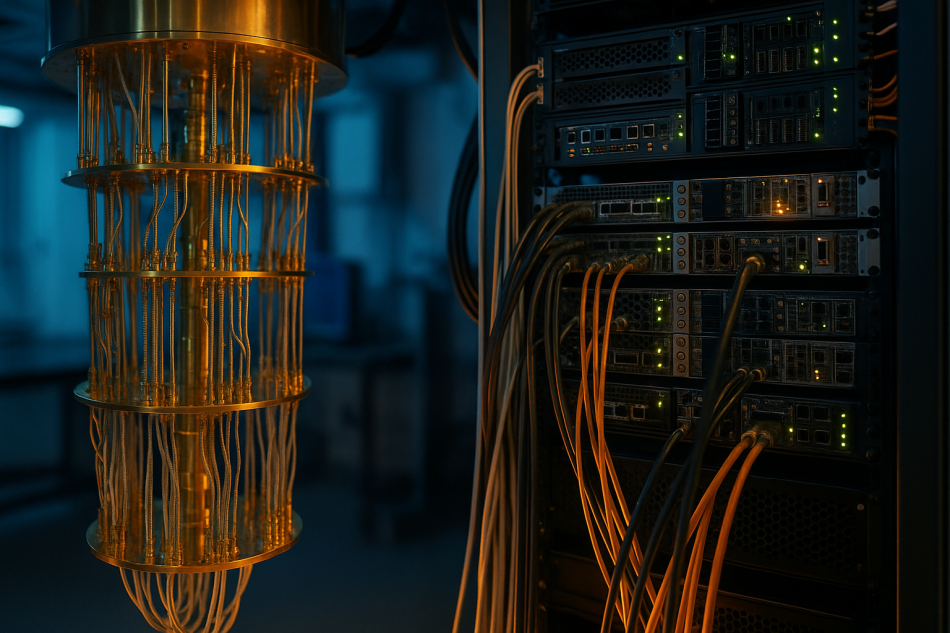

Everyone talks about the qubits. Almost nobody talks about the machine sitting next to them, sweating. Yet without a fast conventional computer running alongside the fridge, a fault-tolerant quantum computer would grind to a halt. That helper is the decoder, and keeping up with it is one of the least glamorous, most stubborn engineering problems in the field.
Where the clues come from
A logical qubit is built from many physical qubits woven into an error-correcting code such as the surface code. The trick of quantum error correction is that you never measure the data qubits directly, because that would collapse the information you are trying to protect. Instead, extra qubits called ancillas are measured over and over. Each measurement returns a bit, and a pattern of those bits, the syndrome, hints that something flipped somewhere nearby.
The syndrome does not tell you exactly what went wrong. It tells you the boundaries of the damage, like smoke without a clear view of the fire. Turning that indirect evidence into a concrete correction, an educated guess about which physical errors actually occurred, is the decoder's job. It is a pure classical computation, running on ordinary silicon, and it has to happen constantly.
The clock nobody can pause
Here is the catch that makes decoding hard. A surface-code machine measures its full lattice of ancillas roughly once every microsecond for superconducting qubits. Each round produces a fresh batch of syndrome bits. So the decoder receives a new frame of data a million times a second, per logical qubit, and it has to process each one before the backlog grows without bound.
That is not a race you win once. It is a treadmill. If the decoder falls a little behind on every round, the unprocessed frames stack up, and the delay grows without limit. Physicists call this the backlog problem. Even a decoder that is nearly fast enough is useless, because the lag compounds until the machine effectively stops making progress. The correction has to be ready before the qubit needs to act on it, particularly at moments when a logical operation depends on knowing the corrected state right now.
Accuracy versus speed
The obvious fix would be to use the smartest, most accurate decoding algorithm available. The most accurate approaches, based on carefully weighing every plausible combination of errors, are also slow. Minimum-weight perfect matching, a longtime workhorse, finds the most likely small set of errors that explains the syndrome, and it does a good job, but its running time can balloon as the code grows and error rates climb.
So the field has split into a hunt for decoders that are fast enough and accurate enough at the same time. Union-find decoders trade a sliver of accuracy for dramatic speed, merging clusters of syndrome evidence in a way that scales gently. Neural-network decoders learn the noise patterns of a specific device. And several groups are chasing decoders built directly into hardware, running on FPGAs or custom chips placed as close to the fridge as possible, because even the microseconds spent shuttling data over a cable start to matter.
Why closeness matters
Latency is not only about compute time. Every centimeter of wire, every buffer, every handoff between systems adds delay. As machines scale to many logical qubits, the syndrome data rate becomes enormous, hundreds of gigabits per second is plausible for a large processor. Moving that much information out of a cryogenic environment and into a distant server room is its own bottleneck. That is why decoder design is increasingly tangled up with the control stack, the wiring, and even where you physically put the classical electronics.
- The decoder must finish before the next round's data arrives, on average, or the backlog wins.
- It must be accurate enough that it does not introduce more logical errors than it prevents.
- It has to scale, because a useful machine needs thousands of logical qubits, each generating its own torrent of syndromes.
The quiet milestone
Recent demonstrations of error correction that actually beats its own overhead have leaned on real-time decoding, not just offline analysis done after the experiment. That distinction matters. Processing syndromes after the fact proves the code works in principle. Processing them live, fast enough to steer the next operation, is what a real fault-tolerant computer will demand every microsecond of every job.
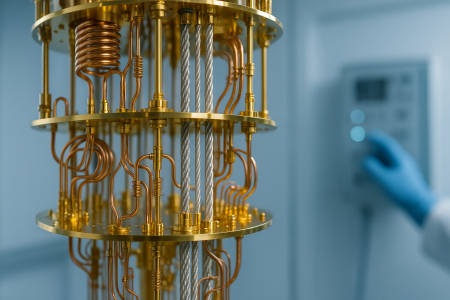
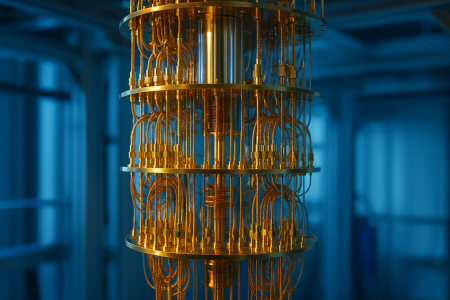
The romantic image of quantum computing is a chandelier of gold wiring chilled near absolute zero. The unromantic truth is that its success may hinge on a rack of very fast, very ordinary processors, quietly keeping pace with a river of error clues that never stops flowing.