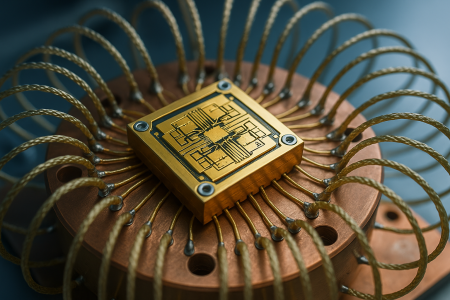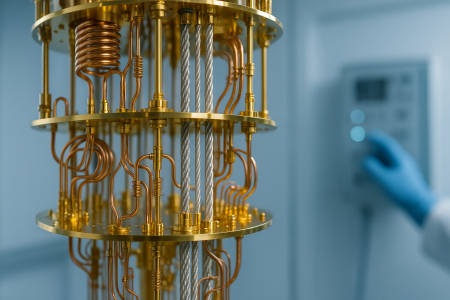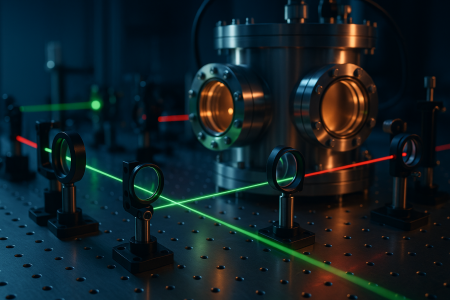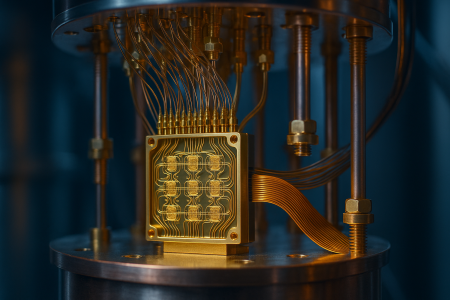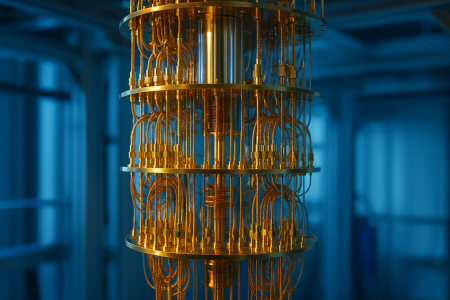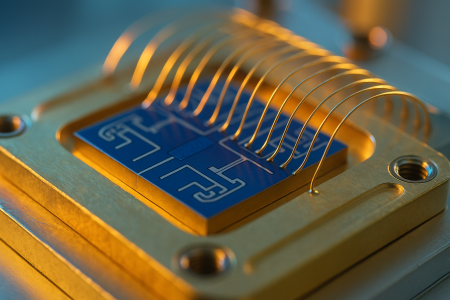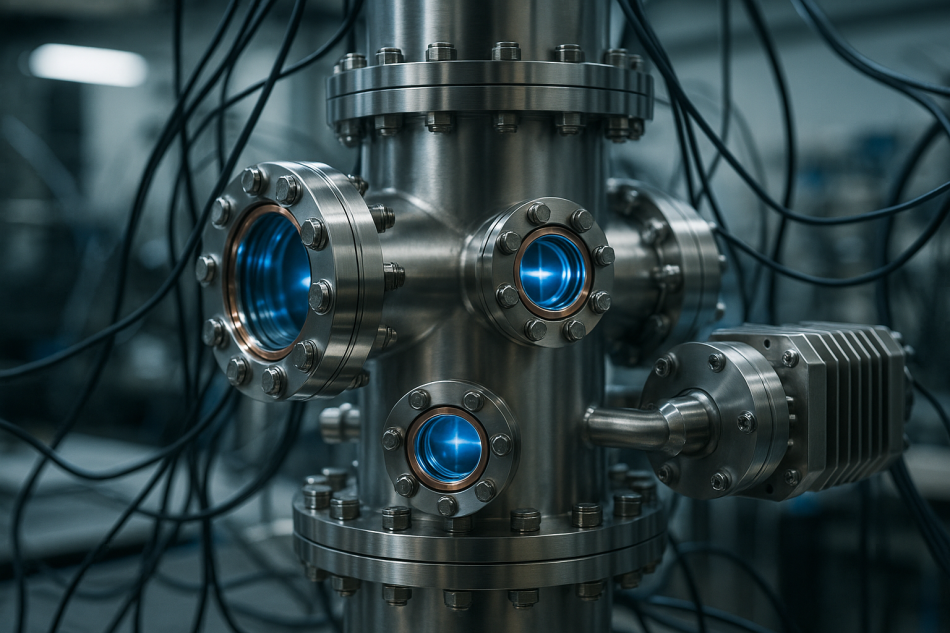

Ask most people what a quantum computer looks like and they picture a golden chandelier hanging inside a refrigerator. That image belongs to the superconducting camp. Machines built from trapped ions or neutral atoms tell a different story. Their qubits are not etched onto a chip. They are individual atoms, floating in a chamber so empty that the nearest stray gas molecule may be centimeters away. Keeping that space clean enough to compute is a job that gets far less attention than qubit counts, yet it decides whether a machine can run at all.
The enemy is a single molecule
A trapped ion is held in place by electric fields, suspended in what is essentially nothing. A neutral atom is pinned by a tightly focused laser beam, an optical tweezer. In both cases the qubit is a lone particle with no solid support. That isolation is exactly what makes it a good qubit, but it also makes it fragile in a specific way. If a leftover molecule of nitrogen or water vapor drifts by and collides with the atom, the atom can be knocked clean out of its trap. The computation ends. There is no error to correct because the qubit has simply vanished.
The fix is to remove as much of the residual gas as physically possible. Ordinary lab vacuum, the kind a rotary pump produces, still leaves billions of molecules per cubic centimeter. Trapped-ion and neutral-atom systems need what engineers call ultra-high vacuum, and often push toward extreme-high vacuum. Pressures land somewhere around a hundred-billionth of atmospheric, and the best cryogenic setups go lower still. At those levels the chamber holds fewer molecules than you would find in the thin gas of low Earth orbit, where the International Space Station circles. The inside of a quantum computer is, in a real sense, emptier than space.
How you empty a metal box that thoroughly
Getting there is slow and unglamorous. You cannot simply pump harder. The last stubborn molecules cling to the inner walls of the chamber, slowly outgassing for weeks. So builders bake the whole assembly, heating it to a couple hundred degrees Celsius for days at a time. The heat drives water and hydrogen out of the metal surfaces, where a pump can finally grab them. After the bakeout comes a slow cooldown, and any small leak or contaminated part means starting over.
The pumps themselves are exotic. Once a chamber is sealed, mechanical pumps step aside for ion pumps, which ionize stray gas and bury it in a metal electrode, and titanium sublimation pumps, which coat the walls with a fresh, chemically hungry film that traps molecules on contact. Getter materials do similar duty as passive sponges. Every window that lets a laser beam in and every electrical feedthrough is a potential leak, so materials are chosen for how little they outgas. Titanium and specific stainless steel alloys show up again and again for this reason.
Cryogenics adds another trick. Cool the chamber walls toward a few kelvin and the residual gas freezes onto them, a process called cryopumping. Companies running cryogenic ion traps use this to reach pressures so low that an ion can sit undisturbed for many minutes. Longer trap lifetimes mean deeper circuits and less time wasted reloading.
Why it shapes the whole machine
Vacuum quality quietly sets the rhythm of these computers. Neutral-atom arrays already reload their atoms between runs, grabbing fresh atoms from a cold cloud and sorting them into position. If background collisions strip atoms out mid-circuit, the machine loses qubits faster than it can replace them, capping how long a program can run. For trapped ions, a lost ion means reloading and recalibrating an entire register. Better vacuum directly translates into higher uptime, and uptime is what turns a physics demo into a usable machine.
This is where the atom-based approach diverges sharply from superconducting hardware. A dilution refrigerator also holds a vacuum, but its qubits are anchored to a chip; the vacuum is there mainly to help with cooling and thermal isolation, not to keep the qubit from floating away. For IonQ, Quantinuum, and the neutral-atom crowd like QuEra, Pasqal, Atom Computing, and Infleqtion, the vacuum is the trap's foundation.
None of this makes headlines the way a new qubit record does. But the empty space is not a detail. It is the room the qubits live in, and building emptier rooms is one of the steady, unshowy advances pushing atom-based quantum computers toward machines you can run all day.