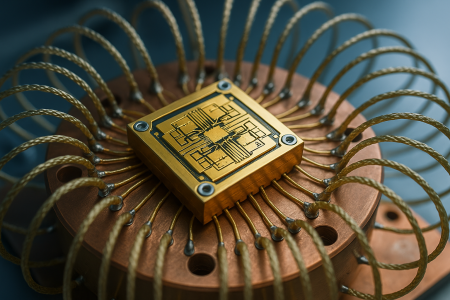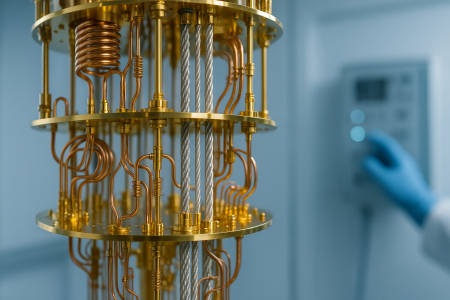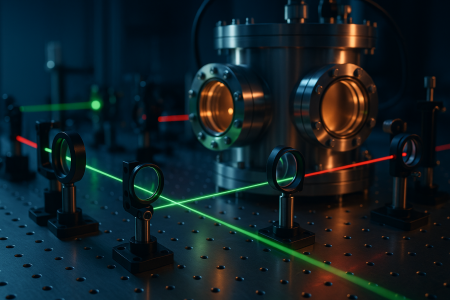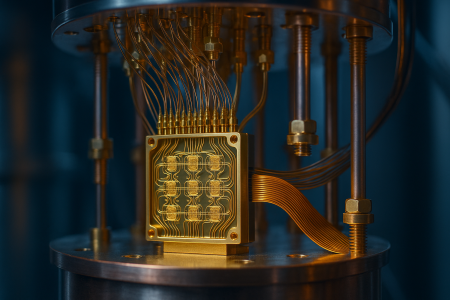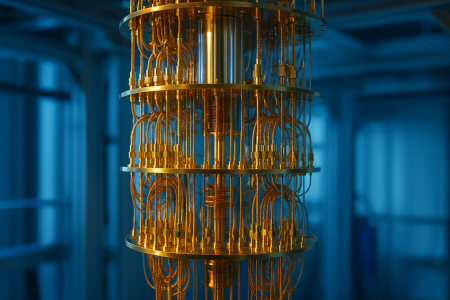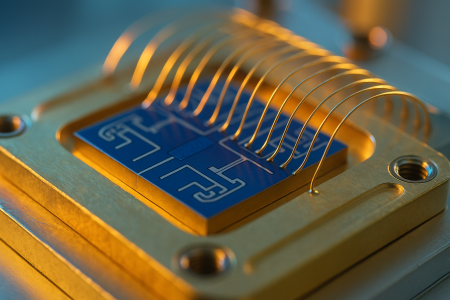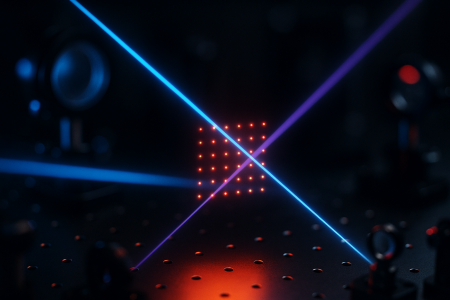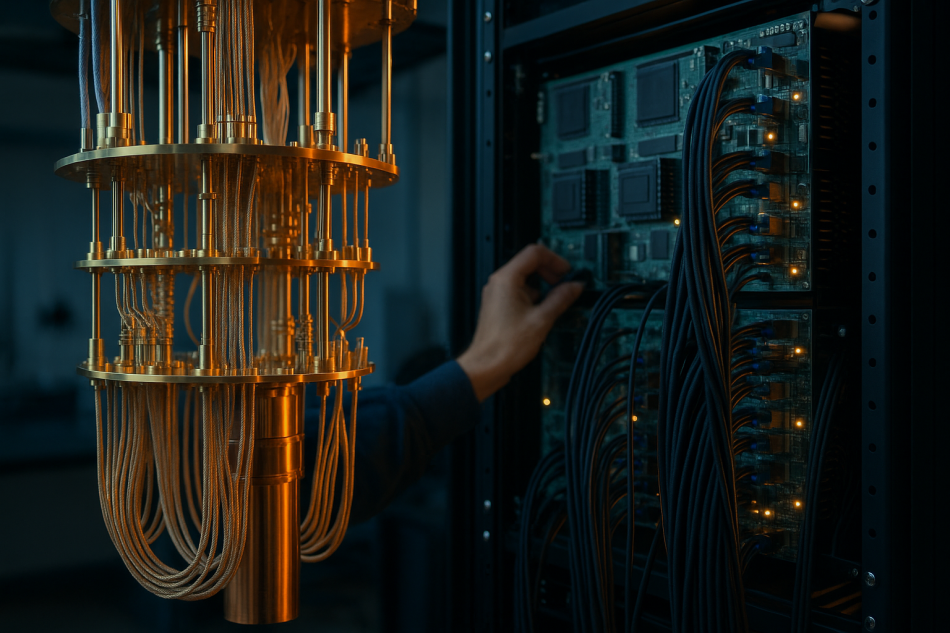

Ask most people to picture a quantum computer and they imagine a chandelier of gold wires or a chamber of trapped atoms. Almost nobody pictures the ordinary computer sitting next to it, sweating. Yet that unglamorous box, running conventional software on conventional silicon, is one of the hardest engineering problems standing between today's machines and useful error correction. It is called the decoder, and it works against a stopwatch.
What the decoder actually does
Quantum error correction never lets you look at the data qubits directly. Peeking would collapse their fragile superposition and destroy the very information you are trying to protect. Instead, the machine spreads one unit of logical information across many physical qubits and repeatedly measures a set of extra qubits sprinkled among them. Those extra measurements, called syndromes, do not reveal the answer. They reveal something subtler: whether an error has crept in, and roughly where.
A syndrome is a clue, not a confession. A single flipped measurement bit could be explained by any of several underlying errors. The decoder's job is to take a stream of these clues and infer the most likely pattern of errors that produced them, then tell the machine what correction to apply. In a surface code, this becomes a matching problem: pairs of syndrome flags get connected across a grid, and the decoder picks the connections that best explain the evidence. Algorithms like minimum-weight perfect matching and union-find were adapted precisely for this task.
Why the clock matters
Here is the catch that turns a solvable math problem into a nightmare. Superconducting qubits get measured roughly once every microsecond. Each measurement round produces a fresh batch of syndromes. If the decoder cannot keep up with that firehose, unprocessed data piles up faster than it can be cleared. Computer scientists call this the backlog problem, and its consequences are brutal: the delay grows without bound, and a long computation grinds to a halt while the classical side plays catch-up.
So the decoder does not just need to be accurate. It needs to digest each round of syndromes at least as fast as the quantum hardware generates them, forever. For a large machine running a long algorithm, that means processing millions of syndrome measurements per second, per logical qubit, with an answer that arrives in time to matter. Some correction schemes also require the decoded result before the next logical operation can proceed, which tightens the deadline from a steady stream to a hard real-time cutoff.
The accuracy-speed tug of war
The obvious fix would be to run a slow, thorough decoder that squeezes every drop of accuracy out of the syndromes. A better decoder tolerates a higher physical error rate, which means fewer physical qubits are needed per logical qubit. That is a big prize, because qubits are expensive. But the most accurate decoders tend to be the slowest, and a decoder that falls behind is useless no matter how clever it is. Every design lives somewhere on that tug of war.
Teams have attacked the problem from several directions. Some run stripped-down matching algorithms that trade a little accuracy for raw speed. Others break the grid into patches, decode each patch in parallel, then stitch the pieces together, a strategy that lets the workload spread across many processing cores. And rather than lean on general-purpose CPUs, several groups have moved decoding onto field-programmable gate arrays and custom chips placed physically close to the quantum processor, shaving off the microseconds lost to shuttling data back and forth.
A bottleneck that scales with the machine
The uncomfortable truth is that the decoding load grows with the machine. Double the number of logical qubits and you roughly double the syndrome traffic. Push the code to a larger size to suppress errors further and each decoding problem gets bigger too. A future machine with thousands of logical qubits will demand a small data center of classical hardware humming alongside the fridge, all of it stitched into a control system with latency budgets measured in microseconds.
This is why recent error-correction demonstrations are judged not only by how low the logical error rate falls, but by whether the decoding happened in real time or was reconstructed afterward from saved data. Offline decoding proves the physics works. Real-time decoding proves the system could actually run an algorithm. Closing that gap is now a headline goal on several roadmaps.
None of this makes for flashy demos. There is no photogenic chandelier here, just racks of classical logic racing an invisible clock. But a quantum computer that cannot read its own errors fast enough is a very expensive way to generate noise. The decoder is where the quantum and classical worlds meet, and it may decide how quickly the whole enterprise gets off the ground.