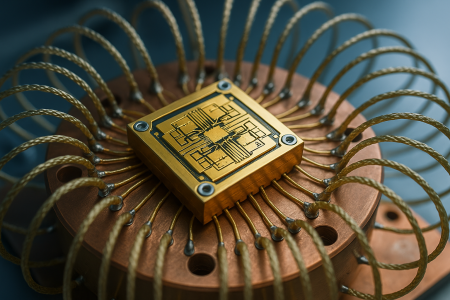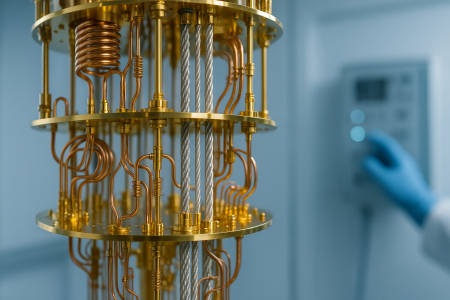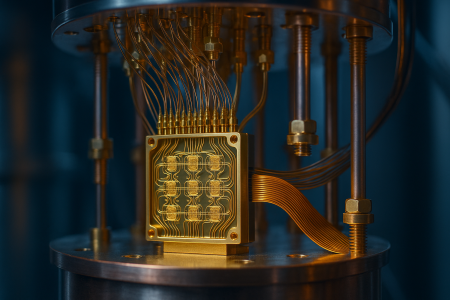

Walk into a chip fab and you expect uniformity. Modern semiconductor plants print billions of transistors that behave the same across a wafer and across the years. Quantum processors are built in similar cleanrooms with similar tools, yet they refuse to cooperate. Fabricate a hundred superconducting qubits with identical designs and you will get a hundred slightly different devices. Closing that gap, the industry's version of a yield problem, is one of the least glamorous and most important battles in the race to scale.
Why sameness matters
A superconducting qubit is defined largely by its frequency, the rate at which its quantum state oscillates. That frequency is set by a handful of physical quantities, most importantly the properties of the Josephson junction at the qubit's heart. Control electronics are tuned to hit each qubit at its expected frequency with microwave pulses. If a qubit lands far from its target, its neighbors' frequencies may collide with it, gates start to interfere, and the careful choreography that keeps a processor coherent falls apart.
On a chip with a dozen qubits, an engineer can work around a few stragglers by hand. Designs like fixed-frequency lattices deliberately assign each qubit a slot on the frequency dial so that neighbors stay out of each other's way. But that scheme only works if the qubits actually land in their assigned slots. Scale to hundreds or thousands of qubits and the tolerances tighten dramatically. A frequency spread that was a nuisance at small scale becomes a wall.
A nanometer of trouble
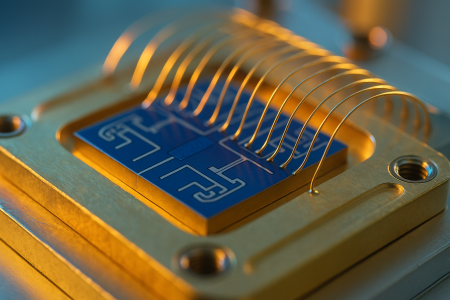
The Josephson junction is where the trouble concentrates. It is a sandwich of two superconductors separated by an insulating barrier only a nanometer or two thick, formed by letting a thin metal film oxidize under controlled conditions. The junction's electrical resistance, which sets the qubit frequency, depends exponentially on that barrier thickness. A tiny variation in oxidation time, oxygen pressure, or the exact area of the junction translates into a meaningful frequency shift.
Because the dependence is exponential, the fab has almost no margin. Getting the average right across a wafer is achievable. Getting every single junction to match its neighbor, wafer after wafer, is a materials-science grind. Junctions also drift after fabrication as the oxide ages, so a chip measured fresh may not match the same chip weeks later. This aging is one reason qubits need constant recalibration once they are cold.
Trimming after the fact
Rather than demand perfect fabrication, several groups have turned to post-fabrication tuning. The most widely used trick is laser annealing. After the junctions are made and their room-temperature resistance is measured, a focused laser gently heats individual junctions, nudging their resistance toward the target value. It is a slow, junction-by-junction correction, but it can pull a scattered distribution into a tight band before the chip ever goes into the refrigerator. Because room-temperature resistance correlates with the cold qubit frequency, engineers can predict where a qubit will land without cooling it first, saving enormous time.
Other approaches try to sidestep the problem in the design. Tunable qubits add a small loop that lets an external magnetic field shift the frequency on demand, so a qubit that landed in the wrong place can be steered into position. The cost is added complexity, extra control wiring, and a new channel through which noise can reach the qubit. Fixed-frequency designs avoid that noise but pay for it in the fabrication tolerances they demand. The choice between them is a running argument in the field, and yield sits at the center of it.
The scaling stakes
Yield is not only about frequency. Every qubit that comes out too lossy, every junction that shorts, every stray defect on the surface drags down the fraction of usable devices on a chip. When roadmaps talk about processors with thousands or eventually a million qubits, they are implicitly promising that fabrication can deliver those qubits at high enough quality and uniformity to be worth wiring up. A 90 percent yield sounds excellent until you multiply it across a large array and realize how many dead spots you inherit.
None of this makes headlines the way a new qubit count does. But the difference between a lab demonstration and a manufacturable technology usually comes down to reproducibility. The companies that learn to print identical qubits by the thousand, the way the semiconductor industry learned to print identical transistors, will be the ones whose roadmaps survive contact with a wafer.