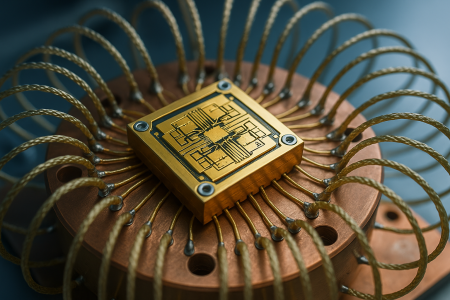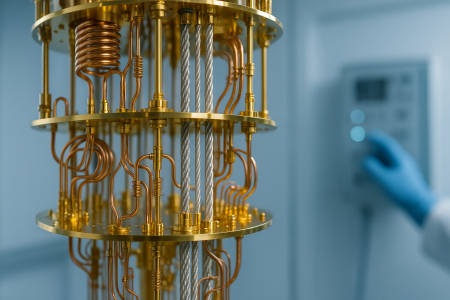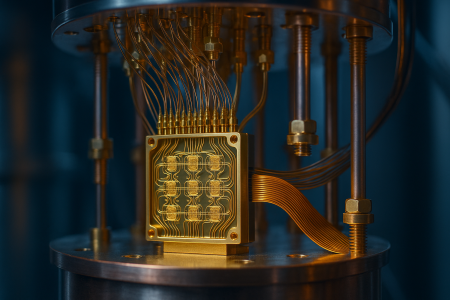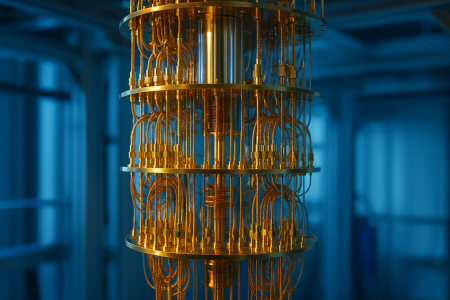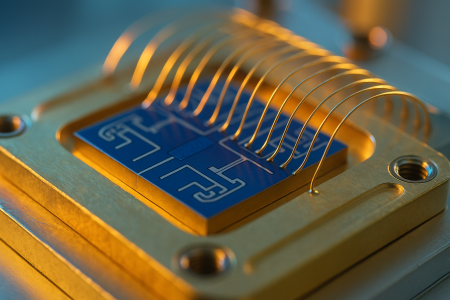

Most quantum computers demand a machine the size of a small car to survive: a dilution refrigerator that chills superconducting chips to a hair above absolute zero, wrapped in shielding, plumbed with helium, and hungry for cables. There is a rival approach that skips almost all of it. Its qubit lives inside a diamond, holds its quantum state at room temperature, and can be read out with an ordinary green laser.
A flaw with a purpose
The trick relies on a defect. In a perfect diamond, carbon atoms sit in a tidy lattice. Occasionally a nitrogen atom sneaks in and sits next to an empty spot where a carbon should be. That pairing, a nitrogen atom beside a vacancy, is called an NV center. It behaves like a single trapped atom frozen in place by the surrounding crystal.
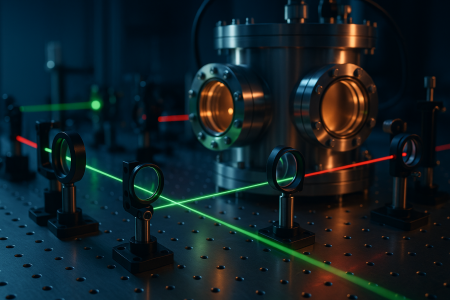
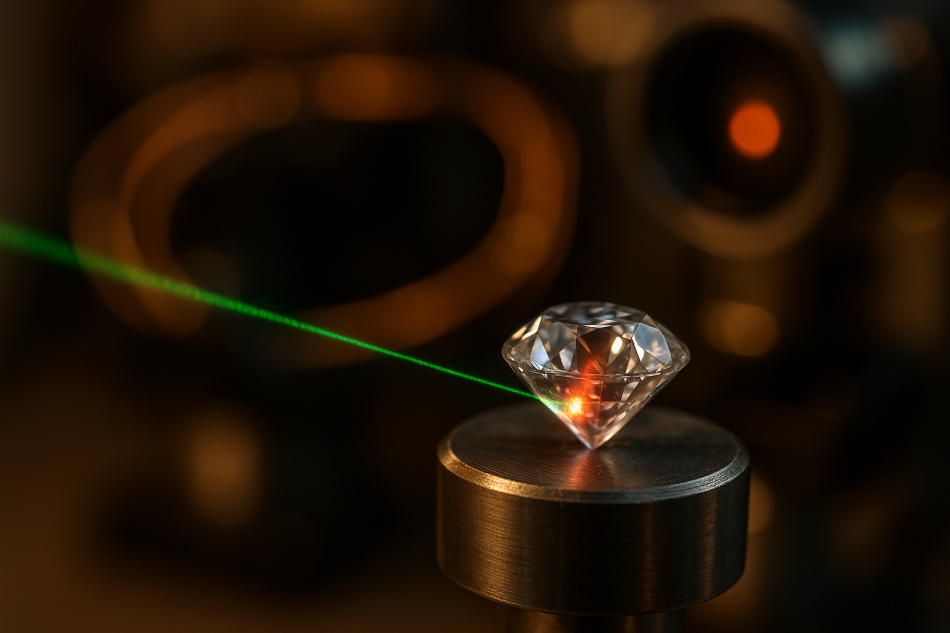
The useful part is the electron spin at that defect. It can point up, down, or exist in a superposition of both, which is exactly what a qubit needs. Shine green light on the diamond and the defect glows red, and crucially it glows a little brighter or dimmer depending on which state the spin is in. That means you can read the qubit optically, no microwave amplifier chain or cryogenic wiring required. Microwave pulses flip the spin, and the whole thing works while sitting on a lab bench.
Why room temperature matters
The diamond lattice is stiff and its carbon atoms are light, so the vibrations that normally scramble a quantum state are weak even at ordinary temperatures. An NV center's spin can hold coherence for surprisingly long stretches without any refrigeration. Nearby carbon-13 nuclei, another kind of spin, can hold information even longer, acting as a small quantum memory attached to each defect.
The payoff is a completely different form factor. A diamond quantum processor does not need a fridge, so in principle it could be shrunk toward the size of a graphics card and slotted into a normal server rack. That is the pitch from companies like Quantum Brilliance, which frames diamond as the qubit for edge computing and for sitting alongside classical hardware in a data center rather than in a specialized cryogenic hall.
The hard part: making qubits talk
Room temperature buys convenience, but it does not solve the deepest problem in quantum computing, which is getting many qubits to interact reliably. Two NV centers only feel each other if they are extremely close, within a few nanometers, and you cannot place defects that precisely on demand. Nitrogen gets implanted into the diamond and lands more or less at random. Getting two working defects near enough to entangle, with the right orientation, is a game of low odds.
Researchers are chasing several ways around this. One is to link distant defects through photons, using the light each one emits to broker entanglement between chips or across a diamond. That is elegant but slow, and success rates are low. Another is to lean on the nuclear spins clustered around a single defect, building a small register from one NV center rather than trying to wire many together. Each route works in the lab at a scale of a handful of qubits. None has yet been pushed to the thousands of interconnected, high-fidelity qubits that a useful machine would need.
Where diamond fits
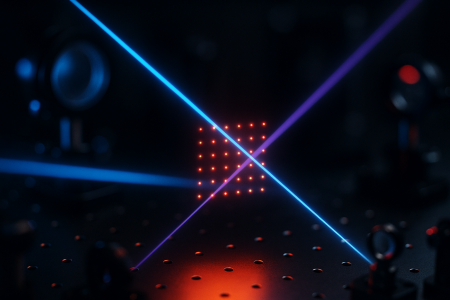
It helps to be honest about the state of play. Superconducting and trapped-ion systems are far ahead on qubit count and gate quality, and neutral-atom arrays have leapt past a thousand physical qubits. Diamond NV computing is earlier, measured in small registers rather than large processors. Its advantage is not raw scale today but the promise of deployment without a cryostat, which could matter enormously if the entanglement problem is cracked.
Interestingly, the same physics that makes NV centers finicky as computers makes them excellent sensors, and much of the world's diamond-defect expertise grew out of that sensing work. Turning that maturity toward computation is the current bet.
The honest summary is that diamond offers a genuinely different set of tradeoffs. It gives up the pristine control of a cold, isolated superconducting chip in exchange for operating in the messy warmth of the real world. Whether that trade pays off depends entirely on whether anyone can make enough diamond qubits reach across the lattice and hold hands. If they can, the quantum computer of the future might not need a fridge at all.