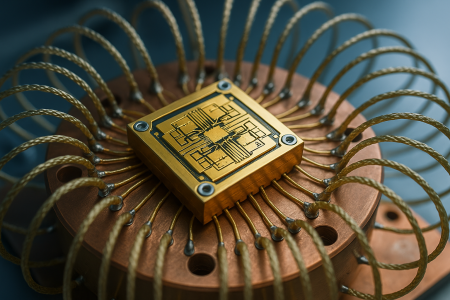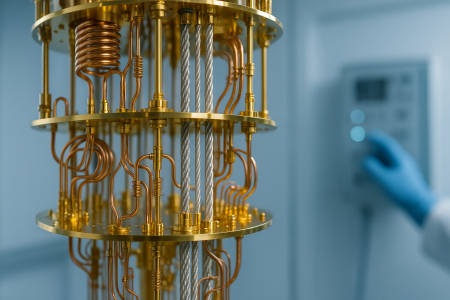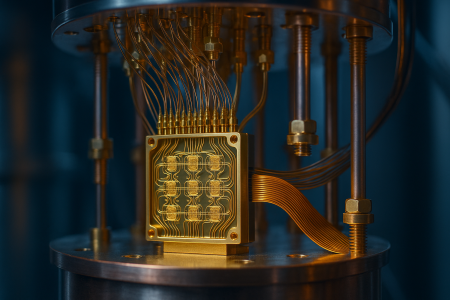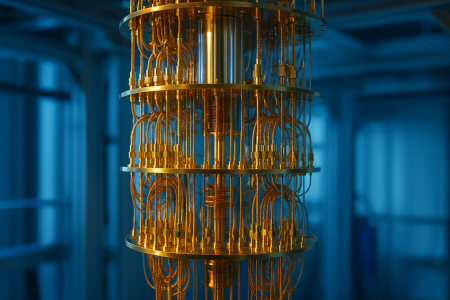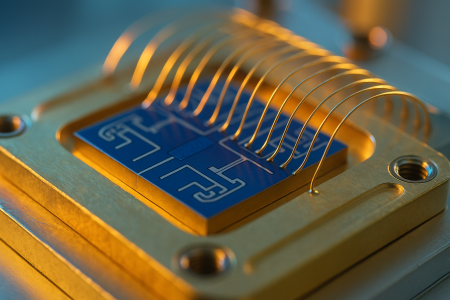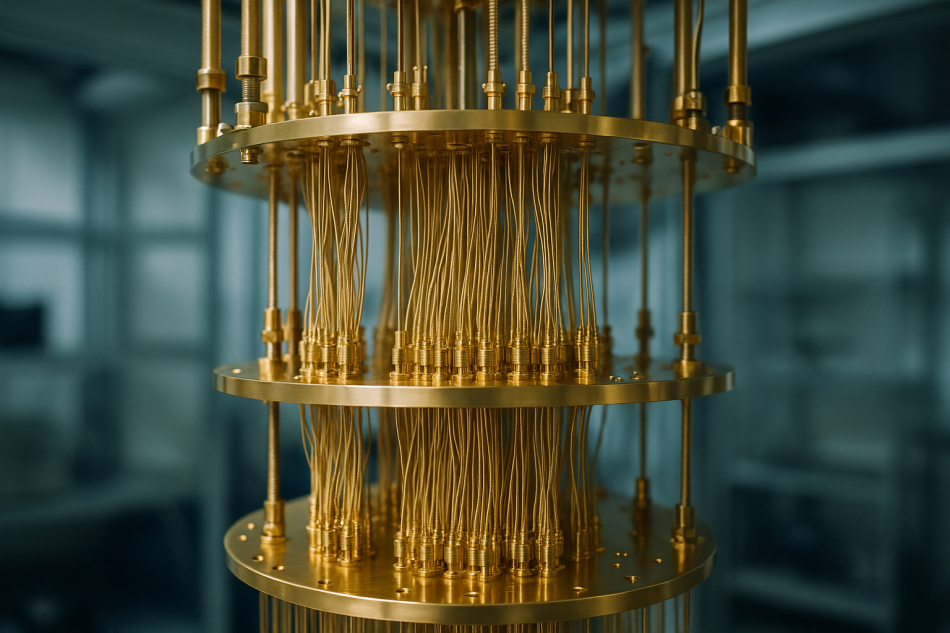

Look inside the photographs quantum computing companies love to publish and you will see a gleaming golden chandelier hanging in a laboratory. It looks like sculpture, but it is plumbing. Those tiers of brass plates and the forest of thin cables threaded between them are how a quantum processor gets fed. Each cable carries a signal from room-temperature electronics down to a chip sitting a hair above absolute zero. And that plumbing, more than the qubits themselves, is quietly setting the pace of the whole field.
One qubit, several cables
A superconducting qubit is not a single wire affair. To operate one you typically need a line to send microwave pulses that rotate its state, a separate line to tune its frequency with magnetic flux, and a readout line to ask what happened afterward. Some of those lines are shared, some are not, but the rough arithmetic is unforgiving. A processor with a few dozen qubits already needs well over a hundred coaxial cables snaking down through the refrigerator. Scale that naively to a thousand qubits and you are talking about thousands of cables. Scale it to the million-qubit machines that roadmaps promise and the picture stops making physical sense.
The cables are not free passengers. Each one is a thermal highway carrying heat from the warm world above straight toward the coldest stage, where the entire refrigerator can only remove a tiny trickle of heat, measured in microwatts. Pack in too many cables and you overwhelm the cooling power long before you run out of room. Even the physical space is a problem. Coaxial cables have a diameter, connectors have a footprint, and the cold plates are only so wide. Somewhere between the qubit count on today's chips and the count on tomorrow's slides, the fridge simply fills up.
Why you cannot just add a bigger freezer
The obvious fix is a larger refrigerator, and vendors are indeed building wider dilution units with more cooling power. But cooling capacity does not grow fast enough to keep up with a wiring scheme that adds several cables per qubit. You also cannot shrink the cables past a point without hurting signal quality, and microwave signals degrade if you route them badly. This is why the wiring problem is not a detail engineers will mop up later. It is a structural constraint baked into the architecture of gate-based superconducting machines, the approach IBM, Google, and Rigetti all lean on.
The escape routes
Nobody in the field thinks the chandelier survives to a million qubits. The interesting question is what replaces it. A few strategies are converging.
- Multiplexing. Instead of one readout line per qubit, engineers put many resonators at different frequencies on a single line and read them all at once. Frequency-division multiplexing already lets a handful of cables serve dozens of qubits, and it is one of the least glamorous but most important tricks keeping cable counts down.
- Cold electronics. If you move the control hardware inside the fridge, sitting close to the chip, you can trade thick bundles of analog coax for a smaller number of digital lines. This cryo-CMOS approach is hard because the controllers generate their own heat, but it attacks the cable count directly.
- Photonic and optical links. Optical fibers carry far less heat than metal coax and can pack enormous bandwidth. Converting microwave signals to optical ones at cryogenic temperatures is an active research frontier precisely because it could break the thermal budget open.
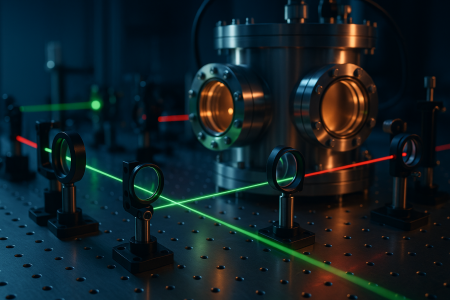
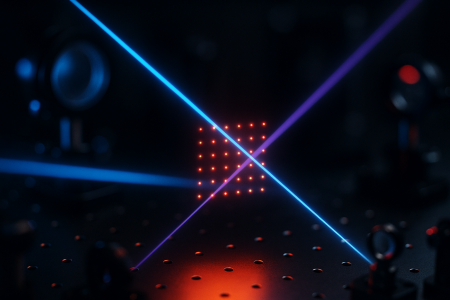
Other qubit technologies dodge the problem in their own ways. Trapped-ion and neutral-atom machines steer many qubits with a modest number of shared laser beams, so they do not face the same one-qubit-one-cable arithmetic, though they carry other scaling headaches. Photonic processors route information through optical components rather than a refrigerated cable harness at all. Each platform is really placing a bet on which scaling wall it would rather hit.
Why it matters for the roadmaps
When a company promises a machine with hundreds of thousands of physical qubits, the honest reading is that they are also promising to solve the wiring problem, even if the press release never mentions cables. Error correction makes this sharper. Protecting a single logical qubit can demand a thousand or more physical qubits, all of which need control and readout. The wiring wall and the error-correction overhead multiply against each other. That is why so much serious engineering effort goes not into exotic new qubits but into the mundane question of how to get signals in and out. The chandelier is beautiful, but the future of the machine depends on figuring out how to tear most of it down.