
Nearly every quantum computer you read about lives inside a refrigerator that hangs like a golden chandelier and chills its chip to a hair above absolute zero. Superconducting qubits need it. Trapped ions need vacuum chambers emptier than orbit. Neutral atoms need banks of stabilized lasers. Against that backdrop, one qubit stands out for a strange reason: it keeps working when the room is warm, the lights are on, and there is no fridge in sight.
That qubit lives in a flaw. Take a diamond, which is a tidy lattice of carbon atoms, and knock one carbon out. Then park a nitrogen atom next to the empty spot. What you get is called a nitrogen-vacancy center, or NV center, and it behaves like a single artificial atom trapped inside solid crystal. The electrons around that defect have a spin, and that spin can be pushed into the delicate superposition and entanglement that quantum computing runs on.
Why the crystal is the trick
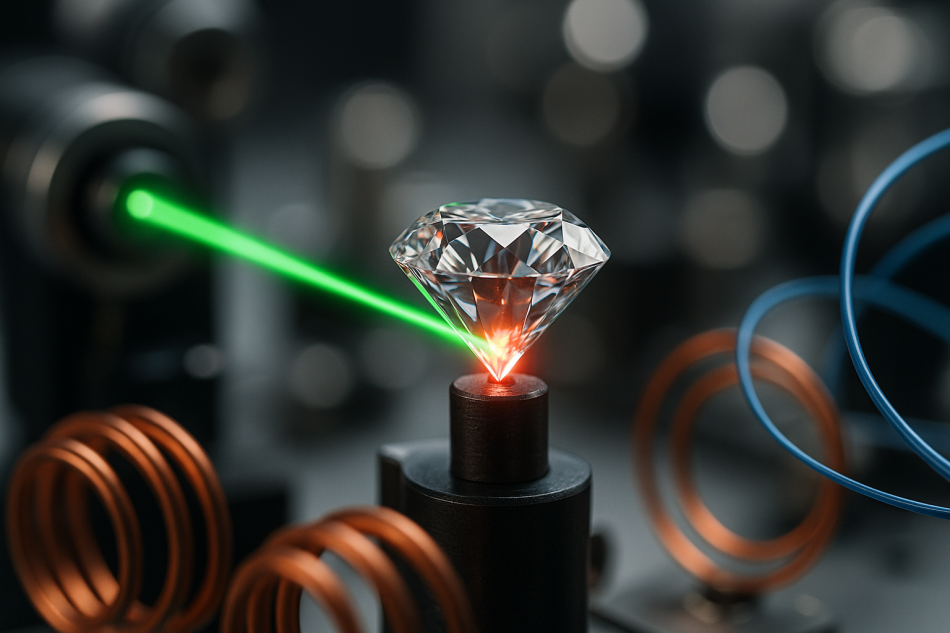
The reason NV centers tolerate heat is the diamond itself. Carbon bonds in diamond are stiff and strong, so the lattice barely jiggles even at room temperature. That rigid cage isolates the defect's spin from the thermal noise that would scramble a more exposed qubit. The spin can hold its state for a surprisingly long time, and it can be prodded and read using green laser light and microwave pulses rather than a wall of cryogenic wiring.
Reading the qubit is almost theatrical. Shine green light on the NV center and it glows red, but the brightness depends on the spin state. A spin pointing one way fluoresces a little brighter than a spin pointing the other. So the machine does not measure a faint electrical whisper the way a superconducting chip does. It literally watches the defect light up and counts photons. That optical readout is part of why the whole system can sit on a benchtop instead of inside a multi-ton cryostat.
The companies making the bet
The most visible name here is Quantum Brilliance, an Australian-German startup that has pushed the idea of small, rugged diamond quantum processors meant to sit alongside ordinary computers rather than in a specialized lab. The pitch is not that diamond will win a raw qubit-count race against IBM or Google. It is that a device you can bolt into a rack, run at room temperature, and deploy at the edge could reach places a fridge-bound machine never will. Think of a quantum accelerator inside a data center node, or eventually something compact enough for a vehicle or a remote sensor platform.
The same NV physics has been a workhorse in academic labs for years, which gives the approach a deep bench of results to draw on. Researchers have entangled the electron spin of an NV center with the nuclear spins of nearby carbon atoms, effectively building tiny multi-qubit registers inside a single defect's neighborhood. Those nuclear spins make excellent memories because they are even better shielded than the electron.
The catch
Room temperature is a gift with a bill attached. The hardest problem is putting NV centers exactly where you want them and making them identical. Each defect sits at whatever spot the manufacturing process happened to create, and no two are perfectly alike in their local environment. Wiring many of them together into a large, uniform processor is far harder than etching another row of identical junctions onto a silicon wafer.
Connectivity is the other wall. Superconducting and ion machines have well-developed ways to make distant qubits interact. Linking many separated NV centers means shuttling entanglement through light or through carefully engineered spin chains, and that plumbing is still immature at scale. For now, diamond machines are small. The honest framing from the field is that NV processors are years behind the leading platforms on qubit count and error rates.
Still, the appeal is easy to understand. A quantum computer that does not need helium-3, does not need a dilution fridge, and does not gulp power to stay cold sidesteps some of the ugliest engineering problems in the industry. If the hard parts of fabrication and connectivity yield, the diamond flaw could become the qubit that shows up in ordinary rooms, doing useful work while its fridge-bound cousins stay locked in the basement. That is the wager, written into a stone that formed under pressure and now holds a spin that refuses to forget.







