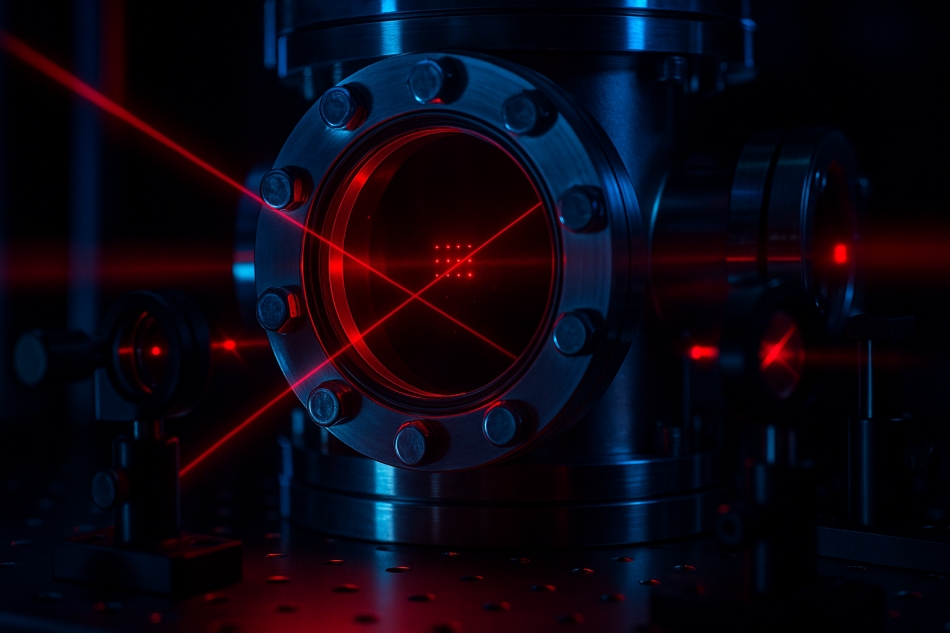

Most quantum computers keep their qubits nailed down. A superconducting chip solders its transmons in place; an ion trap pins its atoms in a line with electric fields. QuEra, the neutral-atom company spun out of research at Harvard and MIT, does the opposite. It picks its qubits up and carries them around during the computation. That single design choice, borrowed from a style of machine sometimes called a reconfigurable atom array, is why a modest number of atoms could be organized into logical qubits that fix their own errors.
Atoms held by light
QuEra's qubits are individual rubidium atoms, each floating in a tiny pocket of focused laser light called an optical tweezer. Cool them to a whisker above absolute zero and they sit still enough to store quantum information in two of their internal energy levels. To make them interact, the machine nudges pairs into high-energy Rydberg states, where their swollen electron clouds feel each other across a gap and refuse to light up independently. That interaction is the entangling gate.
The atoms themselves are not the innovation. Neutral-atom qubits have been explored for years, and other companies work with the same physics. What sets QuEra's approach apart is that the tweezers can move. A second set of steerable beams acts like a pair of optical hands, lifting selected atoms out of their resting spots and gliding them somewhere else, all without disturbing the fragile quantum states they carry.
Three neighborhoods on one machine
That mobility lets the processor be divided into distinct zones, each doing one job well. There is a storage zone, where idle qubits wait in the dark, shielded from the lasers that cause errors. There is an entangling zone, where pairs are brought together and zapped into interaction. And there is a readout zone, off to the side, where atoms can be measured with a bright imaging beam without that light scattering onto the qubits still mid-calculation.
Keeping measurement physically separated matters more than it sounds. In many architectures, reading one qubit risks leaking light or heat onto its neighbors, corrupting data you meant to keep. By shuttling only the atoms it wants to measure into a distant corner, QuEra sidesteps that crosstalk. The same movement trick also means any qubit can be made to interact with any other. You do not need a fixed wiring diagram of who can talk to whom. You just move the atoms next to each other. That all-to-all flexibility is a gift when you are laying out error-correcting codes, which demand awkward connectivity that fixed grids struggle to provide.
From physical atoms to logical qubits
The payoff arrived in a widely noted demonstration built on this platform, carried out with academic collaborators. Rather than treating each atom as a qubit, the team grouped atoms together so that many physical atoms encoded a single, more robust logical qubit. Working with a few hundred atoms, they operated dozens of logical qubits at once and ran entangling operations between them. Crucially, they showed that the logically encoded operations could be more reliable than the raw physical ones, the direction every error-correction effort is chasing.
The zoned, movable design was what made it practical. Encoding a logical qubit means constantly shuffling information among its constituent atoms, checking for errors, and comparing partners. Doing that with atoms you can physically rearrange is far easier than doing it with qubits frozen in place. Instead of routing signals through a maze of fixed couplers, the machine simply reorganizes its atoms into whatever pattern the code requires next.
The catch
None of this makes the atoms fast. Physically transporting a qubit across a chamber takes microseconds to milliseconds, an eternity next to a superconducting gate that fires in tens of nanoseconds. Moving atoms too quickly heats them and knocks them loose, so there is a speed limit baked into the physics. Atoms also occasionally vanish from their traps entirely, so the system must reload from a reservoir. QuEra and its rivals are betting that flexible connectivity and low error rates are worth the slower clock.
Whether the shuffle scales from hundreds of atoms to the thousands or millions a useful machine will need is the open question. But the core idea has already reshaped how people think about neutral-atom computers. The qubits do not have to stay put. Sometimes the smartest thing a quantum computer can do is rearrange itself.







