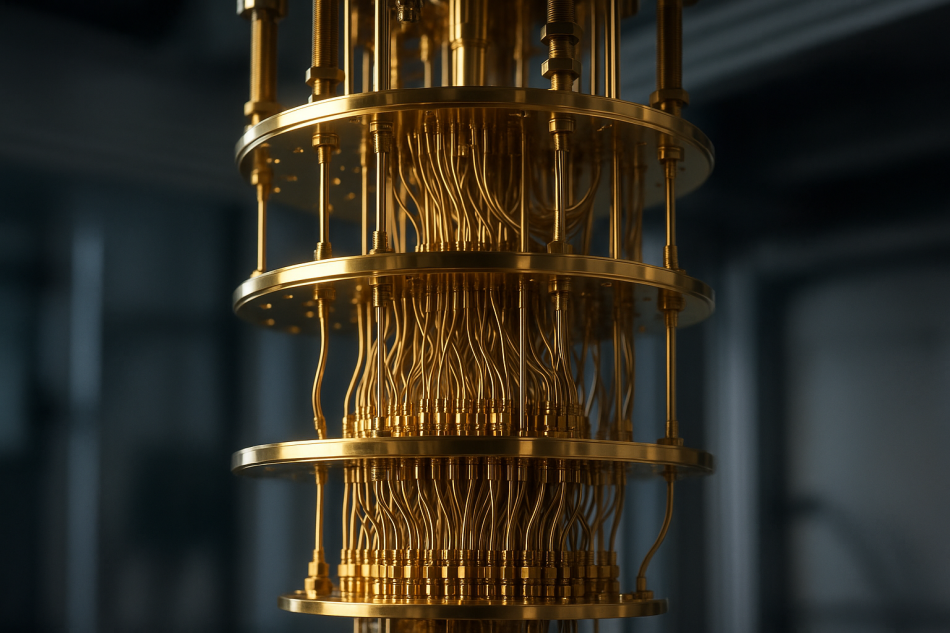

Look at a photograph of a superconducting quantum computer and your eye goes to the golden chandelier, tier after tier of plates and coiled cables descending into the cold. It looks like sculpture. It is actually plumbing, and it is one of the quietest reasons that scaling these machines is so hard. Every qubit on the chip at the bottom needs wires running up to room-temperature electronics, and there is only so much room to run them.
One qubit, many lines
A single superconducting qubit is not controlled by a single wire. It typically needs a microwave drive line to flip its state, sometimes a separate flux line to tune its frequency, and a readout line shared across a handful of qubits to measure the result. Tunable couplers between qubits add still more control lines. Add it up and a modern processor can need something close to one or two coaxial cables per qubit, plus the shared readout infrastructure.
That math is manageable at a hundred qubits. It becomes a nightmare at a million. A thousand cables is already a dense forest inside a refrigerator that is not much bigger than a household water heater. Stretch that to hundreds of thousands and the cables simply will not fit, and even if they did, they would carry so much heat that the fridge could never stay cold enough.
The heat that rides down the wire
Here is the cruel part. Those cables are not just a space problem, they are a thermal one. A qubit lives at around ten to twenty millikelvin, colder than deep space. The control electronics sit at room temperature, roughly 300 kelvin. Every coax cable is a bridge between those two worlds, and heat pours down that bridge by conduction, and more heat arrives as the microwave signals themselves dissipate.
To fight this, engineers break each cable into segments anchored at each plate of the fridge, and they insert attenuators at the cold stages that soak up thermal noise before it reaches the chip. They use exotic materials, superconducting NbTi coax and stainless steel, chosen to carry a signal while conducting as little heat as possible. The mixing chamber at the bottom, the coldest stage, has a cooling budget measured in mere microwatts. Spend it carelessly on too many warm cables and the whole machine loses its edge.
Ways around the wall
The industry knows the brute-force approach dies somewhere in the thousands of qubits, so several escape routes are being explored at once.
- Cryo-CMOS control. Move the control electronics down into the cold, close to the qubits, so signals travel millimeters instead of meters and far fewer cables cross the temperature gap. The catch is that even a well-designed cold chip dissipates power, and power is exactly what the coldest stage cannot afford.
- Frequency multiplexing. Pack many readout signals onto one line at different frequencies, then untangle them at room temperature. This already lets a single cable read out several qubits, and pushing that ratio higher buys real breathing room.
- Optical links. Replace some copper coax with optical fiber, which carries almost no heat and enormous bandwidth. Converting microwave qubit signals to light without wrecking them is an open research problem, but the payoff would be huge.
- Modular fridges. Rather than cram a million qubits into one refrigerator, connect many smaller ones with quantum links, spreading the wiring load across separate cryostats.
Why the boring problem matters
Qubit coherence times and gate fidelities get the headlines, and they should. But a fault-tolerant machine needs perhaps a thousand physical qubits to protect one logical qubit, which means a useful computer wants hundreds of thousands of physical qubits at minimum. You cannot get there if every qubit drags its own tangle of cables into a fridge with a microwatt budget.
This is why so much serious engineering effort is aimed at something as unglamorous as wiring. The chandelier that looks like art in the marketing photos is really a compromise, a hand-built harness that works today and cannot survive tomorrow's qubit counts. Whoever figures out how to feed a million qubits without a million cables will have solved a problem as important as any breakthrough in the qubits themselves.







