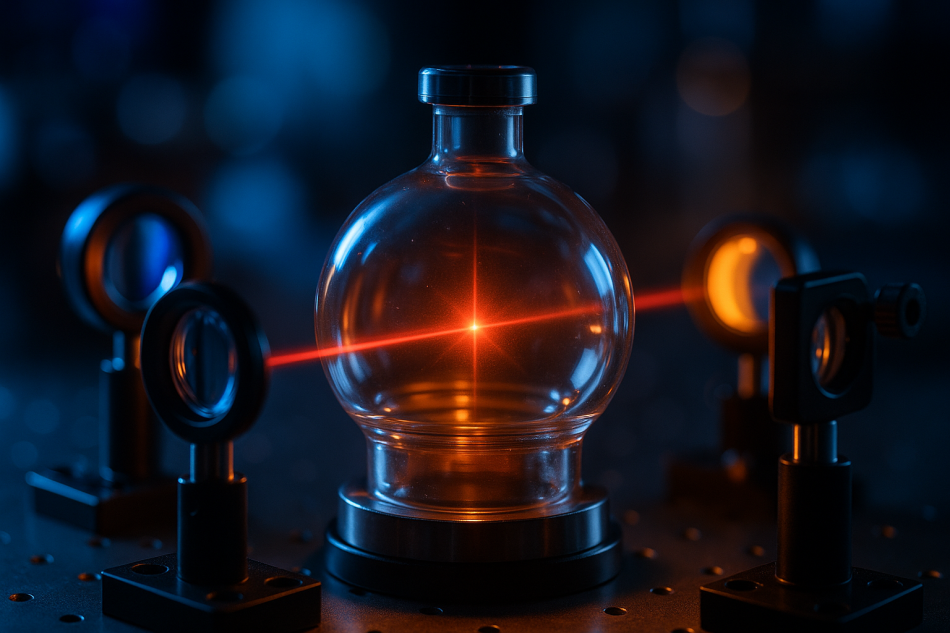

Most descriptions of a neutral-atom quantum computer start with the qubits themselves, single rubidium or cesium atoms floating in a vacuum. But before an atom can store a bit of quantum information, something has to catch it and hold it still. That job falls to the optical tweezer, a beam of laser light focused so tightly that it can pin a lone atom in place and move it around like a bead on an invisible string.
Light that pulls instead of pushes
The intuition is backwards from what most people expect. Light usually pushes on matter, the way sunlight nudges a comet's tail. An optical tweezer does the opposite. When laser light is tuned slightly below the frequency an atom likes to absorb, the atom is drawn toward the region where the light is brightest. Focus that beam to a spot roughly a micron across and the brightest point becomes a tiny well. An atom that wanders in feels a gentle force tugging it back toward the center, no matter which way it drifts.
The forces involved are almost comically small, a fraction of a billionth of a billionth of a newton. That is enough only because the atom is cold. Neutral-atom machines first chill a cloud of atoms with laser cooling until they are moving at a crawl, microkelvins above absolute zero. A warm atom would sail straight through the trap. A cold one settles in and stays for seconds, long enough to run a quantum program.
Hundreds of traps from one beam
A single tweezer holding a single atom is a curiosity. The reason the technique now anchors real machines from companies like QuEra, Pasqal, and Atom Computing is that one laser can be split into hundreds or thousands of tweezers at once. The trick is a device called a spatial light modulator, or an acousto-optic deflector, which acts like a programmable lens. It takes one beam and fans it into a grid of focused spots, each one a separate trap. Load atoms into that grid and you have a register of qubits laid out in whatever pattern the experiment needs, a square lattice, a honeycomb, a custom shape tuned to a specific problem.
Loading is probabilistic, which is the awkward part. When you dip the array into a cold cloud, each trap has roughly a fifty-fifty chance of catching an atom. A grid meant for hundreds of qubits comes up half empty and full of holes. So the machine takes a picture, sees which traps are filled, and then physically rearranges the atoms. Moving tweezers slide filled traps into the gaps, shuffling atoms one by one until a perfect, defect-free array remains. This assembly step happens in a fraction of a second, before every run.
Why the grip matters for computing
The tweezer does more than store qubits. Because the traps can be moved while atoms sit inside them, a neutral-atom processor can physically carry two qubits next to each other to make them interact, then carry them apart again. That mobility is unusual. In a superconducting chip the qubits are soldered in place and can only talk to their fixed neighbors. Atoms on tweezers can be reshuffled mid-computation, which opens the door to flexible connectivity and to error-correcting codes that would be painful to wire up in fixed hardware.
There is a cost. The same brightness that holds the atom also disturbs it slightly, nudging its internal energy levels. Designers get around this by briefly dimming or switching off the tweezers during the most delicate operations, trusting the cold atom to hover in place for the microseconds it takes to run a gate, then snapping the light back on to catch it before it drifts. Every one of those steps has to be timed against the clock of gravity and residual motion.
None of this looks like a chip in the conventional sense. A neutral-atom machine is a table of lenses, mirrors, and vacuum glass, with the actual computer being a faint grid of atoms suspended in nothing. The optical tweezer is the quiet piece of engineering that makes the whole arrangement possible, turning a beam of light into a hand steady enough to hold a single atom and precise enough to build a processor out of them.







