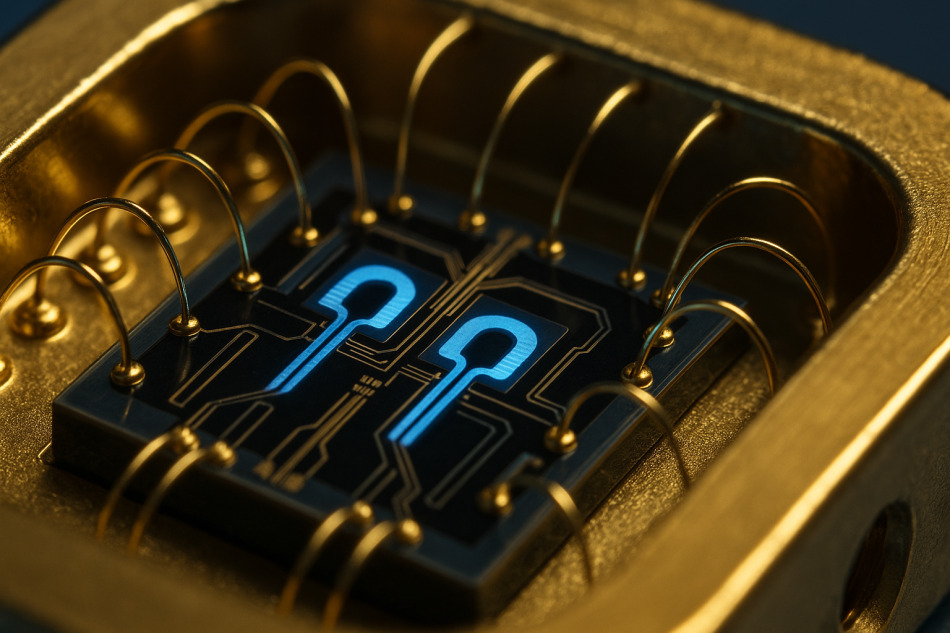

An error you can see coming is easier to handle than one that strikes in the dark. That simple intuition is behind one of the more interesting shifts in quantum hardware design, where engineers are deliberately reshaping qubits so that when they fail, they fail loudly. The idea goes by the unlovely name of erasure conversion, and it is quietly changing how some companies think about the road to fault tolerance.
Two kinds of mistakes
To a quantum error-correcting code, not all errors are equal. The nastiest are the ones whose location is unknown. If a qubit somewhere in a large array silently flips or dephases, the decoder has to work out both what went wrong and where before it can undo the damage. That guessing is expensive, and it is the main reason error-correcting codes need so many physical qubits to protect a single logical one.
An erasure is different. It is an error whose location is known, even if the value is lost. Think of a multiple-choice test where a student leaves a question blank versus one where they confidently fill in the wrong bubble. A blank is honest. The grader knows exactly which answer is missing and can focus effort there. A wrong answer that looks right is far more corrosive. Classical coding theory has understood for decades that erasures are roughly twice as easy to correct as errors of unknown position, because half the detective work is already done.
Building qubits that flag their own failures
The trick is to engineer a qubit whose dominant failure mode leaves a telltale trace you can detect without disturbing the stored quantum information. Several platforms have found ways to do it.
In neutral-atom machines, the two qubit states are often encoded in long-lived atomic levels, but the errors that matter most involve an atom leaking into a different state entirely, or getting lost from its optical trap. Researchers realized they could pick atomic species and encodings where those leakage events land in states that can be checked with a quick, non-destructive measurement. If the atom is gone or has strayed, a fluorescence check reveals it. The qubit is marked as erased, and the decoder treats that site as a known blank.
Superconducting groups pursue a parallel idea with what are called dual-rail qubits. Instead of storing information in a single resonator or transmon, the information lives in the space where exactly one photon is shared between two coupled elements. The most common failure, a photon leaking away, kicks the system out of that shared-one-photon subspace into a zero-photon state. Crucially, you can measure whether a photon is still present without learning which of the two rails it occupies, so the check announces the loss without collapsing the encoded bit. Amazon's quantum team and a handful of startups have leaned into this design precisely because it converts the most likely error into a detectable erasure.
Why the accountants care
The payoff shows up in the numbers that decide whether fault tolerance is affordable. Error-correcting codes have a threshold, a maximum physical error rate below which adding more qubits actually helps rather than hurts. Codes generally tolerate a much higher rate of erasures than they do errors of unknown position. When a large fraction of a qubit's mistakes arrive pre-labeled, the effective threshold loosens, and the number of physical qubits needed per logical qubit can drop substantially.
There is a second benefit. Because erasures are localized, decoders can incorporate that information directly, steering their corrections toward the flagged sites. Simulations of surface codes fed with erasure flags show markedly better performance than the same codes run blind. The hardware and the software cooperate: the qubit does part of the diagnosis, and the classical decoder finishes the job faster and more accurately.
The catch
None of this is free. Converting errors into erasures usually means adding measurement machinery and extra circuitry, and those additions can introduce their own faults. The erasure check has to be fast, gentle, and frequent, running alongside the ordinary stabilizer measurements without disturbing the logical state. If the flagging is noisy or slow, the advantage erodes. And no scheme catches every error, so the residual unflagged faults still have to be handled the hard way.
Still, the direction is telling. For years the qubit race was framed around raw counts and coherence times. Erasure conversion reframes the question. It suggests that the character of a qubit's errors, not just their frequency, may decide which machines cross the fault-tolerance line first. A qubit that fails honestly, it turns out, is worth a great deal more than one that fails in silence.







