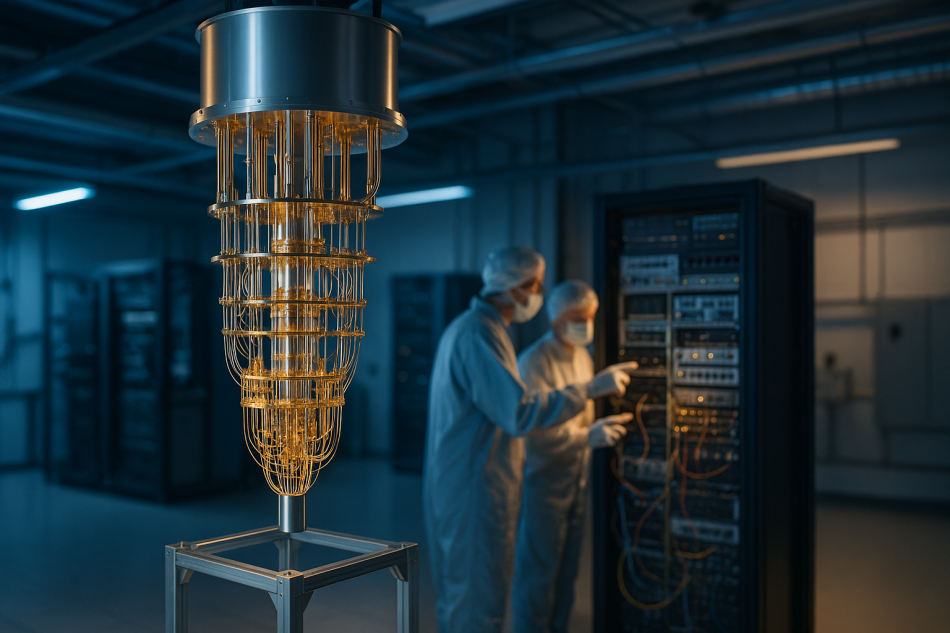

Most quantum computing roadmaps are marketing dressed as engineering. They show a curve climbing toward a million qubits and leave the awkward middle blank. IBM's roadmap is unusual because it names specific chips, ties them to specific years, and stakes a public claim on a machine it calls Starling: a fault-tolerant quantum computer meant to arrive by 2029.
From counting qubits to counting logical ones
For years IBM's public story was about raw qubit counts. The company shipped Eagle at 127 qubits, then Osprey, then Condor at more than a thousand. Those numbers made headlines, but they also exposed a quiet problem. Piling up noisy physical qubits does not get you closer to solving anything useful if the errors pile up faster than the qubits.
The current roadmap reflects that lesson. IBM shifted its language from physical qubits to logical qubits, the error-corrected units that many physical qubits combine to protect. A logical qubit is the thing an algorithm actually runs on. Starling, as IBM describes it, is meant to hold around 200 logical qubits and run on the order of 100 million quantum gates. A later machine, nicknamed Blue Jay and pencilled in for 2033, is supposed to reach roughly 2,000 logical qubits and a billion gates.
The code that makes the math work
The reason IBM feels able to promise this is a change in how it plans to correct errors. The industry default has long been the surface code, which is robust but greedy. It can demand a thousand or more physical qubits to build a single high-quality logical one. Multiply that by 200 and the machine becomes absurdly large.
IBM's bet is on a family of quantum low-density parity-check codes, sometimes called qLDPC or, in one specific IBM design, the gross code. The appeal is a much better ratio. Instead of a thousand physical qubits per logical qubit, these codes aim for something closer to a hundred, roughly a tenfold saving. The catch is connectivity. Surface codes only ask neighboring qubits to talk. The gross code needs some qubits to reach across the chip to partners that are not next door, which forces longer-range couplers and careful wiring. IBM's engineers have to build hardware that supports those non-local links without wrecking the error rates that made the code attractive in the first place.
The stepping-stone chips
What makes the roadmap credible is that it does not jump straight to Starling. It lists intermediate processors, each meant to prove one piece of the puzzle. One chip is tasked with demonstrating the long-range couplers the code needs. Another is meant to store and process information in a small error-corrected memory. A later one is supposed to show two code blocks connected together and running logical operations between them. Only after those pieces work does Starling assemble them at scale.
Underneath the chips sits Quantum System Two, IBM's modular architecture. Rather than build one impossibly large processor, the plan is to link multiple chips inside a shared cryogenic system and, eventually, across systems. Modularity is the escape hatch from the wiring wall that limits any single fridge. If you cannot fit a million control lines into one refrigerator, you tile smaller machines together instead.
Where the plan could slip
A roadmap is a promise, not a proof. Several things have to hold for Starling to arrive on schedule. The physical error rates have to stay below the threshold the gross code needs, and they have to stay there as the chips grow larger and harder to calibrate. The classical decoder, the software that figures out what errors happened in real time, has to keep pace with the machine or the whole correction scheme stalls. And the long-range couplers have to work without introducing fresh noise.
None of these is guaranteed. But the value of publishing dates and chip names is that the claims become falsifiable. If a stepping-stone processor slips, everyone will notice. That is a sharper form of accountability than a vague pledge to reach a million qubits someday.
What IBM is really selling is a claim about sequence. It argues that the path to a useful quantum computer runs through better codes and modular hardware rather than through ever-bigger monolithic chips. Whether Starling lands exactly on time matters less than whether that sequence proves correct. If it does, the roadmap will look prescient. If the gross code stumbles, the field will learn something just as valuable about which corner to turn next.







