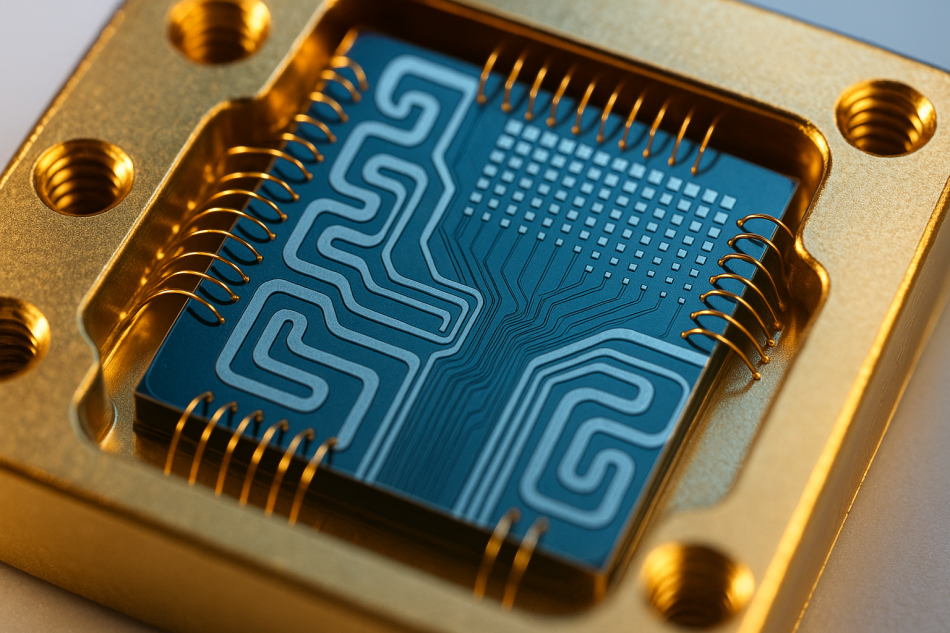

Walk into almost any lab building a superconducting quantum computer and you will find the same workhorse qubit: the transmon. It is the design behind IBM's processors, Google's chips, and Rigetti's foundry output. But the transmon has a quiet weakness, and a rival superconducting qubit called the fluxonium was built specifically to fix it. The fluxonium is slower, stranger, and harder to control. In exchange, it tends to remember its quantum state for much longer.
Why the transmon settled for good enough
A transmon is, at heart, a tiny electrical circuit that behaves like an artificial atom. It uses a Josephson junction to create energy levels that are not evenly spaced, so engineers can pick out just two of them and call that the qubit. The trick that made the transmon popular was flattening its sensitivity to electrical charge noise, which had plagued earlier designs. That fix worked, but it came at a cost. The transmon's energy levels ended up close together in a property called anharmonicity, which limits how fast and clean its gates can be. It also remains exposed to other noise sources that steadily erode its stored information.
Coherence time is the number that captures this. It is roughly how long a qubit can hold a superposition before it decays into noise. Longer coherence means more operations fit inside a single computation before errors overwhelm the answer. For years, chasing longer coherence meant fighting materials defects and stray electromagnetic fields around the transmon. The fluxonium takes a different approach: it changes the circuit itself.
What makes a fluxonium different
The fluxonium adds a strange new component called a superinductor, usually built from a long chain of hundreds of Josephson junctions wired in series. That large inductance reshapes the qubit's energy landscape dramatically. The lowest two energy states end up sitting low and far apart from everything above them, which gives the fluxonium enormous anharmonicity. It also pushes the qubit's operating frequency far below that of a typical transmon, often down toward a few hundred megahertz.
That low frequency is the key to its longevity. Many of the mechanisms that drain a superconducting qubit act more strongly at higher frequencies, so a qubit that lives lower on the spectrum is naturally shielded from some of them. Research groups have measured fluxonium coherence times reaching into the hundreds of microseconds and beyond, comfortably longer than typical transmons, and some experiments have pushed relaxation times toward the millisecond range. Two-qubit gate fidelities in fluxonium experiments have been reported above the 99.9 percent mark in leading academic labs, the kind of figure that matters for error correction.
The catch, and there is always a catch
Nothing in quantum hardware is free. The fluxonium's low frequency creates its own headaches. Reading out and controlling a qubit that oscillates slowly requires different microwave engineering than the mature toolchain built around transmons. The superinductor made of many junctions is more complex to fabricate reliably and introduces new places for things to go wrong. And because the two computational states can sit very close in energy, keeping the qubit properly initialized and preventing it from lingering in the wrong state demands careful pulse design.
These are engineering problems rather than physics roadblocks, which is exactly why the fluxonium has moved from a curiosity into a serious contender. The design traces back to work by Vladimir Manucharyan and collaborators around 2009, and it stayed largely an academic pursuit for over a decade. More recently, groups including teams at the University of Maryland have driven its performance upward, and startups such as Atlantic Quantum have formed to commercialize fluxonium-based machines. Larger players have published fluxonium research too, hedging against the possibility that the transmon is not the final word.
Why it matters for the road ahead
The whole game in quantum computing right now is buying error budget. Every microsecond of extra coherence and every fraction of a percent of gate fidelity reduces how many physical qubits you must spend to protect one logical qubit. If the fluxonium can deliver longer-lived, cleaner qubits without an unmanageable control overhead, it could shift the economics of building a fault-tolerant machine. The transmon has a huge head start and a mature ecosystem. The fluxonium is betting that in a field where errors are the enemy, a qubit that simply forgets more slowly is worth the extra trouble.







