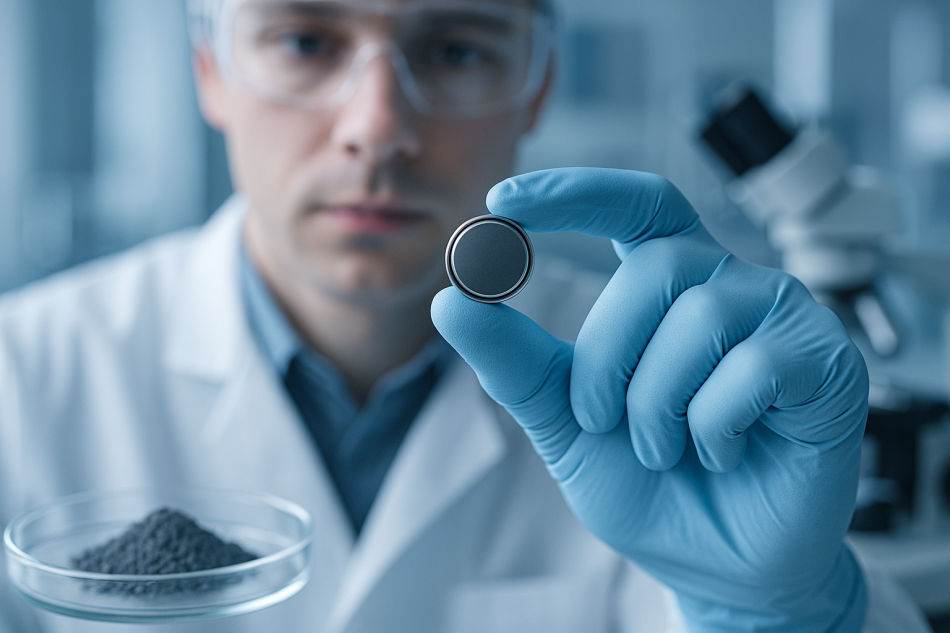

Every electric car, phone, and grid storage bank runs on a chemistry problem nobody has fully solved. Inside a lithium-ion battery, ions shuttle back and forth between two electrodes, and the material that receives them on the positive side, the cathode, largely decides how much energy the cell holds, how fast it charges, and how long it lasts. Chemists have spent decades tweaking cathode recipes by trial and error, mixing nickel, manganese, cobalt, and other elements and measuring what comes out. The reason it stays a guessing game is that the underlying physics is quantum, and quantum systems are exactly what classical computers struggle to simulate.
Why electrons are the hard part
A battery material is a lattice of atoms surrounded by a swarm of electrons, and those electrons do not behave like tiny billiard balls. They exist in a superposition of arrangements, and their behavior is correlated: move one and the others respond. To predict a material's voltage or stability, you need to know the energy of these correlated electron states. That quantity, the ground-state energy, is what determines whether a candidate cathode is worth synthesizing.
The trouble is that the number of possible electron configurations grows exponentially with the number of electrons. A modest cluster of transition-metal atoms can blow past what any supercomputer can track exactly. So chemists rely on approximations, chiefly density functional theory, which is remarkably useful but leans on educated guesses about how electrons interact. For many materials it works well. For strongly correlated systems, and transition-metal oxides in cathodes are a notorious example, the approximations can drift far enough to send a research program down the wrong path.
Where a quantum computer fits
The pitch is simple to state. A quantum computer is itself a controllable quantum system, so it can represent correlated electron states directly instead of approximating them. Feed it the geometry of a molecule or a small chunk of crystal, and in principle it can compute the ground-state energy to chemical accuracy, the level of precision where predictions actually match experiments.
The workhorse algorithm for this on a large machine is quantum phase estimation, which extracts energy levels from a simulated quantum state. On the noisy machines available now, researchers instead use hybrid methods like the variational quantum eigensolver, where a quantum processor prepares trial states and a classical computer nudges the parameters toward lower energy. These runs have handled small molecules and toy versions of catalytic and battery-relevant systems. They are demonstrations, not solutions to industrial problems yet.
The resource reality check
Sober estimates temper the excitement. Simulating a genuinely useful cathode fragment to chemical accuracy is expected to require a fault-tolerant machine with many logical qubits, each built from many physical qubits through error correction. Recent work has pushed the estimated cost down considerably as algorithms improve, but the honest answer is that this is a target for the fault-tolerant era, not a task for the processors sitting in data centers today.
That is why battery chemistry shows up so often on company roadmaps and in partnerships with carmakers and materials firms. It is a problem where classical methods demonstrably fall short, where the payoff is enormous, and where the size of the calculation is bounded. You do not need to simulate an entire battery, just the reactive core where electrons misbehave.
What success would look like
Imagine screening candidate cathode materials in software with confidence, ranking them by predicted voltage and stability before anyone fires up a furnace. Chemists could explore compositions that use less cobalt, a metal that is expensive and ethically fraught to mine. They could probe why some materials degrade after hundreds of charge cycles by modeling the exact electron rearrangements that cause cracks and phase changes.
- Higher energy density from cathodes tuned atom by atom rather than by bulk experiment.
- Reduced reliance on scarce elements by finding substitutes that classical models misjudge.
- Faster development cycles, trading months of synthesis for hours of simulation.
None of this arrives with a single announcement. The near-term value is more modest: quantum machines are becoming laboratories for learning which chemistry problems they can eventually own, and classical simulation keeps improving in the meantime, raising the bar for what counts as a real advantage. But of all the use cases companies wave around, cathode chemistry is among the most defensible. The molecules are small, the classical tools genuinely stumble, and the world would notice a better battery.







